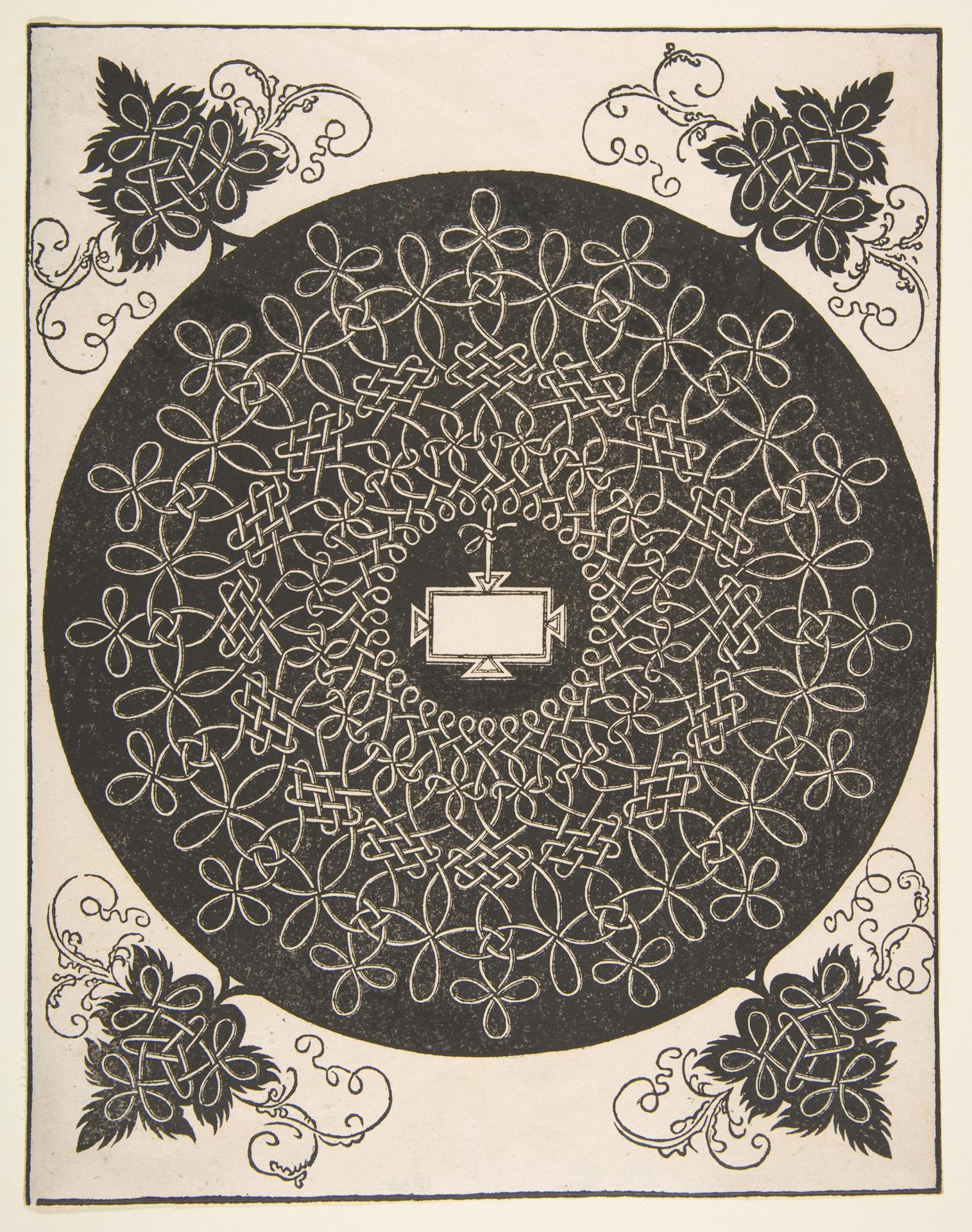
Embroidery Pattern with an Oblong Panel in its Center (1521 before)
Original title: Embroidery Pattern with an Oblong Panel in its Center
kurzbeschreibung
Albrecht Dürer, the Nuremberg master, produced this ornamental embroidery pattern as a woodcut before 1521. An elongated central field forms the core, enclosed by evenly spaced floral and knot shapes. The print measures 26.8 x 21.1 cm and likely served as a model for needlework.
Description
Black on white, a central oval field stands out, surrounded by a dense network of flowers and knots. These flowers are arranged symmetrically, forming a branching pattern. Within the oval lies a smaller rectangular frame, captured by a triangle. Four stylized flowers with tendrils and leaves surround the central field, also in mirror-symmetrical order. The even distribution of light and shadow emerges as contour and detail of the pattern.
Context
Dürer designed this pattern as a model for embroidery, demonstrating the close connection between fine art and craft in the early 16th century. Woodcuts with ornamental designs often served as templates for needlework or decoration. Dürer was known for his precise and innovative woodcut techniques, which he developed in his Nuremberg workshop. The print was made before 1521, during a phase in which he engaged intensively with theoretical and ornamental studies.
Impact
The symmetrical and dense sequence of floral and geometric motifs evokes a calm, balanced mood. The clear lines of the woodcut give the pattern a precise, almost architectural quality. The viewer is encouraged to examine the details closely, which in their repetition have a meditative effect.
Technique
Dürer prepared the design as a woodcut, a medium well suited to the period's printmaking. The result renders the intricate pattern with crisp, even lines: the symmetrical blossoms and knots, the central oblong panel with its inner rectangular frame and triangle, and the four stylized flowers with tendrils and leaves all emerge with precise clarity against the black-and-white contrast.
AI-generated description text
Source: Metropolitan Museum of Art · Public Domain (CC0 1.0)