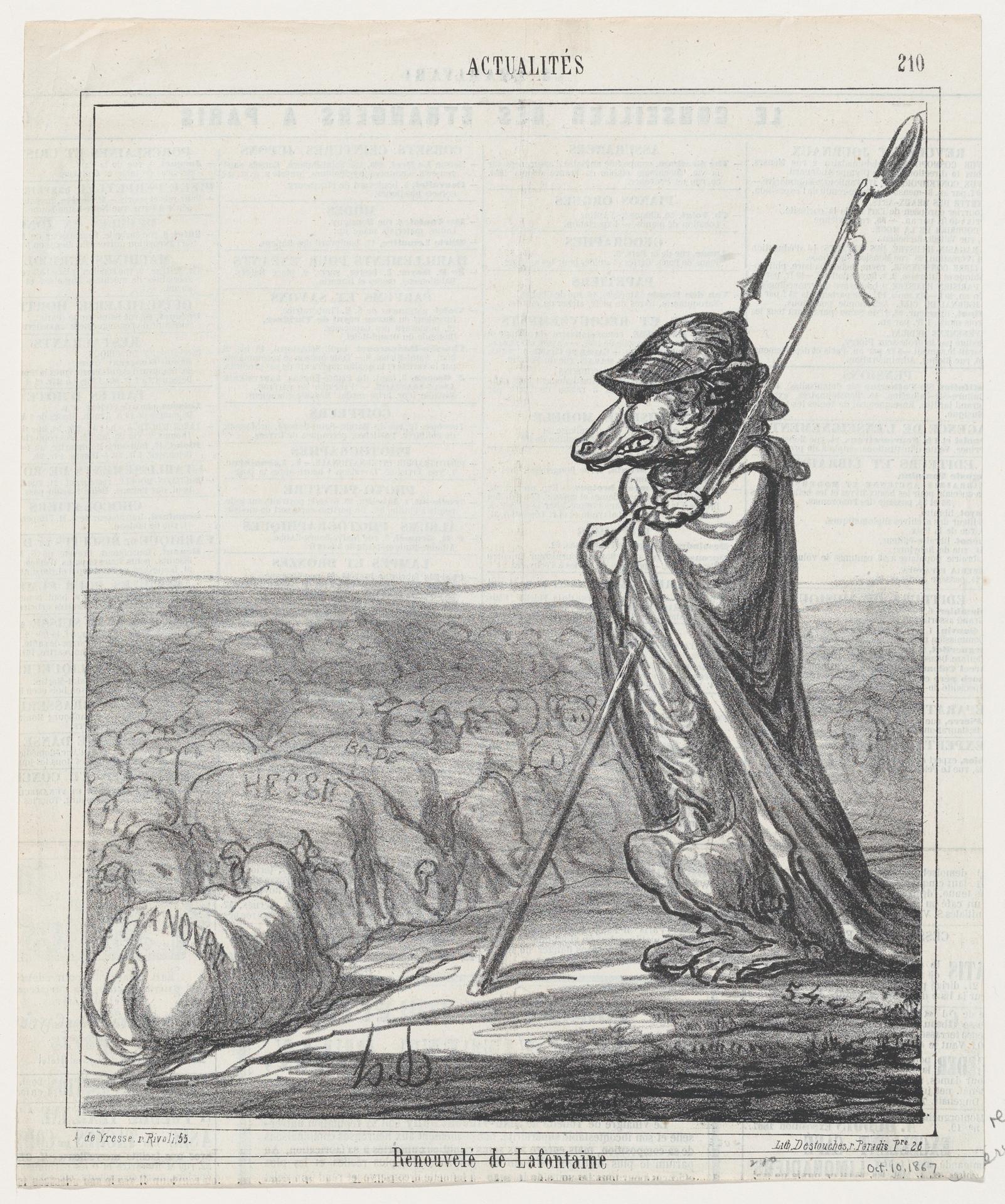
La Fontaine renewed, from "News of the Day"
Original title: La Fontaine renewed, from "News of the Day"
kurzbeschreibung
Honoré Daumier's lithograph 'Der erneuerte Brunnen' (The Renewed Well) from 1867, part of the series 'Neuigkeiten des Tages' (News of the Day), presents a satirical scene: a man in knight's armor, his helmet shaped like a pig's head, stands over a figure on the ground labeled 'FRANCE.' Behind them appear sheep-like creatures bearing the word 'HESSE.' The sheet is a lithograph on newsprint, second state of two (Delteil).
Description
A knight dominates the picture: he wears a helmet in the form of a pig's head and carries a lance, while beneath him lies a figure marked 'FRANCE.' Several sheep inscribed 'HESSE' are scattered across the distance. The landscape stays flat and undefined, the backdrop plain. Monochrome and evenly lit with barely any shading, the print reads as a caricature with a satirical purpose.
Context
Daumier made this caricature in 1867 for the satirical journal 'Le Charivari,' where it appeared within the series 'Neuigkeiten des Tages.' That year was marked by political tensions in Europe, above all the rivalry between Prussia and Austria and the reshaping of the German Confederation. The sheep labeled 'HESSE' likely allude to Hesse's role in those disputes. Daumier used lithography as a vehicle for political and social criticism, widely circulated in the press of the day.
Impact
The grotesque exaggeration and symbolic imagery are immediately provocative. A disquieting tension arises between the aggressive knight and the passive sheep, prompting the viewer to reflect on power and powerlessness. The clear, pared-down forms sharpen the satirical message and open it to a broad audience.
Technique
The sheet was printed as a lithograph on newsprint, a common method for mass publication in the nineteenth century. The second state (of two) represents the final version as it appeared in the journal. The technique allowed for fine lines and shading, though here they are deliberately kept simple to heighten the caricatural effect.
AI-generated description text
Source: Metropolitan Museum of Art · Public Domain (CC0 1.0)