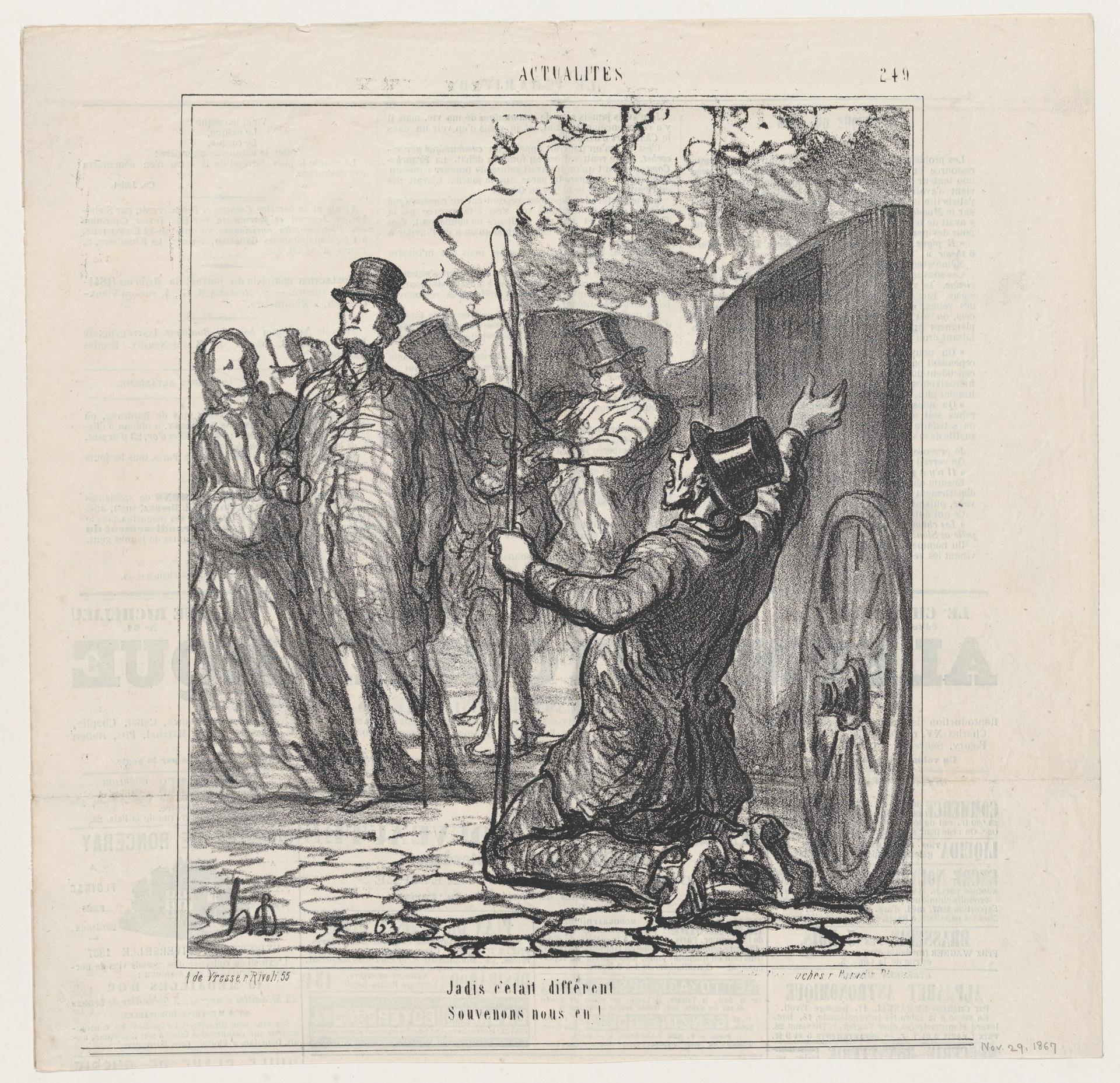
In the past it was different. Let us try to remember, from 'News of the day,' published in Le Charivari, November 29, 1867
Original title: In the past it was different. Let us try to remember, from 'News of the day,' published in Le Charivari, November 29, 1867
kurzbeschreibung
Unlike the other sheets in Daumier's 'Nachrichten des Tages' (News of the Day), this 1867 lithograph does not unfold in a salon or at a speaker's rostrum but out on the open street: several people sit in a carriage while, in front, a man in a jacket and top hat kneels and raises his hand to speak. The other occupants appear in the dress of bygone eras. The print was published in the satirical journal Le Charivari.
Description
What separates this sheet from comparable street scenes is the tension between the kneeling speaker in the foreground — long-sleeved jacket, top hat, one hand thrust upward — and the carriage passengers, who sit in coats and hats of an older cut. Cobblestones carry the group, while trees and a fence at the edge hint at a town setting. Black and white holds throughout the image, close in detail both in the figures and in their surroundings.
Context
Made for Le Charivari, where Daumier regularly published political and social caricatures, this sheet belonged to the series 'Nachrichten des Tages', which followed current events and social shifts in France under the Second Empire. In 1867, a period of political tension and social unrest, the lithograph was printed in its second state and issued on newsprint.
Impact
An ironic distance arises because the kneeling man's gesture summons up a pathos-laden appeal that sits awkwardly in an everyday setting. The historicizing wardrobe of the figures pushes the action further into the past and gives the title a double edge. Clean lines and the hard black-and-white contrast make the sheet strike the eye at once.
Technique
The sheet was printed as a lithograph on newsprint — the process Daumier favored for his satirical work because it allowed fine lines and quick reproduction for the press. According to the Delteil catalogue, the print survives in the second of two states.
AI-generated description text
Source: Metropolitan Museum of Art · Public Domain (CC0 1.0)