The Congress of Princes at Vienna
Original title: The Congress of Princes at Vienna
kurzbeschreibung
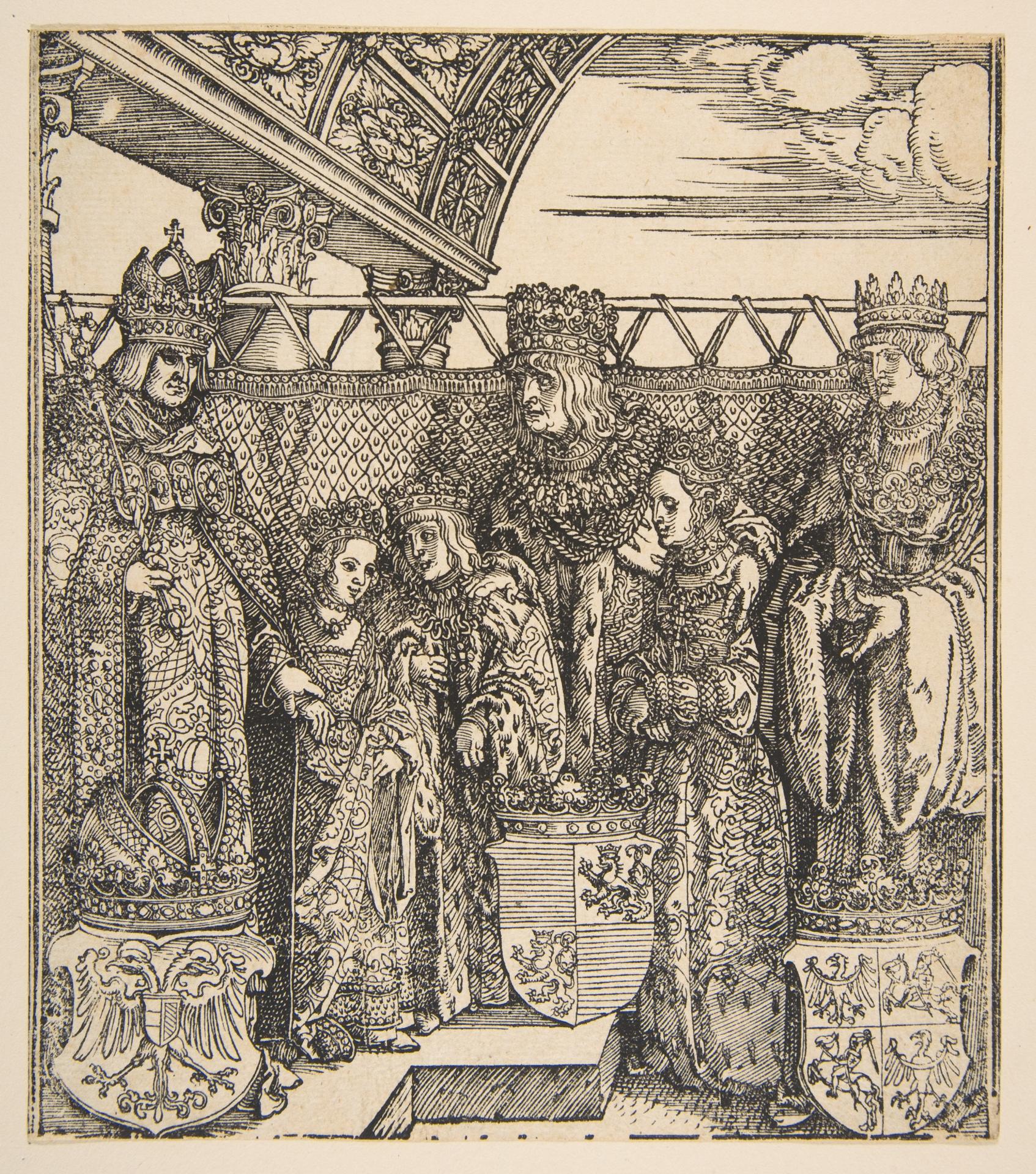
This woodcut, attributed to Albrecht Dürer, depicts a solemn assembly of crowned rulers and nobles in a grand hall. The composition shows the figures in a row, some elevated on pedestals, set against a backdrop of columns and heraldic motifs. The exact date of the work is unknown, but it reflects the style of Renaissance printmaking.
Description
The scene is dominated by a line of elegantly dressed figures, each wearing ornate robes and crowns, suggesting their royal or noble status. They stand within an architectural interior featuring tall columns and decorative coats of arms, which frame the assembly. Some figures are placed on raised platforms, giving the composition a hierarchical rhythm. The monochrome palette, typical of woodcuts, relies on fine, detailed linework to render the textures of garments and architectural elements. The lighting is even and flat, with no dramatic shadows, keeping the focus on the figures and their regalia.
Context
Dürer, a master of printmaking, created numerous woodcuts that documented historical and allegorical subjects. The title refers to a congress of princes in Vienna, though the specific event is not precisely dated in the available metadata. Such gatherings were common in early modern Europe, where rulers met to negotiate alliances or settle disputes. Dürer's prints were widely circulated, serving both as artistic statements and as records of political pageantry.
Impact
The print conveys a sense of solemn grandeur and political order, with the symmetrical arrangement of figures lending a formal, ceremonial quality. The detailed attire and architectural setting evoke the opulence of court life, while the monochrome palette gives the scene a timeless, almost documentary feel. Viewers are drawn into the hierarchical composition, which emphasizes the dignity and authority of the assembled princes.
Technique
This is a woodcut, a relief printing technique where the image is carved into a wooden block, inked, and pressed onto paper. The fine, parallel lines and cross-hatching visible in the details are characteristic of Dürer's meticulous approach to the medium. The use of a single block produces a monochrome image, relying on line density to create texture and depth.
AI-generated description text
Source: Metropolitan Museum of Art · Public domain (CC0)