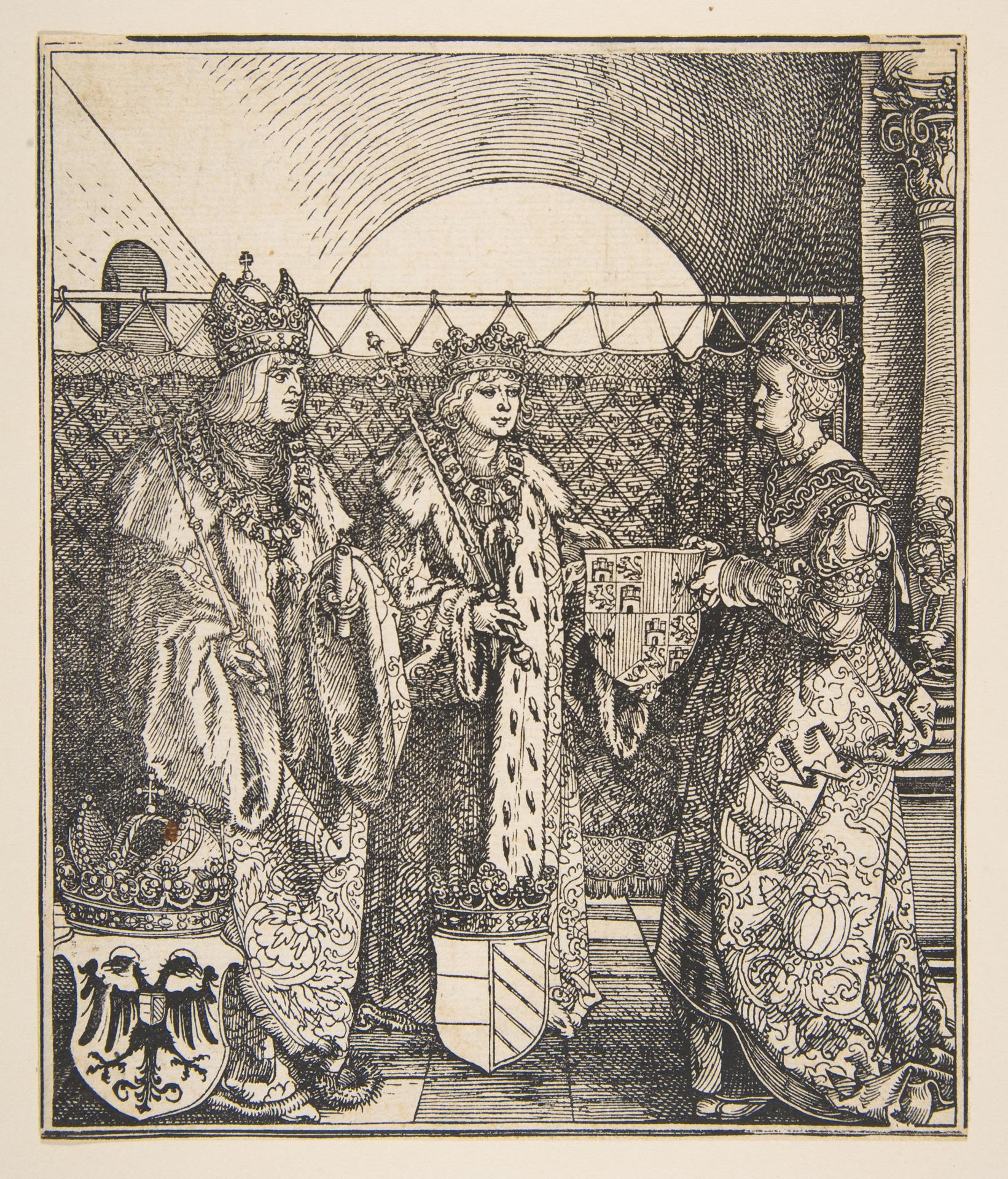
The Betrothal of Philip and Joanna
Original title: The Betrothal of Philip and Joanna
kurzbeschreibung
This woodcut by Albrecht Dürer depicts the ceremonial betrothal of Philip the Handsome and Joanna of Castile. The scene shows three royal figures in a symmetrical composition, with coats of arms and a curtained backdrop. Dürer's detailed linework brings a sense of grandeur to this historic union.
Description
The composition centers on a woman in lavish royal attire holding a shield with a coat of arms, flanked by a crowned, bearded man on the left and another crowned woman on the right, both also holding shields. A patterned curtain fills the background, while a window with a cross appears at the upper left. A small eagle coat of arms sits in the lower left corner. The figures are frontal and static, with monochrome ink and even lighting typical of woodcuts.
Context
The woodcut commemorates the 1496 marriage of Philip of Habsburg (Philip the Handsome) and Joanna of Castile, a political alliance between the Habsburg and Trastámara dynasties. Dürer, active in Nuremberg, was a leading printmaker of the Northern Renaissance, and this work reflects the period's interest in royal propaganda and heraldic imagery. The exact date of creation is unknown, but it likely dates from the early 1500s.
Impact
The symmetrical arrangement and formal poses lend the scene a ceremonial gravity, appropriate for a royal betrothal. Dürer's intricate linework in the costumes and coats of arms invites close inspection, while the frontality creates a direct, almost iconic presence.
Technique
This is a woodcut, a relief printing technique where the image is carved into a wooden block, inked, and pressed onto paper. Dürer's masterful use of parallel and cross-hatched lines creates texture and depth, despite the monochrome limitation. The sharp, detailed contours are characteristic of his printmaking style.
AI-generated description text
Source: Metropolitan Museum of Art · Public domain (CC0)