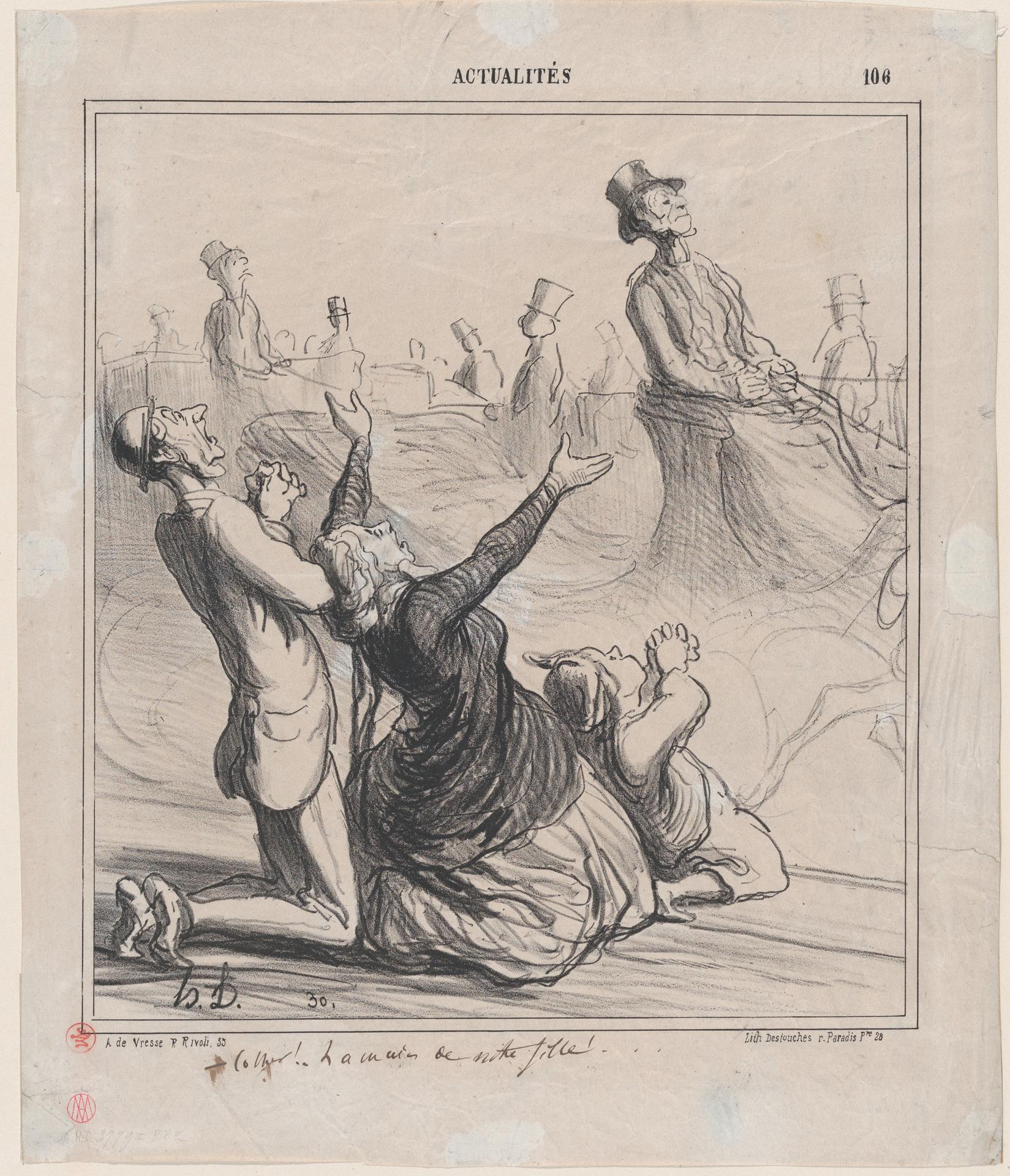
Coachman, for the hand of our daughter!..., from 'News of the day,' published in Le Charivari, June 6, 1867
Original title: Coachman, for the hand of our daughter!..., from 'News of the day,' published in Le Charivari, June 6, 1867
kurzbeschreibung
Honoré Daumier's lithograph 'Kutscher, um die Hand unserer Tochter!...', dated 6 June 1867, belongs to the series 'News of the day' and was published in the journal Le Charivari. It presents a dramatic public scene in which several figures look upward, apparently caught up in a confrontation or an unusual event.
Description
Three main figures occupy the foreground: a man in shirt and trousers stretching upward, a woman in a long dress also gazing aloft, and a small boy kneeling on the ground and looking up. Behind them appear other people wearing hats, watching the main group as spectators or passers-by. The arrangement suggests a public confrontation or a dramatic incident in which those involved look upward in desperation. The black-and-white lithograph reveals a detailed structure of the figures and their surroundings.
Context
Daumier made this print for the series 'News of the day', which appeared regularly in the satirical journal Le Charivari. The date of 6 June 1867 falls during the Second Empire under Napoleon III, when Daumier often caricatured social and political abuses. The series took up current events and everyday situations, frequently with biting irony. This is the fourth state of four (Delteil), indicating careful reworking by the artist.
Impact
The upward gazes and stretched postures create an immediate tension that draws the viewer into the action. Ordinary figures in dramatic poses give the print a humorous yet thoughtful note, typical of Daumier's satirical style.
Technique
For this lithograph Daumier drew with grease crayon on the stone, from which the drawing was then transferred to paper. The work was printed on newsprint, as was usual for publications in Le Charivari. The black-and-white execution and delicate lines attest to Daumier's skill in lithographic rendering of movement and expression.
AI-generated description text
Source: Metropolitan Museum of Art · Public Domain (CC0 1.0)