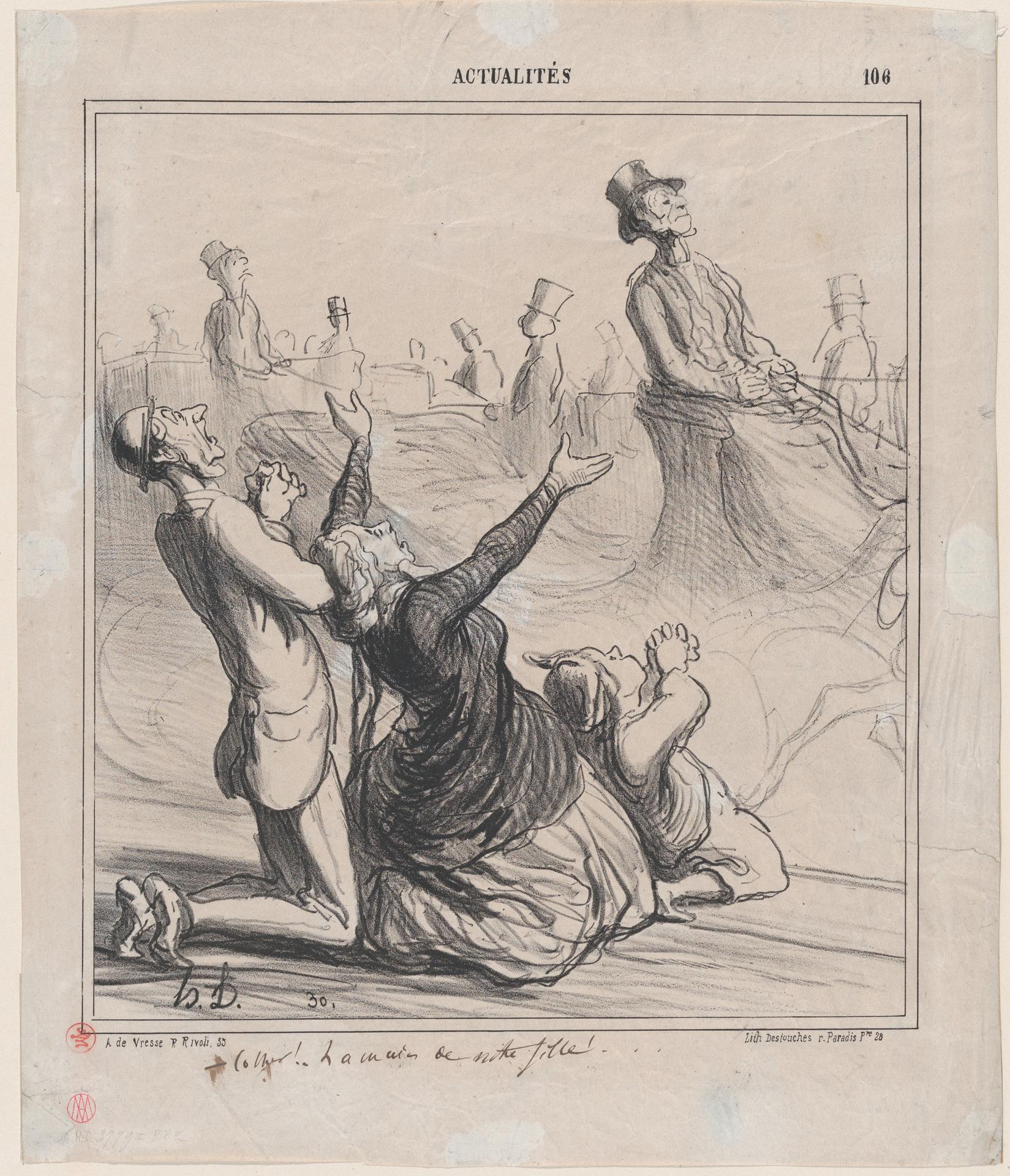
Coachman, for the hand of our daughter!..., from 'News of the day,' published in "Le Charivari"
Original title: Coachman, for the hand of our daughter!..., from 'News of the day,' published in "Le Charivari"
kurzbeschreibung
Honoré Daumier published the lithograph "Kutscher, für die Hand unserer Tochter!..." on June 6, 1867, as part of his series "News of the day" in "Le Charivari". The print presents a caricatural scene with kneeling figures and men behind, executed as a lithograph with pen and brown ink on newsprint.
Description
A lively scene unfolds in a public space: in the foreground a woman kneels with raised arms, straightening up toward another kneeling figure who stretches their arms upward and seems to shout or pray. Behind them stand several men in suits and hats, some looking toward the kneeling pair. The arrangement is dynamic, with figures caught in action. Grays dominate, and light and shadow are worked out through fine lines and contrasts. The style feels caricatural and satirical, typical of Daumier.
Context
For the satirical newspaper "Le Charivari", Daumier created the series "News of the day", in which he commented on current social and political events. The lithograph appeared on June 6, 1867, during a period of profound social upheaval in France under Napoleon III. The motif of courtship appears here distorted into absurdity, revealing Daumier's critical attitude toward bourgeois conventions. Newsprint as a support was common for the inexpensive mass production of caricatures in the 19th century.
Impact
Through exaggerated gestures and the unusual arrangement, the print is immediately comic and at the same time unsettling. The kneeling figures create a theatrical tension that invites a smile but also prompts reflection on the social situation depicted. Daumier's draftsmanship gives the scene a lively energy that reinforces the satire.
Technique
In lithography, a design is drawn with greasy chalk on a stone and then printed. Daumier also used pen and brown ink on the impression to emphasize or correct details. The present impression is the second state of four, indicating that the printing plate was reworked. Newsprint was used as the paper, as was customary for publication in "Le Charivari".
AI-generated description text
Source: Metropolitan Museum of Art · Public Domain (CC0 1.0)