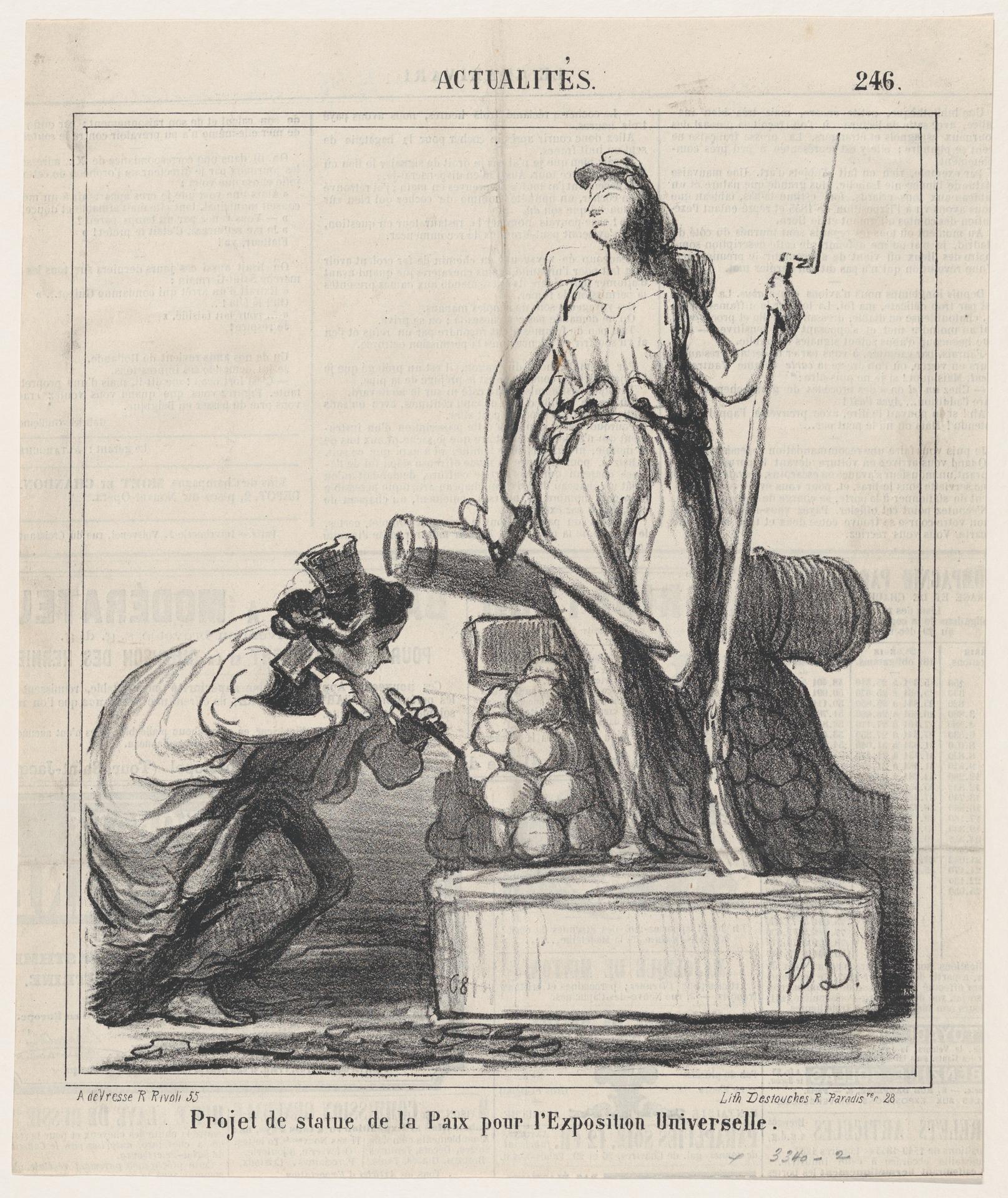
Project for the statue of peace at the Universal Exposition, from 'News of the day,' published in "Le Charivari"
Original title: Project for the statue of peace at the Universal Exposition, from 'News of the day,' published in "Le Charivari"
kurzbeschreibung
Honoré Daumier took up the idea of a peace statue for the World's Fair in 1867 and mocked it in this lithograph. The print belongs to the series 'News of the Day' and exists in the second of two states. Political critique and artistic statement are tightly interwoven here.
Description
A woman in a simple cap and robe stands in the foreground, pointing with a pencil at a sketch resting on a pedestal; the pedestal is adorned with a globe and a shield. Behind her, on a similarly decorated base, rises the statue of a woman holding a weapon and a globe. The view remains in shades of gray, with clearly drawn contours and no strong shadows or highlights.
Context
On January 5, 1867, the lithograph appeared in the French satirical magazine 'Le Charivari', famous for its political caricatures. Daumier was referring to the Paris World's Fair of 1867, which presented itself as a stage for progress and peace but also revealed military and imperialist ambitions. The series 'News of the Day' accompanied current events with sharp irony.
Impact
An ironic tension arises between the woman's peaceful gesture and the warlike statue behind her. The plain, detailed execution directs attention to the contradiction between claim and reality. Viewers are prompted to reflect on the proclaimed peace.
Technique
Lithography on newsprint was the standard method for reproduction in satirical magazines. The second state of the print shows reworkings that sharpened contours and details. The gray tones result from lithographic printing with ink on stone.
AI-generated description text
Source: Metropolitan Museum of Art · Public Domain (CC0 1.0)