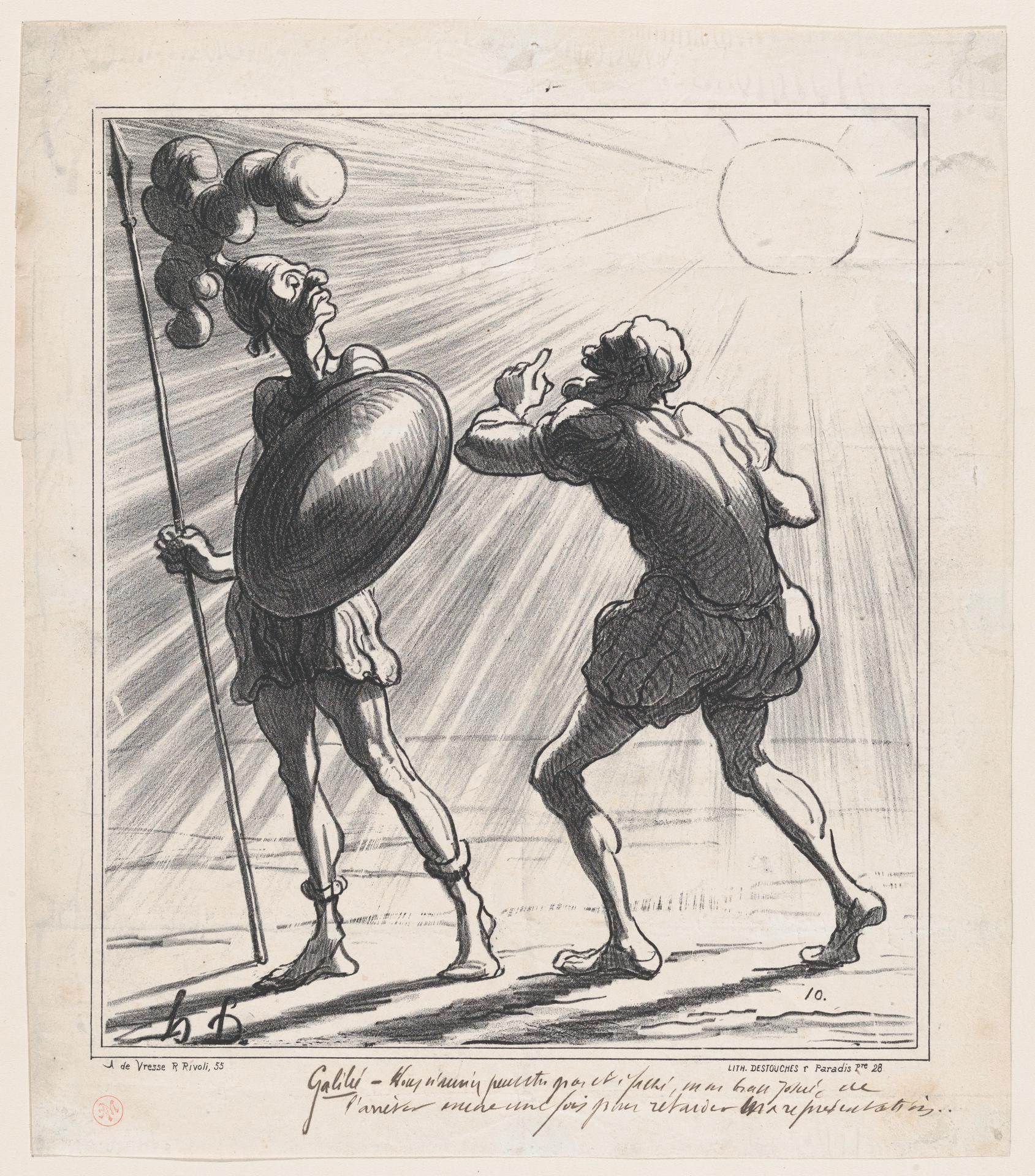
Galileo: You wouldn't be annoyed, my good Joshua, to stop the sun once again for the sake of my show, from 'News of the day,' published in 'Le Charivari'
Original title: Galileo: You wouldn't be annoyed, my good Joshua, to stop the sun once again for the sake of my show, from 'News of the day,' published in "Le Charivari"
kurzbeschreibung
Two figures in classical garb face off in a sharp, combative scene, drawn by Honoré Daumier in 1867 for a lithograph that blends biblical and scientific references into caricature. The image was printed on newsprint.
Description
On the left, a figure braces with spear and shield, eyes fixed on the opponent; on the right, the other readies an arrow and steps into a defensive stance. Behind them, a sunburst pattern spreads across the ground, heightening the tension of the encounter. The classical drapery points to history or myth, while the detailed linework captures the motion of the fight. Caricatural exaggeration—especially in the faces—gives the print a humorous yet dramatic edge.
Context
The lithograph was published in 1867 in the French satirical journal Le Charivari. Daumier, known for his political and social caricatures targeting authorities and established institutions, here links the biblical story of Joshua stopping the sun with an allusion to Galileo Galilei and his conflict with the church. Within the series 'News of the day', he used the motif to comment on current events and social issues.
Impact
Humor and satire arise mainly from the exaggerated faces and the heightened combat depiction. The clash of classical motifs with scientific controversy creates an ironic tension that invites reflection. The black-and-white print sharpens the contrasts and reinforces the dynamism of the action.
Technique
The image was executed as a lithograph with pen and brown ink on newsprint; it is the third state of three and a proof, as noted in the Delteil reference. The lithographic process allowed for fine lines and shading, rendering figures and background with precision.
AI-generated description text
Source: Metropolitan Museum of Art · Public Domain (CC0 1.0)