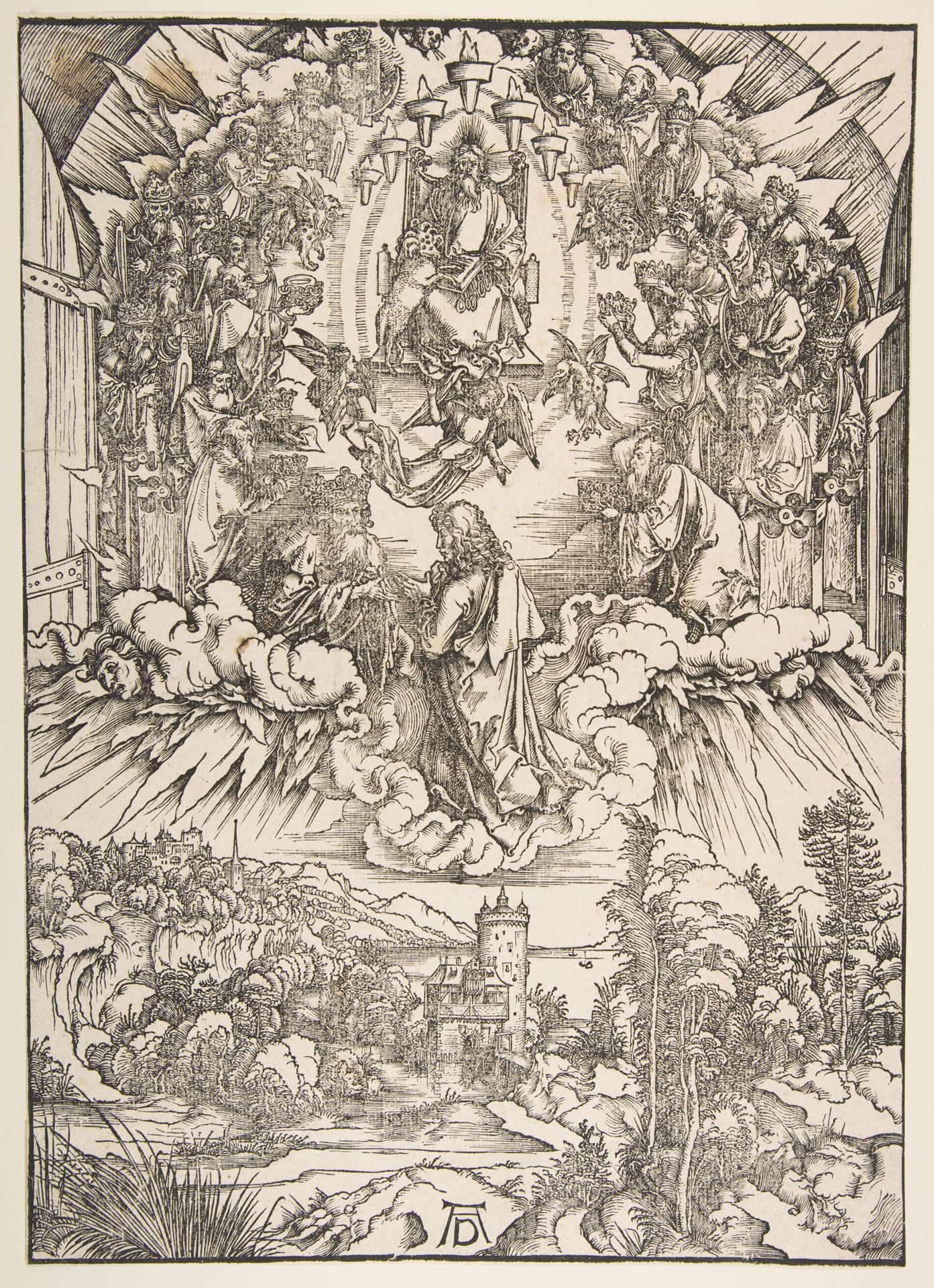
Saint John before God and the Elders, from "The Apocalypse"
Original title: Saint John before God and the Elders, from "The Apocalypse"
kurzbeschreibung
This woodcut by Albrecht Dürer, dating to around 1496, depicts Saint John kneeling before God on a throne, surrounded by the four Evangelists and a host of angels. It is part of Dürer's famous Apocalypse series, illustrating scenes from the Book of Revelation.
Description
The composition centers on Saint John, who kneels in the foreground wearing a long-sleeved robe, his gaze directed upward. God sits on a majestic throne in the upper background, encircled by angels and spiritual beings, with rays of light emanating to emphasize divine presence. The four Evangelists, identifiable by their distinct facial features and hairstyles, are positioned around the throne, each clad in traditional garments. Below, a detailed landscape unfolds with trees, a river, and a tower, possibly alluding to Jerusalem or another holy site. The scene is framed by clouds and radiant beams that reinforce the sacred atmosphere.
Context
Dürer created this woodcut as part of his Apocalypse series, published in 1498, which was the first book entirely designed and printed by an artist. The series drew on the Book of Revelation and was notable for its intricate compositions and emotional intensity, reflecting late medieval religious anxieties. Dürer's work was revolutionary in its fusion of Northern European printmaking techniques with Italian Renaissance influences, which he had absorbed during his travels to Italy. The Apocalypse series achieved widespread popularity, contributing to Dürer's international fame.
Impact
The stark contrast of black lines against white paper creates a dramatic, almost theatrical effect, drawing the viewer's eye to the divine radiance around God. The detailed landscape and expressive figures ground the heavenly vision in a tangible world, making the supernatural scene feel immediate and accessible. Dürer's masterful linework conveys both the awe of the prophet and the overwhelming majesty of the divine court.
Technique
This work is a woodcut, a relief printing technique where the image is carved into a wooden block, inked, and transferred to paper. Dürer employed sharp, fine lines and cross-hatching to achieve subtle gradations of light and shadow, a hallmark of his printmaking skill. The precision of the carving allows for intricate details, from the folds of garments to the textures of the landscape, demonstrating Dürer's technical virtuosity.
AI-generated description text
Source: Metropolitan Museum of Art · Public domain (CC0)