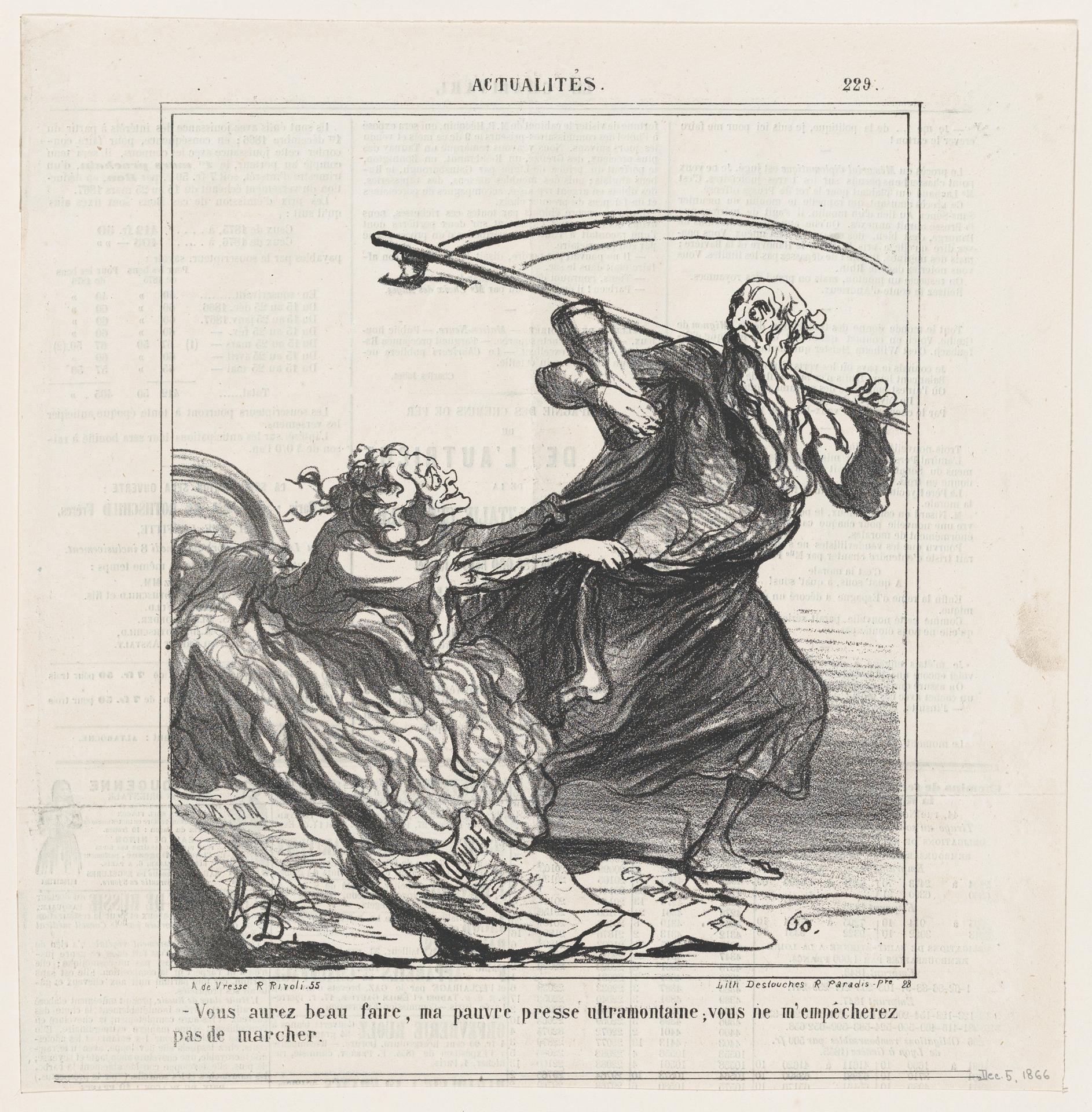
Do what you like, my poor ultramontane press. You will not prevent me from marching on
Original title: Do what you like, my poor ultramontane press. You will not prevent me from marching on, from 'News of the day,' published in Le Charivari, December 5, 1866
kurzbeschreibung
Unlike many contemporary caricatures that crowd the stage with figures to make their point, Honoré Daumier's 1866 lithograph 'Do what you like, my poor ultramontane press' stages an almost chamber-play confrontation between just two figures. The sheet belongs to the series 'News of the Day' and appeared on December 5, 1866, in Le Charivari. It is executed as a lithograph on newsprint; four states of the plate exist.
Description
Two figures fill the image: a woman lying on the ground and a figure towering above her, aiming a large saber-like instrument at her. The face of the woman on the ground betrays fear and desperation, while the standing figure appears dominant and threatening. This figure wears a garment resembling a coat or robe and has long curly hair; the face remains unrecognizable, which directs attention to the action. The arrangement feels dynamic: the woman in the middle, the second figure above her, creating strong tension. The print remains black and white, with even light and shadows built from line hatching of varying density.
Context
Daumier's caricature emerged against the backdrop of political struggles in the Second Empire of Napoleon III. 'Ultramontane press' refers to Catholic newspapers that supported the pope and often stood in opposition to the government. The work was published in the satirical journal Le Charivari, known for its critical visual wit. Daumier used lithography to comment on current political events; the series 'News of the Day' repeatedly took up questions of press freedom and church influence.
Impact
The print is immediately gripping through its clear visual language and exaggerated threat. The fact that the standing figure's facial features remain unrecognizable and the gesture is so dramatic reinforces the allegorical dimension: the conflict between press and political power becomes vivid. The emotional expression of the lying woman directly engages the viewer and prompts reflection on the power dynamic shown.
Technique
The lithograph was printed on newsprint, as was usual for Daumier's satirical works in periodicals. The lithographic process allows fine lines and graduated shading, so that fabric textures and facial features stand out in detail. This sheet is the fourth of four states, indicating that the printing plate was reworked to optimize sharpness and detail.
AI-generated description text
Source: Metropolitan Museum of Art · Public Domain (CC0 1.0)