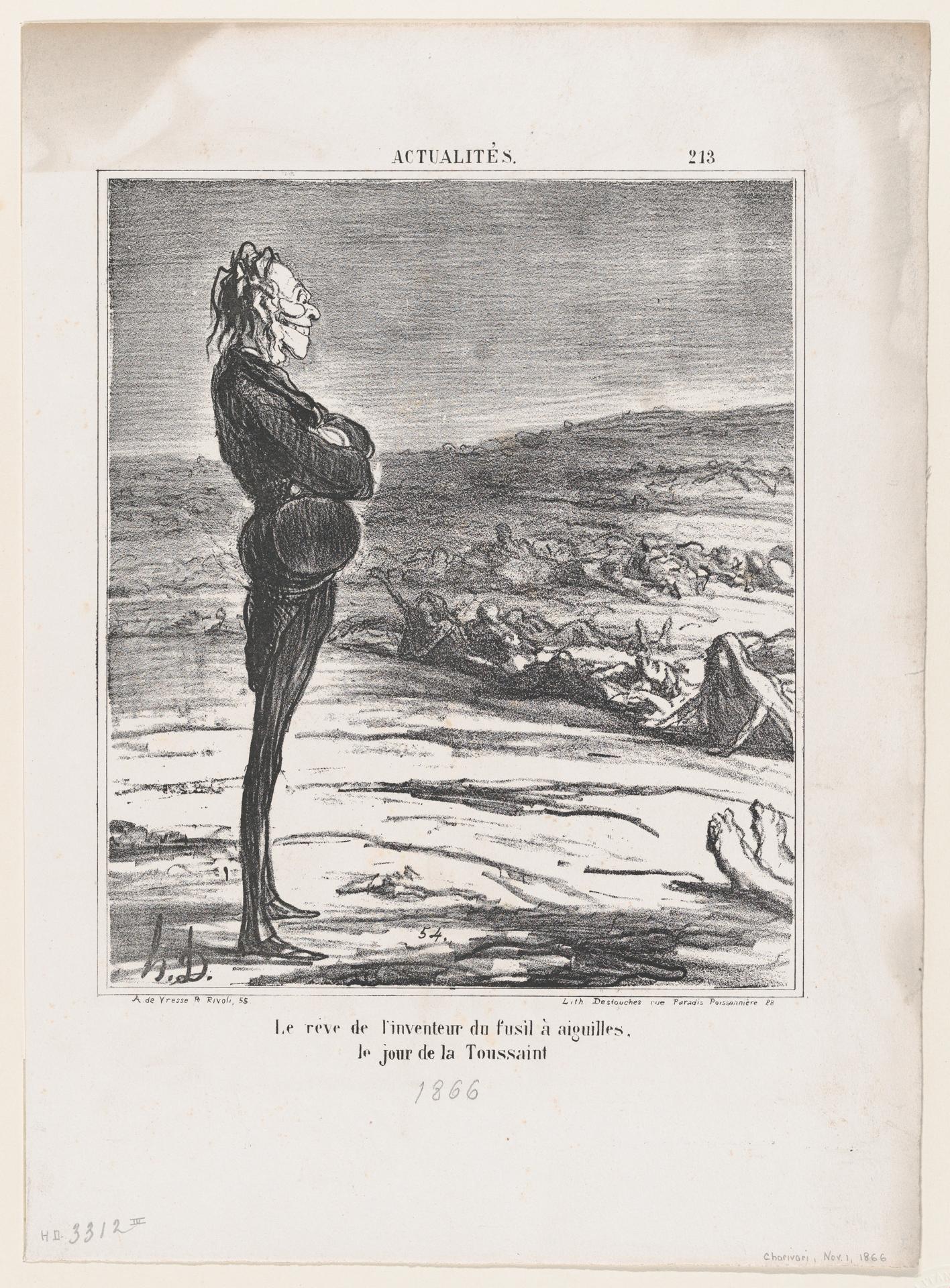
The Dream of the Inventor of the Pin-Gun on All Saints' Day, from 'News of the Day,' published in Le Charivari
Original title: The dream of the inventor of the pin-gun on All Saints' Day, from 'News of the day,' published in "Le Charivari"
kurzbeschreibung
Honoré Daumier made this lithograph in 1866. It shows an inventor with grotesquely distorted features dreaming of his invention on All Saints' Day. The print appeared in the satirical journal 'Le Charivari' and is the third state of three.
Description
A man with an exaggerated face, hat on head and arms crossed, occupies the left half of the image. Behind him opens a bleak, gloomy expanse where several figures lie or sleep on the ground. The layout is asymmetrical, directed entirely toward the foreground figure. Black-and-white areas with dense lines and graduated shading give figures and landscape sculptural depth; the distorted features and ironic staging set the caricatural tone.
Context
The print was made for the daily column 'News of the day' in the Parisian satirical journal 'Le Charivari', to which Daumier regularly contributed political and social caricatures. The needle gun, also called the needle-fire rifle, was a new weapon of military importance in the 19th century; Daumier here targets the widespread enthusiasm for inventions of the time. Dated November 1, 1866, it refers to All Saints' Day, the holiday on which France traditionally commemorates the dead. The work was executed as a lithograph on wove paper; three states are known, and this impression belongs to the third.
Impact
Grotesque and melancholy enter into a peculiar union in this print. The inventor's exaggerated facial expression seems comic, while the gloomy landscape with the sleeping figures is more thought-provoking. Because the arrangement is asymmetrical, the gaze is directed at the protagonist and his absurd vision — that is precisely the satirical point.
Technique
The print was made by lithography, a planographic process: drawing with greasy chalk on the stone, then printing. Fine lines and graduated shading model the facial features and the landscape in detail in Daumier's work. The impression was pulled on wove paper, whose characteristic texture contributes to the print quality.
AI-generated description text
Source: Metropolitan Museum of Art · Public Domain (CC0 1.0)