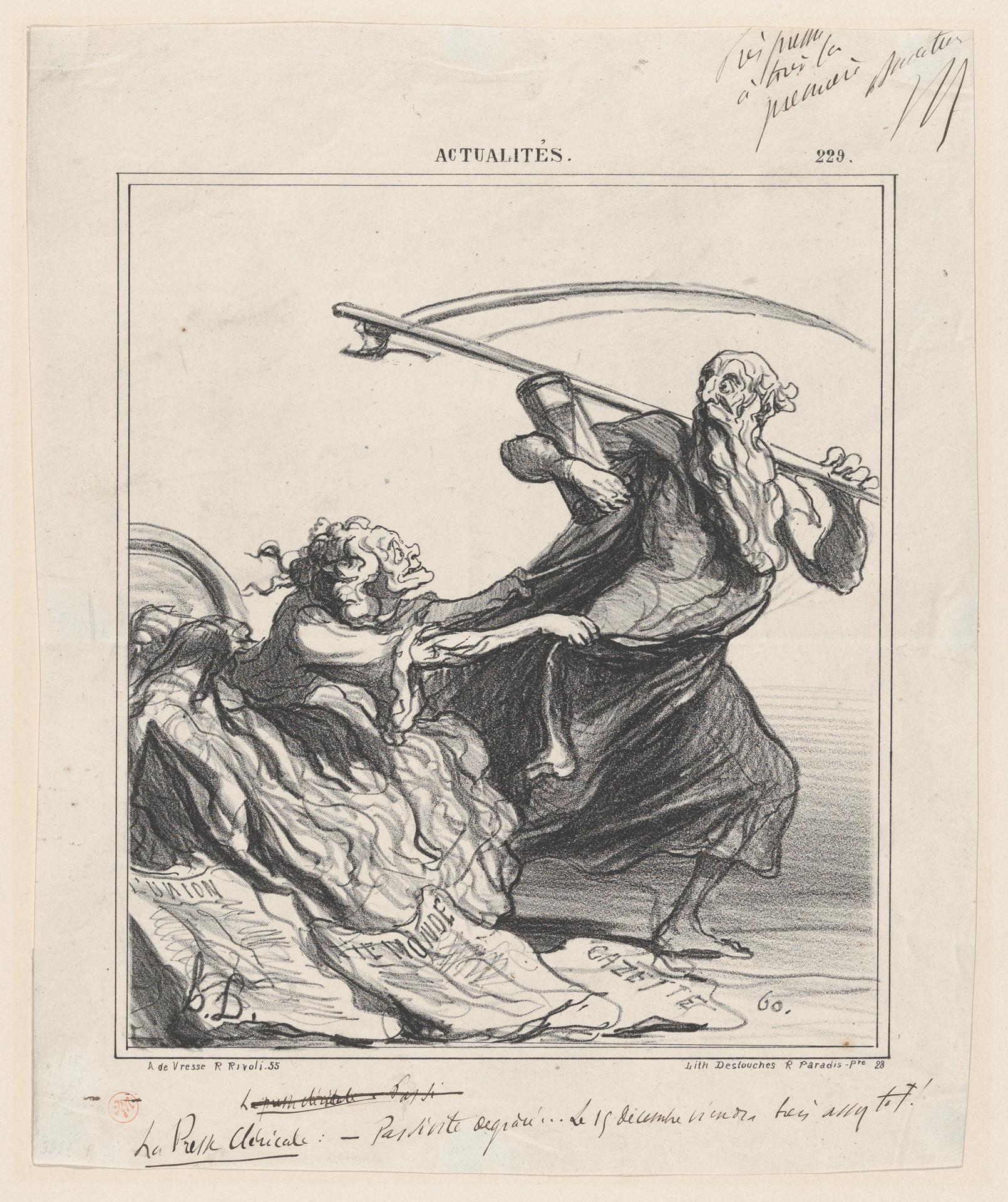
The clerical press: Not so quickly... December 15 will come soon enough!
Original title: The clerical press: Not so quickly... December 15 will come soon enough!, from 'News of the day,' published in "Le Charivari"
kurzbeschreibung
Honoré Daumier's 1866 lithograph caricatures two adversaries: a newspaper writer swings a stick and presses forward against a retreating figure whose head is drawn as a newspaper masthead. The print belongs to the series 'News of the day' and appeared in the satirical journal 'Le Charivari'.
Description
Two figures divide the field. On the left a writer in traditional dress lunges forward, stick raised; on the right a seated figure pulls back with a defensive gesture, its head formed as a newspaper masthead. The attacker's energetic stance meets the opponent's guarded, backward-turning pose. Crisp, detailed lines shape this largely black-and-white lithograph, while lettering points to title and origin.
Context
The sheet appeared on 5 December 1866 in 'Le Charivari' as part of the series 'News of the day'. Daumier took up the confrontation between the clerical press and its opponents shortly before 15 December 1866, the date on which the Prussian Indemnity Law was proclaimed. This is the second state of four, printed as a proof (Delteil) on wove paper.
Impact
Tension registers at once: the writer's raised hand and thrust stick pull the eye to the right, where the defensive figure shrinks back into the image. That contrast makes the political quarrel of those days immediately tangible. The pared-down black-and-white rendering and expressive gesture give the sheet a poster-like, insistent presence.
Technique
The sheet was made as a lithograph on wove paper, a process allowing fine gradations of shading and strong contrasts. Present here is the second state of four, a proof (Delteil). Precise lines and richly differentiated internal drawing distinguish the work.
AI-generated description text
Source: Metropolitan Museum of Art · Public Domain (CC0 1.0)