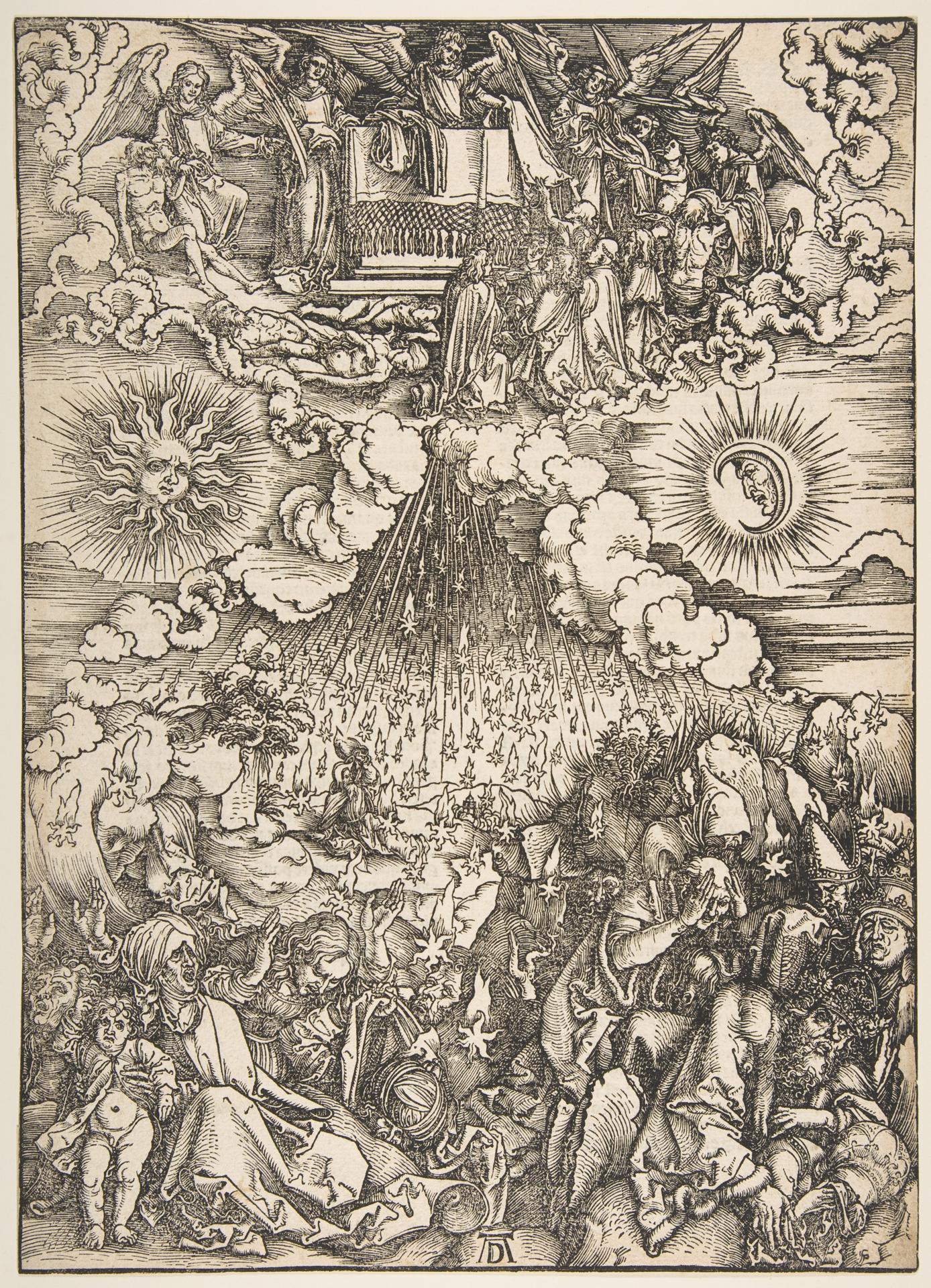
The Opening of the Fifth and Sixth Seals, from 'The Apocalypse', Latin Edition
Original title: The Opening of the Fifth and Sixth Seals, from "The Apocalypse", Latin Edition
kurzbeschreibung
This woodcut by Albrecht Dürer, dated 1511, depicts the opening of the fifth and sixth seals from the Book of Revelation. It is part of Dürer's famous Apocalypse series, which was published in both Latin and German editions. The scene shows angels above and terrified humans below, rendered in stark black-and-white.
Description
In the upper half, angels sit on clouds and hold an open scroll, presumably the Book of Life, from which smaller angels descend in a pyramidal arrangement. These angels appear in varied poses—some flying, others seated or reclining on clouds. The lower half is filled with human figures in states of fear, prayer, and despair, their gestures conveying panic. A dramatic backdrop of clouds and a radiating sun pattern heightens the apocalyptic mood. The composition is monochrome, with sharp, intricate lines and strong contrast between light and dark areas.
Context
Dürer created the Apocalypse series between 1496 and 1498, but this particular woodcut was reprinted in the 1511 Latin edition. The series was groundbreaking in its scale and ambition, as Dürer both designed and cut the woodblocks himself, a departure from the common practice of separate block cutters. The Latin edition was aimed at an international audience, reflecting the widespread interest in apocalyptic themes around the turn of the 16th century, a period marked by religious and social upheaval.
Impact
The woodcut's stark contrasts and dense detail draw the viewer into the chaotic scene, evoking both awe and dread. The pyramidal flow of angels contrasts with the scattered, agitated humans below, creating a sense of divine order versus earthly turmoil. Dürer's precise lines give the image a dynamic energy that remains visually striking centuries later.
Technique
This is a woodcut, a relief printing technique where the image is carved into a wooden block, inked, and pressed onto paper. Dürer's exceptional skill in cutting fine, expressive lines is evident in the detailed textures of clouds, hair, and drapery. The monochrome palette relies on the interplay of black ink and paper to achieve its dramatic effect.
AI-generated description text
Source: Metropolitan Museum of Art · Public domain (CC0)