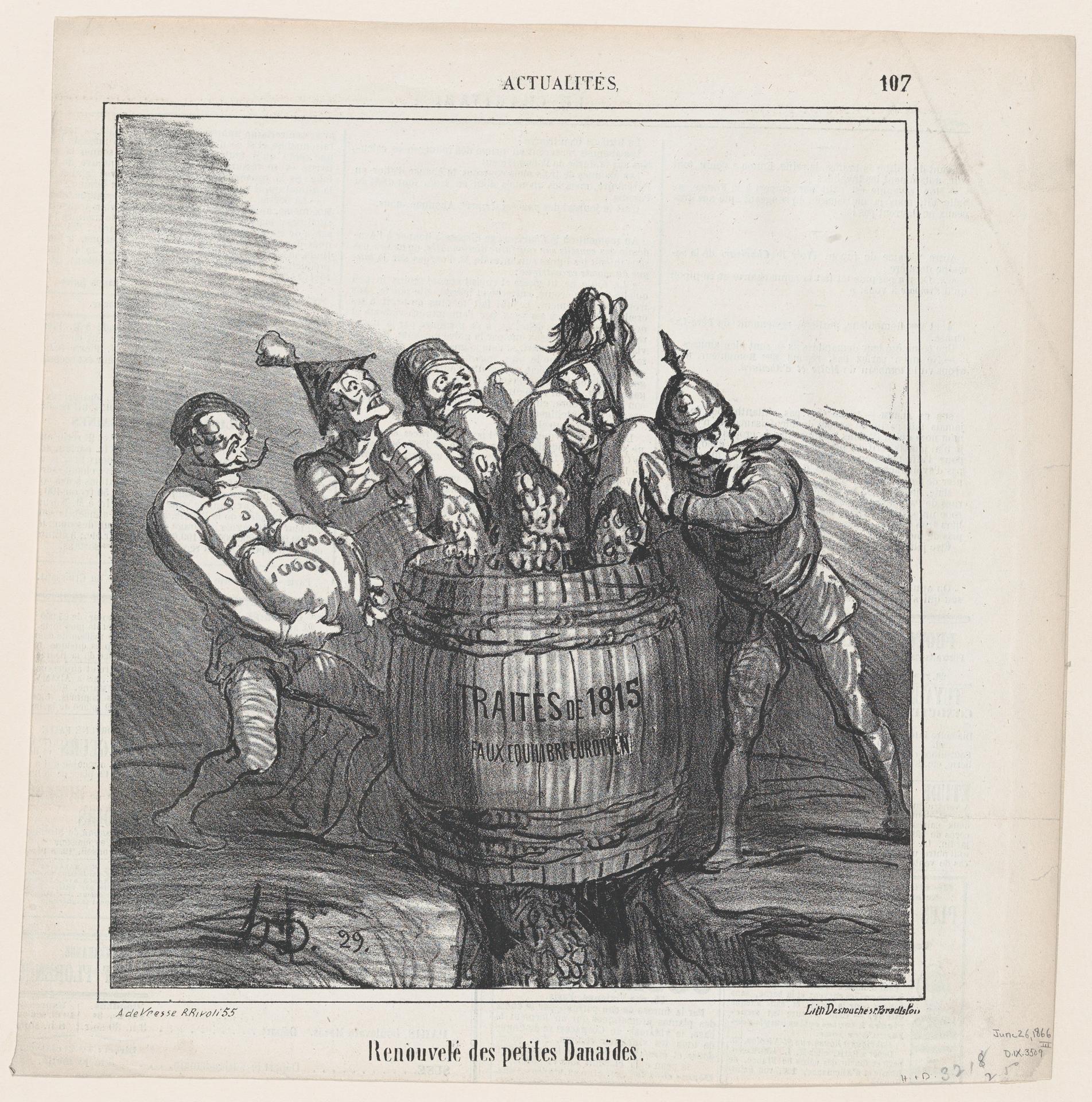
Revival of the little Danaides, from "News of the day"
Original title: Revival of the little Danaides, from "News of the day"
kurzbeschreibung
Honoré Daumier's lithograph of 1866 gathers a crowd of figures around an enormous barrel marked 'TRAITS DE 1815 FAUX EQUILIBRE EUROPEEN', all of them straining to hoist it aloft. Published in the journal 'News of the day' and printed on newsprint, the sheet is a caricature that reads as political satire on the European balance-of-power settlement after 1815.
Description
Bodies press close around the great cask, pushing it upward with visible effort. Caps and uniforms suggest military or political roles, and the twisted postures, with exertion written plainly on every face, convey how heavy the task is. Black and white with evenly distributed light, as lithographs usually are, the drawing works through caricature: exaggerated expressions and gestures carry the scene.
Context
The print appeared in June 1866, during a period of European tension that would lead into the Austro-Prussian War. Daumier, known for his political and social satires, issued it through 'News of the day'. The inscription on the barrel refers to the Congress of Vienna of 1815 and the European balance it established, a settlement increasingly called into question in the 1860s. The 'little Danaides' allude to the myth of the Danaids, condemned to fill a vessel without a bottom, an image of futile labor.
Impact
Humor and criticism meet as the figures' efforts are made ridiculous. Their overwrought poses and faces sharpen the satirical edge and prompt the viewer to reflect on the pointlessness of the political exertions depicted. The plain black-and-white design directs attention to the arrangement and to the message.
Technique
Daumier worked in lithography: a drawing is transferred to a stone and then printed on paper. This impression was pulled on newsprint, as was common for satirical sheets of the period. It survives in the third state of four (Delteil), indicating that the print was revised several times.
AI-generated description text
Source: Metropolitan Museum of Art · Public Domain (CC0 1.0)