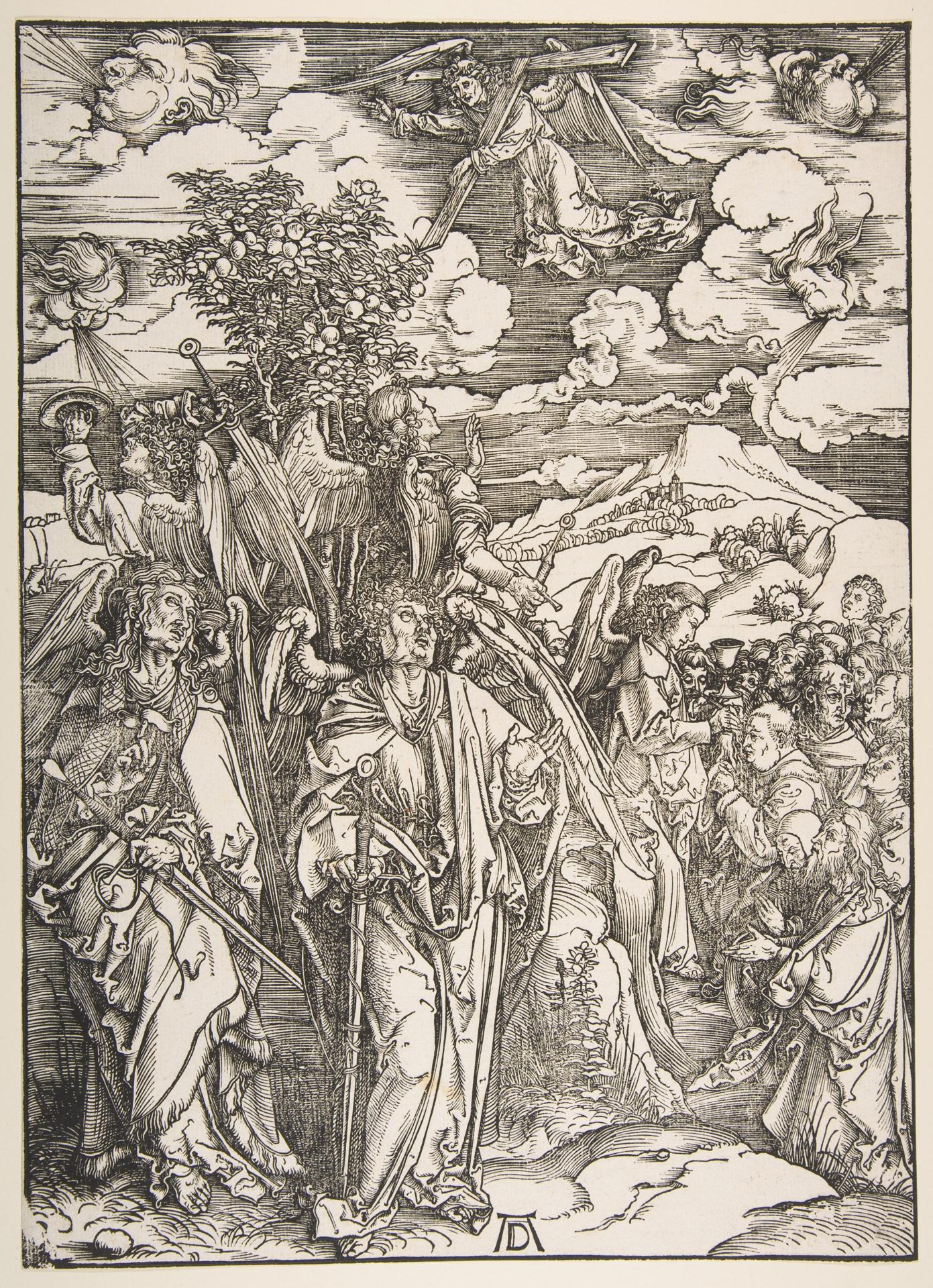
Angels Restraining the Four Winds
Original title: Angels Restraining the Four Winds
kurzbeschreibung
Albrecht Dürer's woodcut 'Angels Restraining the Four Winds' depicts a dramatic scene of angels holding back the winds. The work is undated but exemplifies the artist's mastery of the woodcut medium. It portrays a moment of divine control over the natural forces.
Description
The central composition features several angels, some holding swords and crosses, who appear to command the four winds, symbolized by swirling clouds and gusts in the background. The angels are dressed in flowing robes and have prominent wings. In the distance, other figures participate in a procession or ceremony, adding narrative depth. The monochrome print is filled with intricate details, including clouds, trees, and a landscape that extends to the horizon.
Context
Albrecht Dürer (1471–1528) was a German painter, printmaker, and theorist of the Renaissance. This woodcut likely draws on biblical imagery, possibly from the Book of Revelation, where angels hold back the winds of the earth. Dürer's prints were widely disseminated and influential across Europe, reflecting the era's interest in religious themes and the natural world.
Impact
The image conveys a sense of cosmic drama and divine power, with the angels' calm demeanor contrasting with the turbulent winds they control. The detailed, evenly lit composition invites close inspection, revealing the artist's skill in creating texture and depth through line work. The monochromatic palette focuses attention on the interplay of light and shadow, enhancing the spiritual atmosphere.
Technique
This is a woodcut, a relief printing technique where the image is carved into a wooden block, inked, and pressed onto paper. Dürer elevated the woodcut to a fine art, using cross-hatching and varied line weights to achieve tonal variation. The print exhibits the characteristic sharp contours and bold contrasts of the medium, showcasing Dürer's technical precision.
AI-generated description text
Source: Metropolitan Museum of Art · Public domain (CC0)