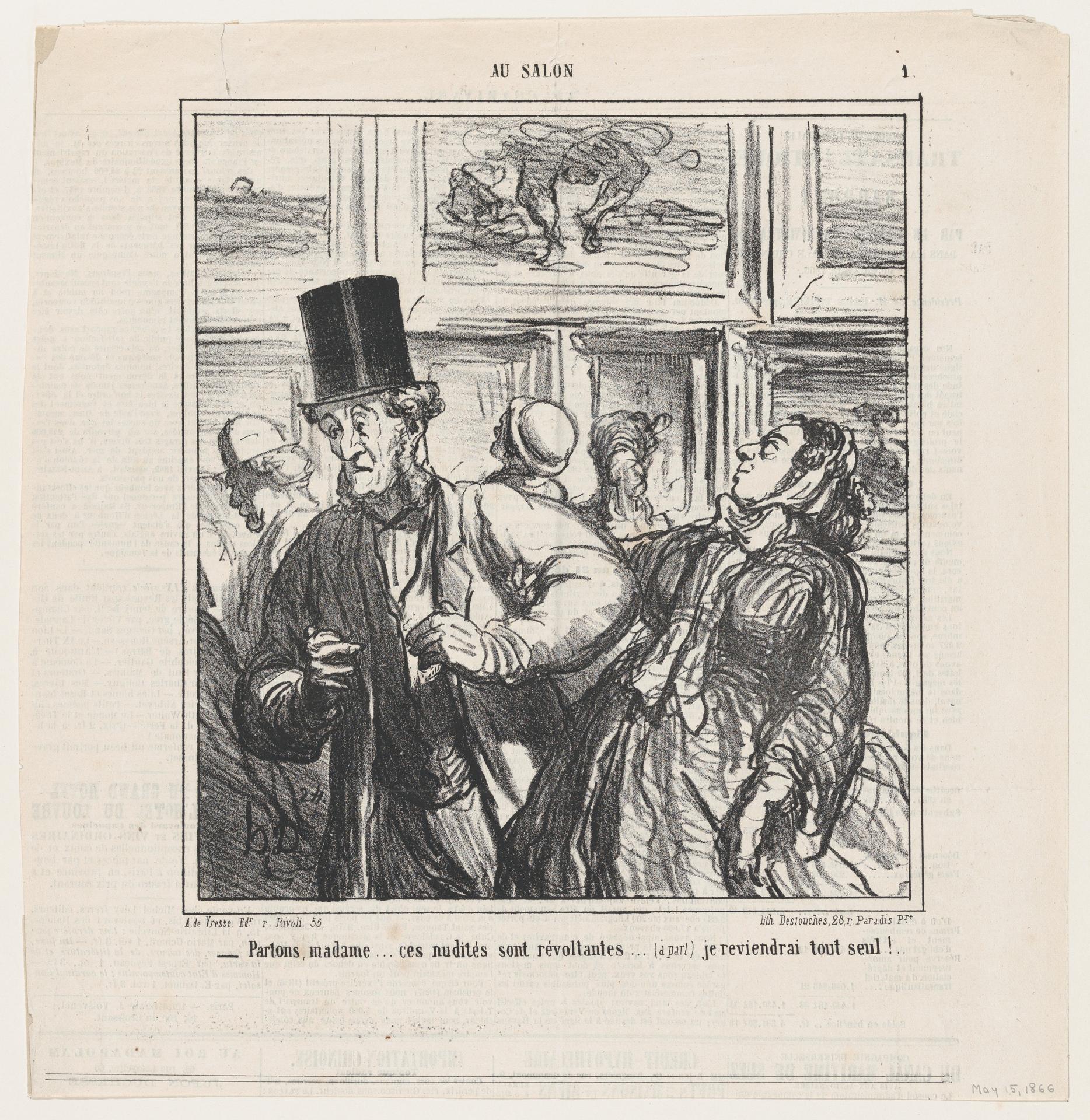
Let's leave Madame... these nudes are revolting... (aside) I'll come back later., from 'At the Salon,' published in Le Charivari, May 5, 1866
Original title: Let's leave Madame... these nudes are revolting... (aside) I'll come back later., from 'At the Salon,' published in Le Charivari, May 5, 1866
kurzbeschreibung
Unlike many Salon caricatures that focus on the works themselves, this 1866 print by Honoré Daumier puts the audience front and center: a top-hatted man leaves the room with a lady, indignant about a nude, only to announce aside that he will return later. The lithograph belongs to the series 'At the Salon' and appeared on May 5, 1866, in Le Charivari.
Description
In the foreground, a man in a top hat grabs his companion's arm and turns to leave while speaking; the other looks surprised. On the wall hang several paintings of nudes, which are the cause of the criticism. Bystanders look in different directions, some laughing or chatting. Black and white, even light without harsh shadows, the style caricatural and humorous.
Context
This lithograph was made for the satirical journal Le Charivari, where Daumier regularly published caricatures. It is part of the series 'At the Salon,' which accompanied the annual Paris art exhibitions and lampooned public reactions to the works on display. Daumier used lithography for social and art criticism; he was known for his close observation of bourgeois life.
Impact
The exaggerated figures and the ironic caption make the scene immediately comic. The contrast between the man's public outrage and his secret comment creates a satirical effect that invites a smile. Thus the print conveys a timeless critique of hypocrisy and bourgeois morality.
Technique
Daumier used lithography, a printing process based on the repulsion of grease and water that allows fine lines and tonal gradations. It was printed on newsprint, indicating cheap mass production for the journal. This is the second state of two known impressions, as noted in the signature 'second state of two (Delteil).'
AI-generated description text
Source: Metropolitan Museum of Art · Public Domain (CC0 1.0)