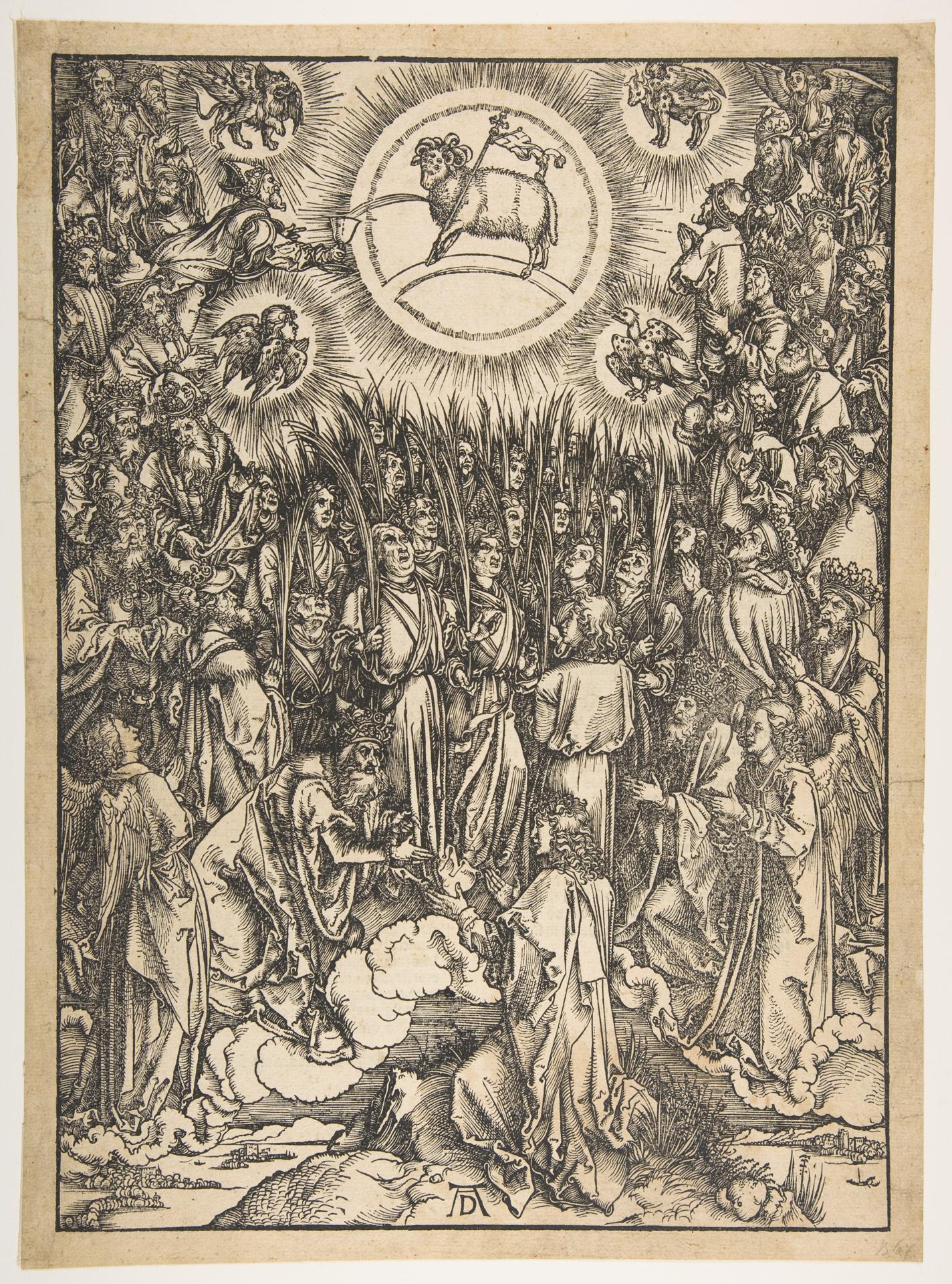
The Adoration of the Lamb, from 'The Apocalypse', Latin Edition
Original title: The Adoration of the Lamb, from "The Apocalypse", Latin Edition
kurzbeschreibung
This 1511 woodcut by Albrecht Dürer depicts the Adoration of the Lamb, a scene from the Book of Revelation. It is part of Dürer's famous Apocalypse series, known for its intricate detail and dramatic composition. The print shows the Lamb of God surrounded by worshipping figures, symbolizing divine glory.
Description
The composition centers on the Lamb, shown with a cross on its back, standing within a radiant circular halo that signifies its holy nature. Around this central image, numerous figures—angels and humans—kneel in reverence, dressed in flowing traditional garments. The scene is symmetrically arranged, with the Lamb as the focal point and worshippers arranged around it. The woodcut uses sharp, detailed lines and a monochrome palette, with light appearing to emanate from above, emphasizing the rays of the halo. The overall effect is one of ordered, celestial veneration.
Context
Dürer created the Apocalypse series between 1496 and 1498, with this Latin edition published in 1511. The series was groundbreaking in its use of woodcut to illustrate a full biblical book, and it catered to a growing market for printed religious imagery. Dürer's work combined traditional iconography with his own artistic innovations, making the prints widely influential across Europe.
Impact
The image conveys a sense of awe and solemnity, drawing the viewer's eye to the radiant Lamb at the center. The dense, intricate linework and symmetrical arrangement create a feeling of harmony and divine order. The monochrome starkness enhances the spiritual intensity, making the scene both immediate and timeless.
Technique
This is a woodcut, a relief printing technique where the image is carved into a wooden block, inked, and pressed onto paper. Dürer's mastery of the medium is evident in the fine, precise lines and the subtle variation in line weight, which create depth and texture. The use of cross-hatching and parallel lines allows for tonal variation within the monochrome print.
AI-generated description text
Source: Metropolitan Museum of Art · Public domain (CC0)