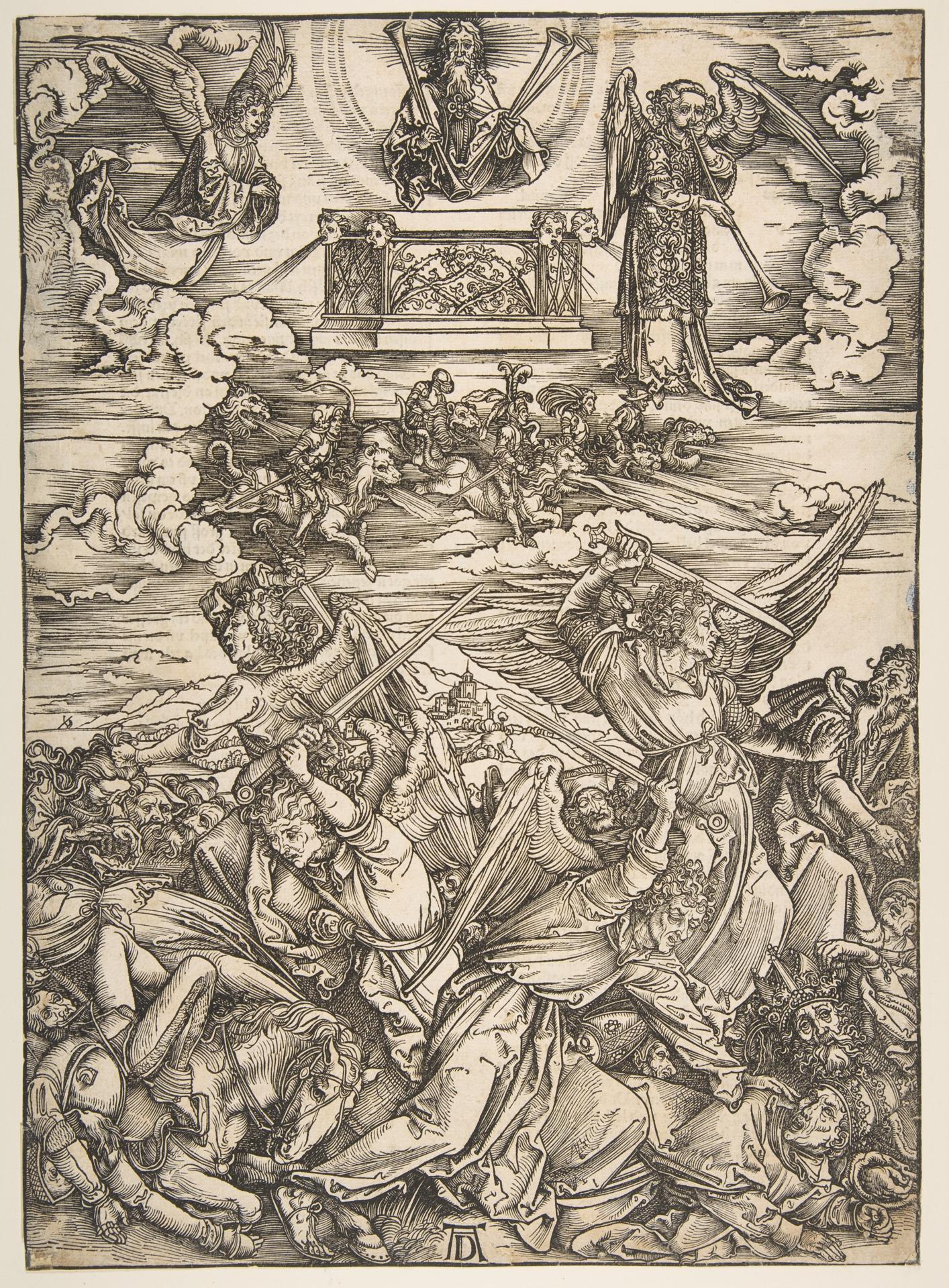
The Four Avenging Angels, from "The Apocalypse"
Original title: The Four Avenging Angels, from "The Apocalypse"
kurzbeschreibung
This woodcut by Albrecht Dürer, dating to around 1498, depicts four angels descending from heaven with swords. They are shown above a group of people in various states of distress, while a divine figure on a throne appears in the background. It is part of Dürer's famous Apocalypse series.
Description
The composition is centered on four angels who hover in the sky, each holding a sword and looking downward. Below them, a crowd of people is scattered across the ground, some lying prone and others gesturing in panic. In the upper background, a seated figure surrounded by clouds suggests a heavenly authority. The scene is rendered in monochrome with strong contrasts between the dark, heavily inked areas and the lighter, finely carved lines.
Context
Dürer created this woodcut as part of his Apocalypse series, published in Nuremberg in 1498. The series was the first book to be designed and printed entirely by an artist, and it combined text and image on facing pages. The imagery draws on the Book of Revelation, specifically the sixth chapter, where four angels are commanded to harm the earth and sea. This work reflects the late medieval fascination with apocalyptic themes and Dürer's engagement with Italian Renaissance ideas of composition and form.
Impact
The dynamic poses of the angels and the chaotic crowd below create a sense of urgency and divine judgment. The stark black-and-white contrast and intricate linework give the scene a dramatic, almost theatrical intensity. The viewer is drawn into the tension between heavenly power and earthly suffering.
Technique
This is a woodcut, a relief printing technique where the image is carved into a wooden block, inked, and pressed onto paper. Dürer's masterful use of cross-hatching and varied line weights creates depth and texture, allowing for subtle shading and a sense of movement. The large format of the print (approx. 39 x 28 cm) was unusual for the time and contributed to its visual impact.
AI-generated description text
Source: Metropolitan Museum of Art · Public domain (CC0)