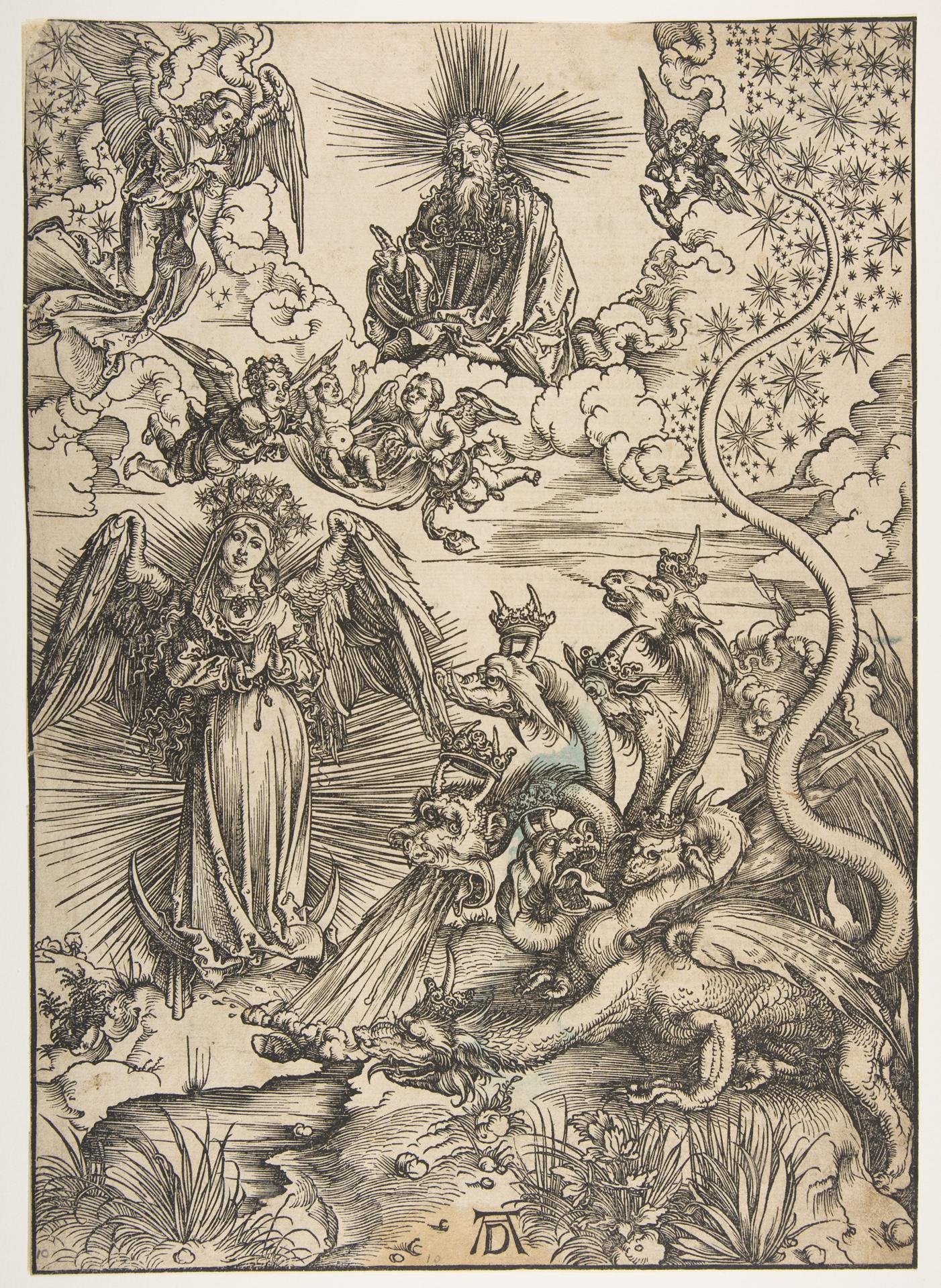
The Apocalyptic Woman, from "The Apocalypse", Latin Edition
Original title: The Apocalyptic Woman, from "The Apocalypse", Latin Edition
kurzbeschreibung
This woodcut by Albrecht Dürer, dated 1511, depicts the apocalyptic woman from the Book of Revelation. The scene shows a crowned female figure, often interpreted as the Virgin Mary, standing on a rock amid dragons and angels. It is part of Dürer's famous Apocalypse series, known for its dramatic imagery and technical mastery.
Description
At the center, a woman stands on a rock, her head encircled by a halo and crowned by an angel hovering above. She is surrounded by several dragons, one of which appears to be attacking, while other angels float in the sky. In the upper background, a majestic figure, likely God or Christ, is enthroned, with additional angels and celestial elements like stars and clouds filling the scene. The composition is symmetrical, with the female figure as the focal point, and the monochrome woodcut relies on strong lines and contrasts to define forms.
Context
Dürer created this woodcut for the Latin edition of his Apocalypse series, first published in 1498 and reissued in 1511. The series was groundbreaking, as it combined text and image on the same page, making the biblical narrative accessible to a wider audience. The apocalyptic woman is a reference to Revelation 12, a popular subject in medieval and Renaissance art, reflecting contemporary religious anxieties and the hope for divine intervention.
Impact
The woodcut conveys a sense of cosmic struggle and divine protection, with the central figure appearing serene despite the surrounding chaos. The intricate details and dynamic composition draw the viewer's eye upward, emphasizing the heavenly realm. The stark black-and-white contrast gives the scene a dramatic, almost theatrical intensity.
Technique
This is a woodcut, a relief printing technique where the image is carved into a wooden block, inked, and pressed onto paper. Dürer's skill in woodcut is evident in the fine lines and varied textures, achieved through careful carving and cross-hatching. The monochrome print allows for strong contrasts, which are typical of his graphic works from this period.
AI-generated description text
Source: Metropolitan Museum of Art · Public domain (CC0)