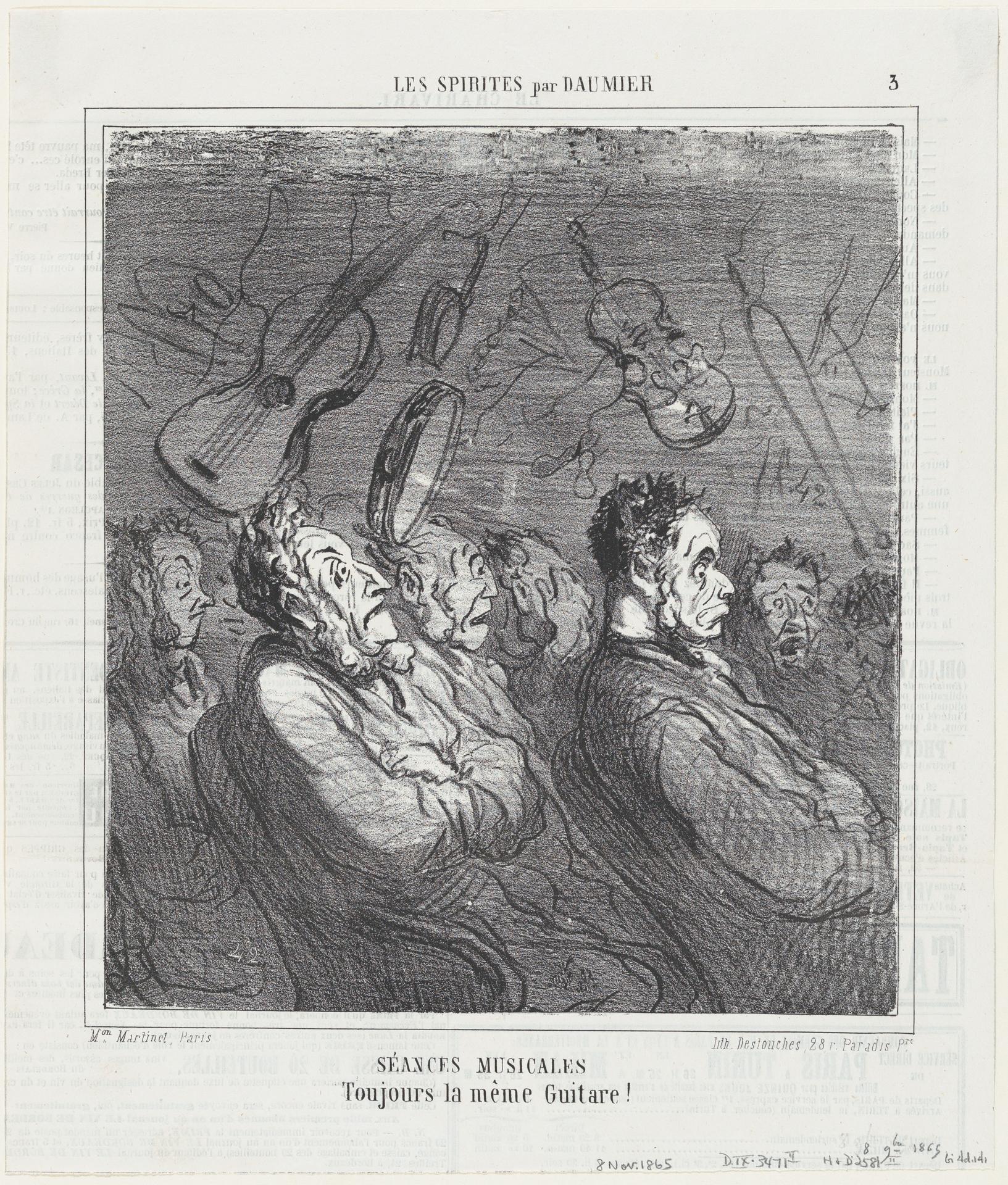
Musical séances, always the same song!, from 'The spiritualists,' published in Le Charivari, November 8, 1865
Original title: Musical séances, always the same song!, from 'The spiritualists,' published in Le Charivari, November 8, 1865
kurzbeschreibung
Honoré Daumier’s lithograph Musikalische Séancen, immer dasselbe Lied! appeared on 8 November 1865 as part of the series Les Spiritistes. It shows a group of people during a spiritualist musical séance, with floating instruments arranged above them. The sheet was printed as a lithograph on newsprint and is the second of two states.
Description
Above the row of figures hover stylized guitars and violins, their lines suggesting movement. The people stand side by side, their gazes directed upward at something outside the image. Their clothing is plain and contemporary, their faces drawn with expressive strokes that convey astonishment or devotion. The arrangement links the figures in a chain that leads the eye toward the musical session. Gray tones dominate the monochrome print, and the light falls evenly, without special effects.
Context
The lithograph was published on 8 November 1865 in the satirical journal Le Charivari as part of the series Les Spiritistes. Daumier thus took up spiritualism, which had many adherents in nineteenth-century France, especially among the bourgeoisie. The series mocked the fashionable séances of the time, with table-turning and supposed conjuring of spirits. As a recognized caricaturist, Daumier used his position to comment critically on social phenomena.
Impact
What mainly makes the viewer smile is the contrast between the exaggerated facial expressions and the freely floating instruments, which tilts the scene into irony. The lined-up figures create a sense of the absurdity of the séance. Clear lines and expressively drawn emotions define the monochrome sheet.
Technique
Daumier worked in lithography: the drawing was made with chalk or ink on the stone and then printed on newsprint. That the work survives in the second of two states points to later reworking of the stone. The gray tones result from the varying density of the lithographic drawing, which allows fine gradations.
AI-generated description text
Source: Metropolitan Museum of Art · Public Domain (CC0 1.0)