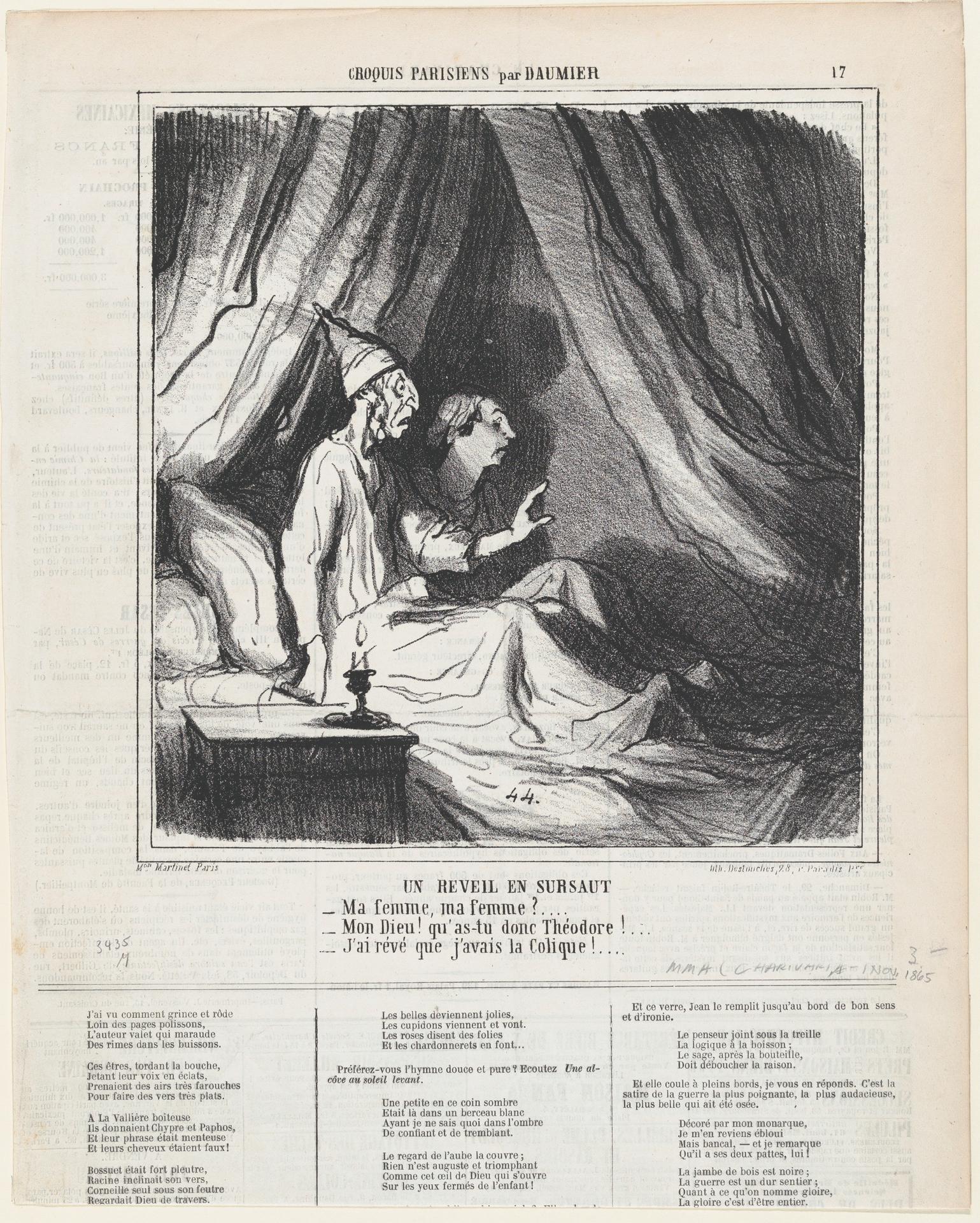
A sudden awakening, from 'Parisian sketches,' published in Le Charivari, November 1, 1865
Original title: A sudden awakening, from 'Parisian sketches,' published in Le Charivari, November 1, 1865
kurzbeschreibung
Honoré Daumier's lithograph 'A Sudden Awakening' appeared on 1 November 1865 in the satirical journal Le Charivari as part of the 'Parisian Sketches' series. It transports us into a nighttime bedroom and captures a moment poised between sleep and waking.
Description
A woman sits up in bed, her upper body raised, while a man stands beside her. Both faces register alarm; she turns to him, and he looks equally dismayed. Heavy curtains darken the room and reinforce the intimacy of the moment. A candle on a table in front of the bed provides the only light. Below the scene, the printed dialogue reads: 'Ma femme, ma femme?... Mon Dieu! qu'as-tu donc Théodore!... J'ai rêvé que j'avais la colique!...'
Context
This print was made for Le Charivari, where Daumier regularly took aim at social and political ills. The 'Parisian Sketches' gather scenes from everyday life in the capital. By 1865 the artist could look back on a long career as a sharp-eyed caricaturist. Two states of the lithograph exist; the present impression is the second.
Impact
The nighttime calm collides with the man's absurd fear, making the image both comic and unsettling. The strong contrast of light and shadow and the nuanced linework give the print an urgent, almost dramatic intimacy.
Technique
For his satirical prints, Daumier often turned to lithography on newsprint, as he did here. The process allows fine lines and a pronounced interplay of light and dark. This impression corresponds to the second state (Delteil).
AI-generated description text
Source: Metropolitan Museum of Art · Public Domain (CC0 1.0)