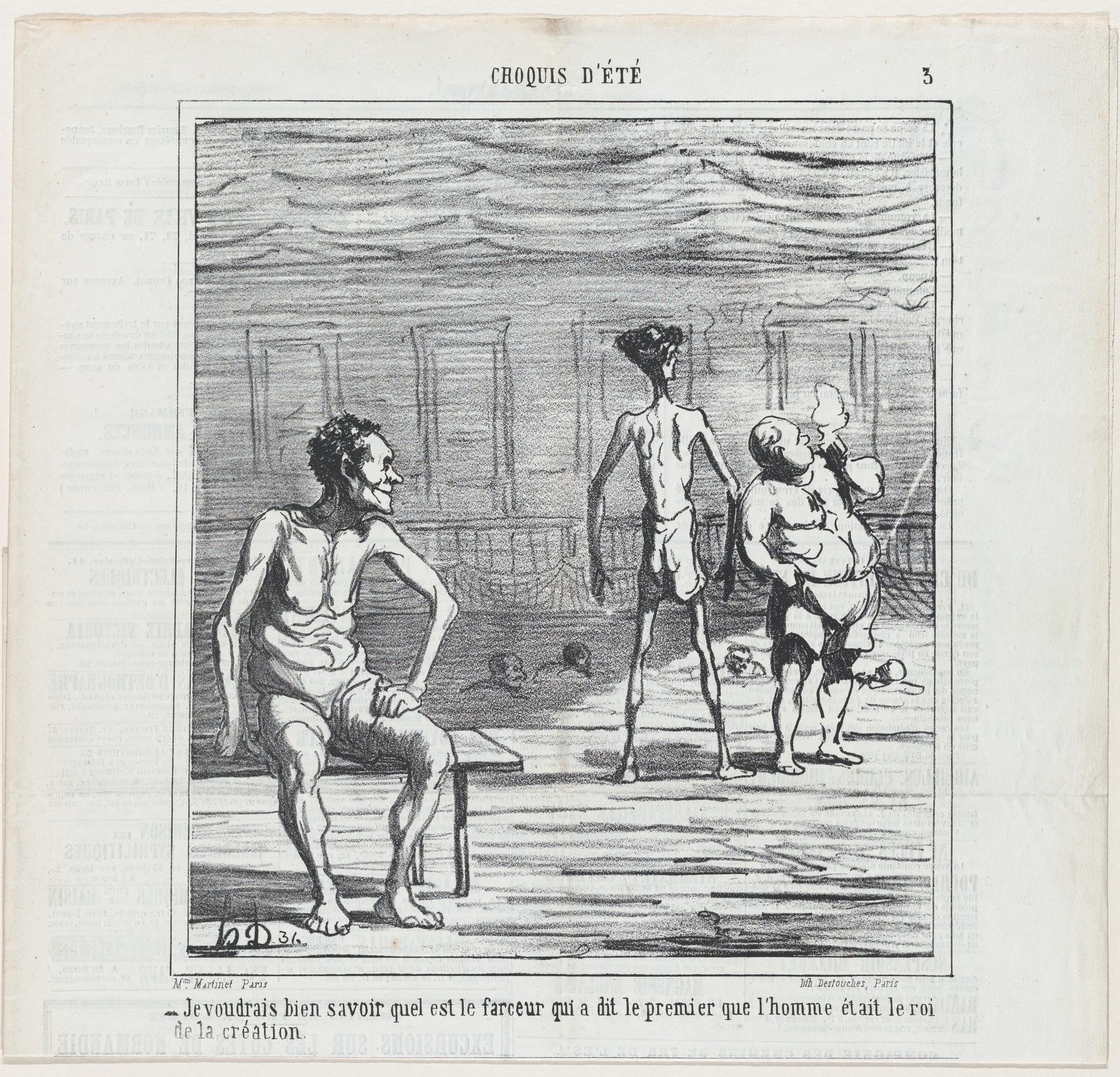
I'm just wondering who might have been the joker who insisted that man was at the pinnacle of creation, from "Summer sketches"
Original title: I'm just wondering who might have been the joker who insisted that man was at the pinnacle of creation, from "Summer sketches"
kurzbeschreibung
Honoré Daumier made this lithograph in July 1865 as part of his series 'Croquis d'Été' (Summer Sketches). It shows three people in a bathing room and carries a caption that mocks human self-importance. The print is the second state (Delteil) and was printed on newsprint.
Description
Three figures occupy a room with columns and a grid-like background that recalls a sauna. On the left, one person sits on a bench, while on the right two others stand and talk with gestures. Their different body shapes and clothing stress their individuality. The black-and-white rendering is typical of lithographs from this period. Along the bottom runs the line: 'Je voudrais bien savoir quel est le farceur qui a dit le premier que l'homme était le roi de la création.'
Context
This lithograph belongs to Daumier's series 'Croquis d'Été' (Summer Sketches), in which he captured humorous scenes of everyday life. It was made during the time of Napoleon III, when Daumier worked regularly for satirical papers such as 'Le Charivari'. The bathing scene takes up a leisure activity popular in Parisian society of the Second Empire. With the ironic caption, Daumier expresses his critical view of human vanity.
Impact
The ironic caption and the unidealized figures make the print both funny and thought-provoking. A stuffy, warm atmosphere arises, highlighting the absurdity of human self-assessment. The reduced black-and-white technique draws attention to the gestures and the interaction between the figures.
Technique
For this print, Daumier used lithography, a planographic printing process that was widespread in the satirical press in the nineteenth century. It was printed on newsprint, indicating quick and cheap production for mass papers. The second state (Delteil) shows slight changes compared to the first, as is common with reworked lithographs.
AI-generated description text
Source: Metropolitan Museum of Art · Public Domain (CC0 1.0)