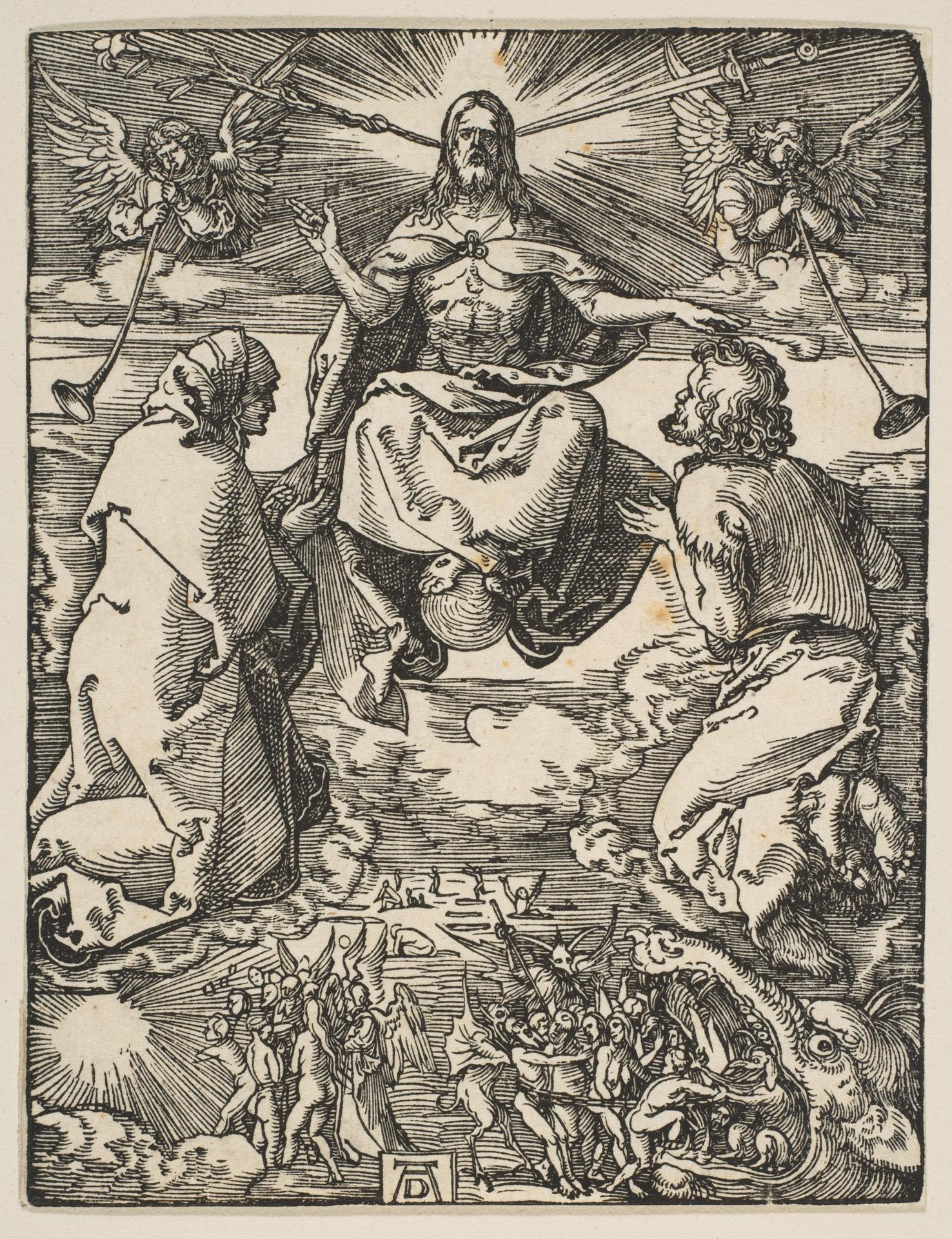
The Last Judgment, from "The Small Passion"
Original title: The Last Judgment, from "The Small Passion"
kurzbeschreibung
Albrecht Dürer's woodcut The Last Judgment belongs to his Small Passion series and was made around 1510. Christ appears as the Judge of the World at the center, flanked by angels and the apostles Peter and Paul; below, the resurrected are separated into the righteous and the damned.
Description
Christ sits enthroned at the center with arms outstretched against a radiant ground, a sign of his divine authority. Beside him stand two figures, likely Peter and Paul, who traditionally act as intercessors in the Last Judgment. Below, a crowd is pushed in different directions—a hint of the separation of the righteous from the wicked. In the lower part of the sheet, further figures appear in combat or pursuit. The layout is strictly symmetrical, with Christ as the unmistakable focal point.
Context
The Small Passion comprises 36 woodcuts that Dürer produced between 1509 and 1511 and that were published as a book in 1511 with Latin texts by Benedict Schwalbe. Intended as a devotional image for a broad, middle-class audience, it did much to spread Dürer's fame beyond his region. In this series, The Last Judgment concludes the history of salvation and takes up the late medieval theological idea of the final separation.
Impact
The clear lines and strong contrast of light and dark give the sheet a dramatic intensity that makes the seriousness of the theme palpable. The symmetrical arrangement and clear hierarchy of figures produce a calm but insistent effect, prompting the viewer to reflect on their own salvation.
Technique
Dürer nutzt feine, parallele Schraffuren und eine differenzierte Strichführung, um den Figuren eine bemerkenswerte Binnenmodellierung und dem Blatt eine nuancierte Lichtwirkung zu geben – ganz ohne Farbe. Gerade die Reduktion auf Schwarz und Weiß schärft so den Kontrast zwischen dem strahlenden Zentrum und den bewegten Figuren darunter.
AI-generated description text
Source: Metropolitan Museum of Art · Public Domain (CC0 1.0)