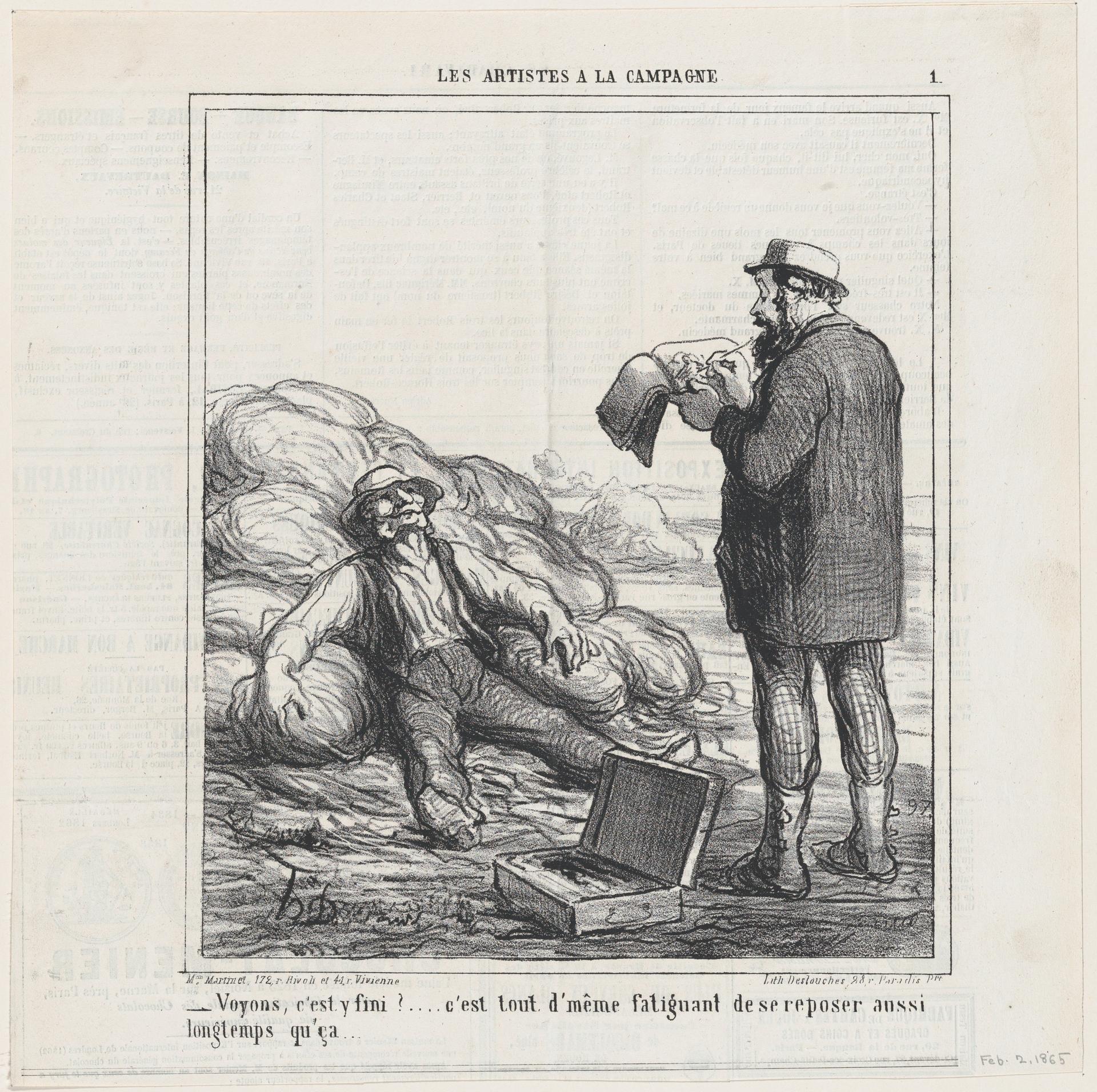
Well, are you finally finished?... after all, it's tiring to relax for such a long time
Original title: Well, are you finally finished?... after all, it's tiring to relax for such a long time, from 'The countryside artists,' published in Le Charivari, February 2, 1865
kurzbeschreibung
Unlike many comparable prints, this 1865 lithograph by Honoré Daumier does not present an idyllic rural scene but instead a two-man encounter: one sits exhausted while the other stands holding a drawing. The work belongs to the series 'Die Landkünstler' (The Country Artists) and appeared in the satirical journal Le Charivari.
Description
An open suitcase lies on the ground; at left a man sits on a pile of straw, wearing a cap, shirt, and trousers. At right a second man, in a coat and checked trousers, presents a sketch. More straw piles and a flat landscape form the backdrop. The clear outlines of the figures and their directed gazes emphasize the conversation. Below the scene, a French quotation introduces the dialogue.
Context
For the satirical newspaper Le Charivari, Daumier created the series 'Die Landkünstler', in which he lampooned artists' comportment in the countryside. During this period he regularly caricatured social types and professions. The series plays on the often ironic contrast between artistic ambition and rural reality.
Impact
By juxtaposing the seated man's exhaustion with the standing man's presentation, the image creates an amused distance from the artist's profession. The spare line work and clear layout draw attention to the interaction between the two figures, reinforced by the ironic caption.
Technique
Lithography on newsprint, indicating inexpensive reproduction for publication in Le Charivari. The black-and-white execution uses fine hatching and contrasts to render textures such as straw and clothing. The printing plate allowed precise reproduction of details and the quotation.
AI-generated description text
Source: Metropolitan Museum of Art · Public Domain (CC0 1.0)