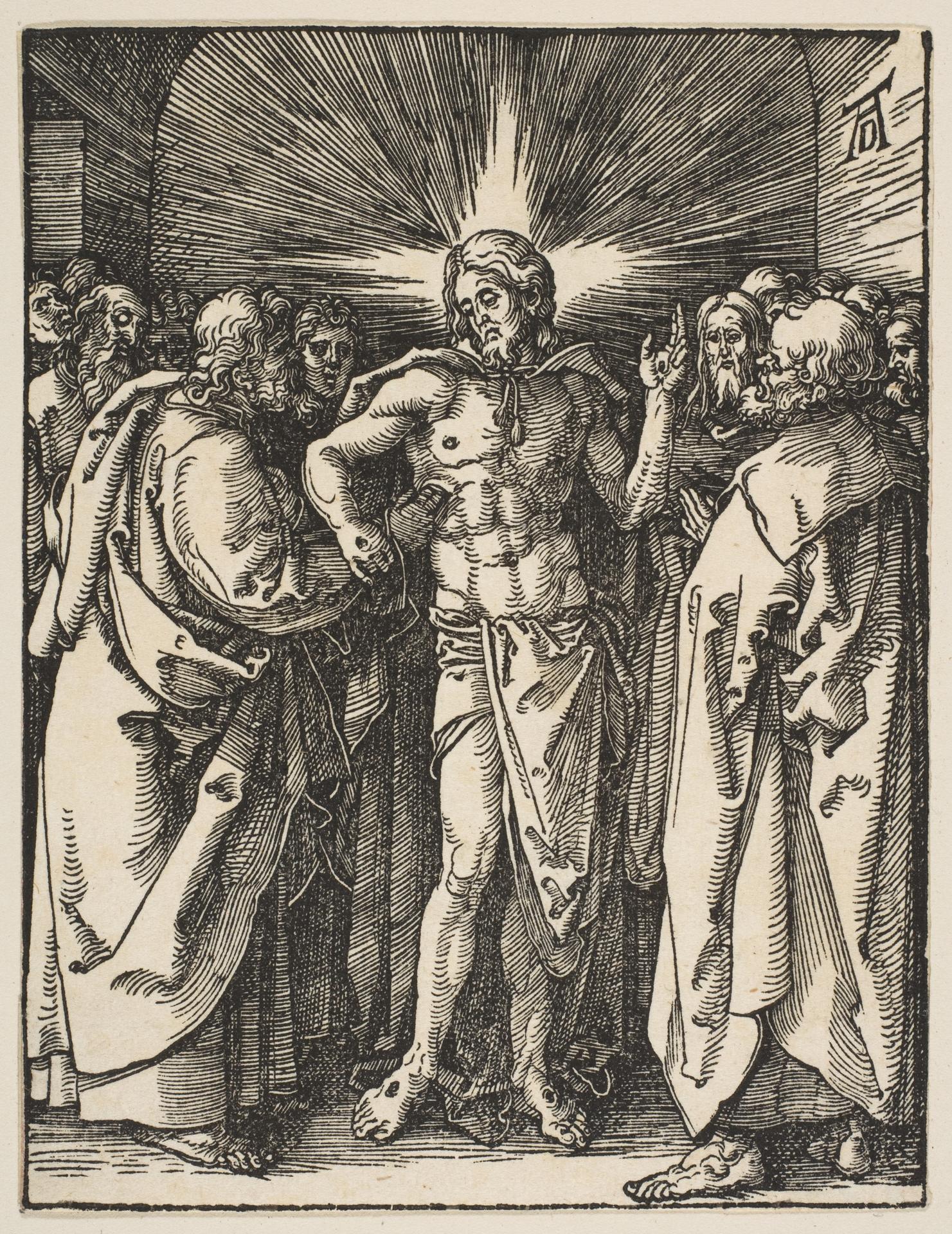
The Doubting Thomas, from "The Small Passion"
Original title: The Doubting Thomas, from "The Small Passion"
kurzbeschreibung
Around 1510, this sheet was made for Albrecht Dürer's 'Little Passion,' a series of images published in 1511. The woodcut, titled 'The Unbelieving Thomas,' presents Jesus Christ, marked by a rayed crown, showing his wounds to the apostles. Executed in black and white, the image focuses on the community of disciples around the risen Christ.
Description
Jesus wears a rayed crown, is barefoot, and dressed in a simple tunic that leaves his arms and chest uncovered. His left arm is raised, while the index finger of his right hand points to his own chest—an iconographic sign of resurrection. The apostles, in traditional garments, stand clustered around him; some look toward him, others turn away. The figures form a crowded, symmetrical group from which Jesus emerges as the center. Precise lines and shading create various gray values; light appears to fall from above onto the contours.
Context
Between 1509 and 1511, the 'Little Passion' was created with 37 woodcuts depicting Christ's suffering and resurrection. Dürer worked on it in Nuremberg, where he had returned after his second Italian journey in 1507. In 1511, the woodcuts appeared together with Latin texts by the poet Benedictus Chelidonius; they were aimed at a broad, educated audience.
Impact
The strict symmetry and central placement of Jesus give the image a solemn calm. The detailed linework directs the gaze to the gestures and interaction of the figures, thereby conveying the theological message of resurrection directly.
Technique
The image was printed from a woodblock in which the light areas were left uncut and the dark lines remained as raised ridges. Dryer used fine parallel hatching and cross-hatching to model volume and shadow. With a block size of about 12.7 x 2.1 centimeters, the sheet is exceptionally small and demonstrates the high precision of the printing.
AI-generated description text
Source: Metropolitan Museum of Art · Public Domain (CC0 1.0)