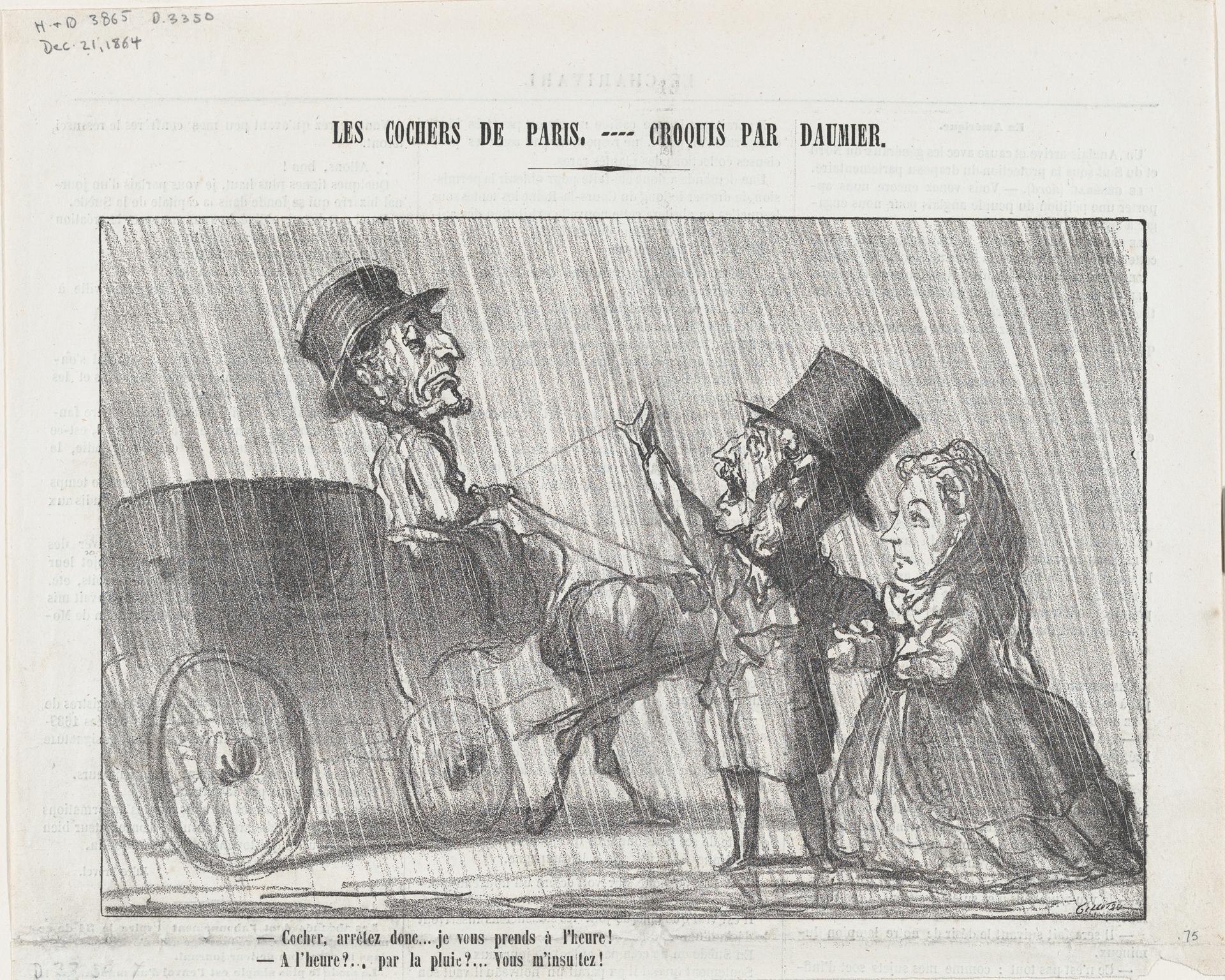
Driver, Stop, I will hire you and pay you by the hour!
Original title: Driver, Stop, I will hire you and pay you by the hour!, from 'The coachmen in Paris,' published in Le Charivari, December 21, 1864
kurzbeschreibung
Honoré Daumier made this lithograph in 1864 as part of the series Les Cochers de Paris. Two passengers flag down a cab driver and try to bring him to a halt. Le Charivari published the sheet on 21 December 1864. It was printed as a lithograph on newsprint, in the third of three states.
Description
A cabbie in a top hat sits on the horse harnessed to his carriage. Facing him stand a man in an overcoat and top hat and a woman in a long skirt and dress; both appear to be urging him to stop. Black and white throughout, the image relies on heavy shading and parallel hatching to suggest falling rain. The arrangement feels restless and draws the eye to the encounter between the figures, with Daumier's caricatural hand plainly on show.
Context
This lithograph appeared within Les Cochers de Paris, a series that satirized the conduct of cab drivers in the French capital. Le Charivari was an influential satirical journal in which Daumier regularly published political and social caricatures. At the time, horse-drawn vehicles dominated public transport in Paris, and drivers had a reputation as a stubborn lot, often the butt of criticism and mockery.
Impact
Clean outlines and the figures' expressive faces give the print an immediate, comic punch. The hatching brings the rainy scene to life and conveys a frantic slice of everyday life that invites a smile. Daumier's caricature pairs situational comedy with close observation of the urban milieu, which lends the sheet an enduring vividness.
Technique
The work was printed as a lithograph on newsprint, a process common for satirical prints in the nineteenth century. The drawing was set down on the lithographic stone with greasy chalk and then transferred to paper, producing the delicate lines and shading. The third state may carry revisions over earlier states that strengthened the contrasts.
AI-generated description text
Source: Metropolitan Museum of Art · Public Domain (CC0 1.0)