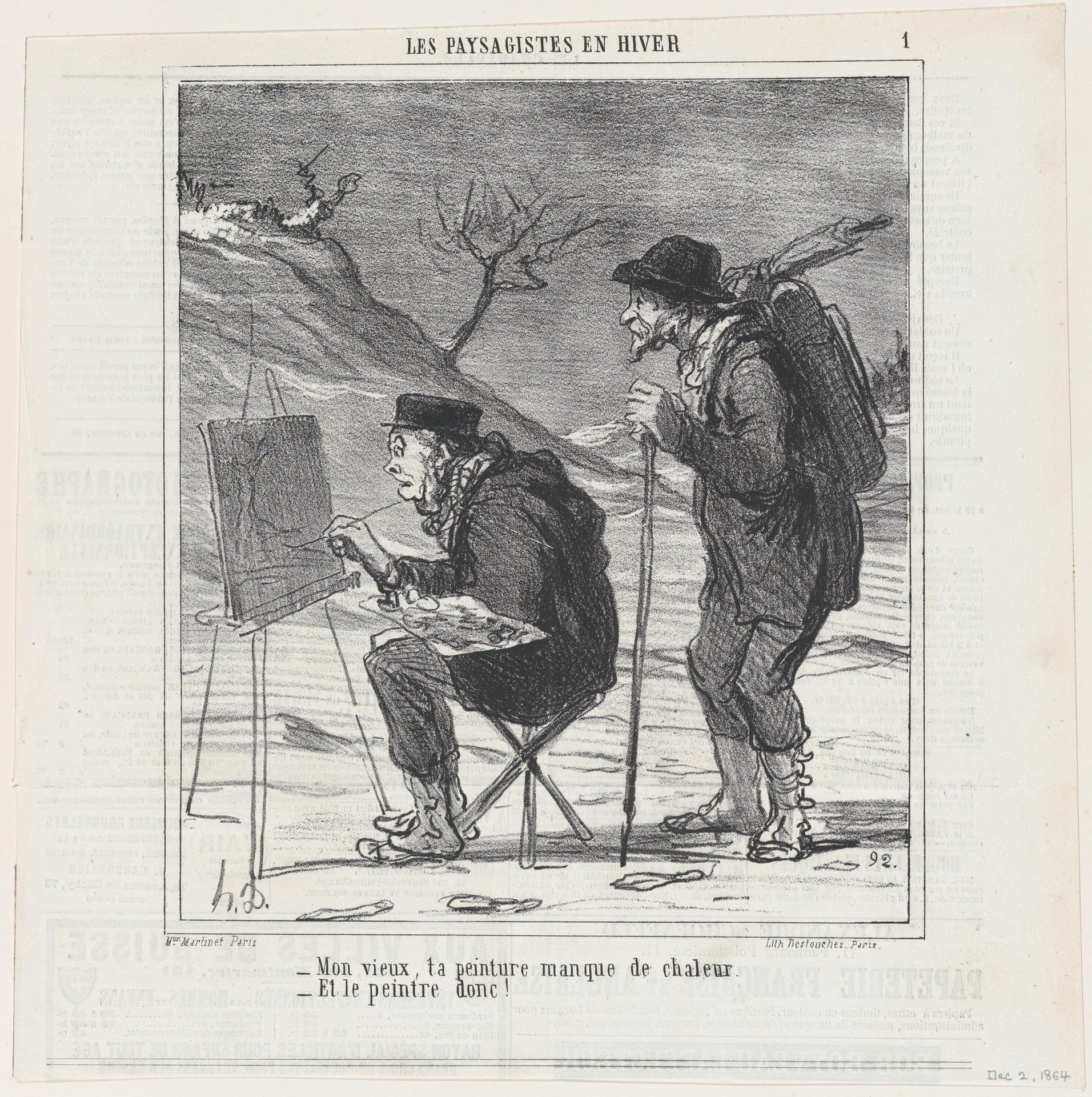
Old fellow, your painting lacks warmth, and the painter to be sure!
Original title: Old fellow, your painting lacks warmth, and the painter to be sure!, from 'The winter landscape painters,' published in Le Charivari, December 6, 1864
kurzbeschreibung
Honoré Daumier's 1864 lithograph sets a painter at his easel beside a standing critic in a snowy landscape, where the viewer complains that the picture lacks warmth. The print appeared in the satirical journal Le Charivari.
Description
At left a painter sits on a folding stool before his easel, jacket and cap keeping out the cold, his palette resting on his lap. Facing him at right stands a second man with a walking stick, likewise in jacket and cap, plus knapsack and trousers, sizing up the painter. Bare trees and a hill form the backdrop of this wintry setting. The whole view stays black and white, as lithographs do, with two lines of French dialogue inserted beneath the figures.
Context
Daumier made this sheet for the series 'The Winter Landscape Painters,' and it ran in Le Charivari. With it he took on the contemporary art scene and its often contradictory reviews. This is the second state of two (Delteil), printed on newsprint; the date of December 6, 1864 places it in Daumier's later years.
Impact
The exaggerated figures and the pointed line of dialogue produce a comic effect that invites a smile. Ironic, too, that the wintry chill should meet the charge that the painting lacks warmth, which sharpens the satire. Plain line and a pared-down layout draw the eye to the exchange between the two men.
Technique
Lithography on newsprint, a common process for caricature in the nineteenth century. The drawing went onto the stone in greasy chalk and was then transferred to paper, yielding fine lines and broad areas alike. Black-and-white printing brings out the high-contrast rendering of figures and landscape.
AI-generated description text
Source: Metropolitan Museum of Art · Public Domain (CC0 1.0)