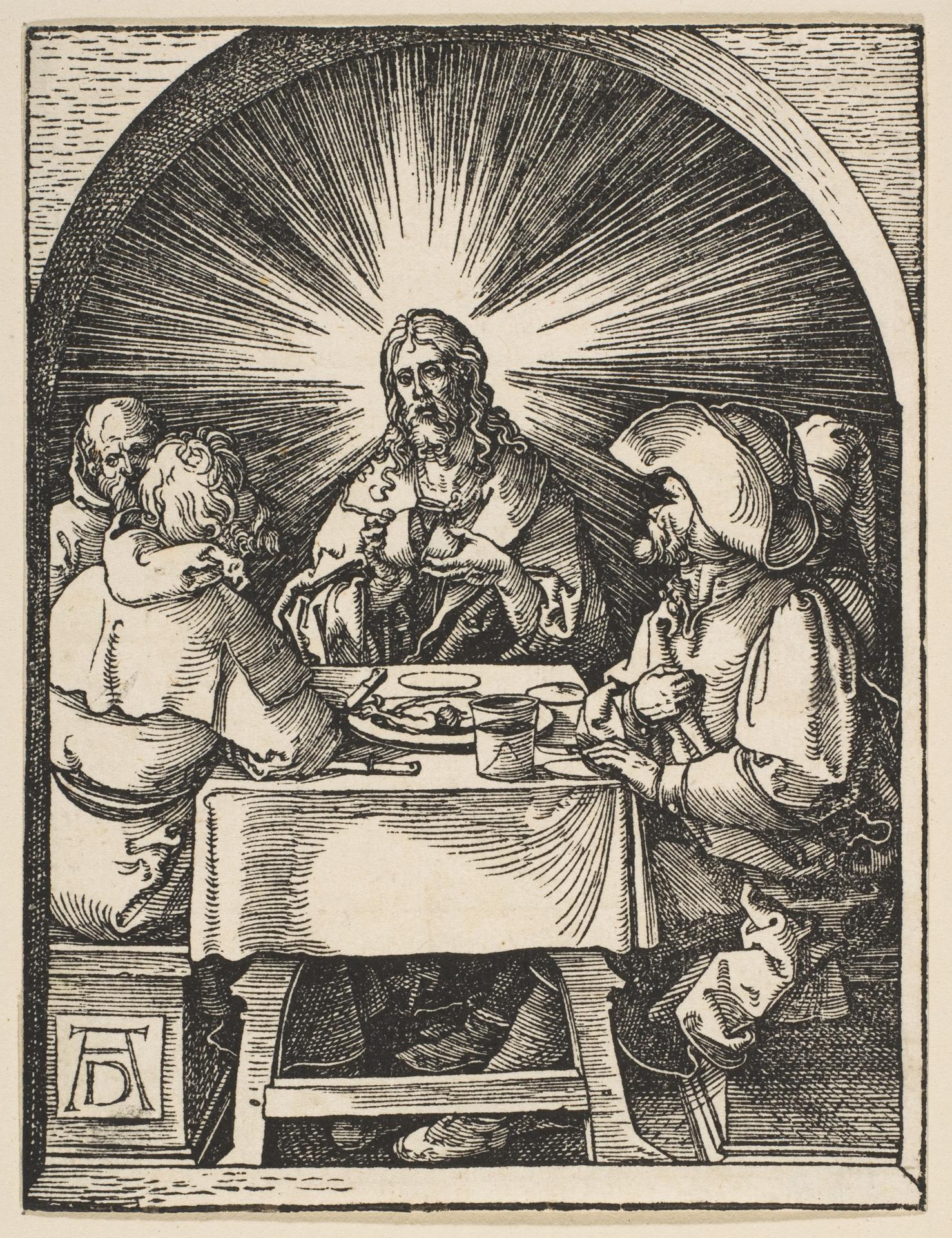
Christ in Emmaus, from "The Small Passion"
Original title: Christ in Emmaus, from "The Small Passion"
kurzbeschreibung
This woodcut by Albrecht Dürer, dating to around 1510, depicts the scene of Christ in Emmaus from his series 'The Small Passion'. It shows Christ seated at a table with two disciples, who recognize him as he breaks bread. The work is a masterful example of early 16th-century printmaking.
Description
In the center, Christ sits at a table, flanked by two disciples who turn toward him. Rays of light emanate from a point above his head, symbolizing his divine nature. On the table are a plate with food and two cups, rendered with precise line work. The composition is balanced, with the figures arranged symmetrically around Christ. The monochrome woodcut relies on intricate hatching to model forms and create depth.
Context
Dürer created 'The Small Passion' between 1508 and 1511, a series of 36 woodcuts illustrating the life and passion of Christ. This series was intended for a broad audience, as woodcuts were relatively inexpensive to produce and could be widely distributed. The scene of Emmaus is based on the Gospel of Luke, where the resurrected Christ reveals himself to two disciples. Dürer's work reflects the growing interest in religious imagery during the Northern Renaissance.
Impact
The composition draws the viewer's eye to Christ, whose central position and radiating light create a focal point of spiritual significance. The detailed linework and careful shading give the scene a sense of gravity and reverence. The simplicity of the monochrome palette enhances the narrative clarity, making the moment of recognition both intimate and profound.
Technique
This woodcut is printed from a single carved block, with lines cut into the surface to create the image. Dürer's technique involves fine, varied hatching to suggest volume, texture, and light. The use of white space and dense line clusters demonstrates his mastery of the medium, allowing for subtle tonal gradations in a monochrome print.
AI-generated description text
Source: Metropolitan Museum of Art · Public domain (CC0)