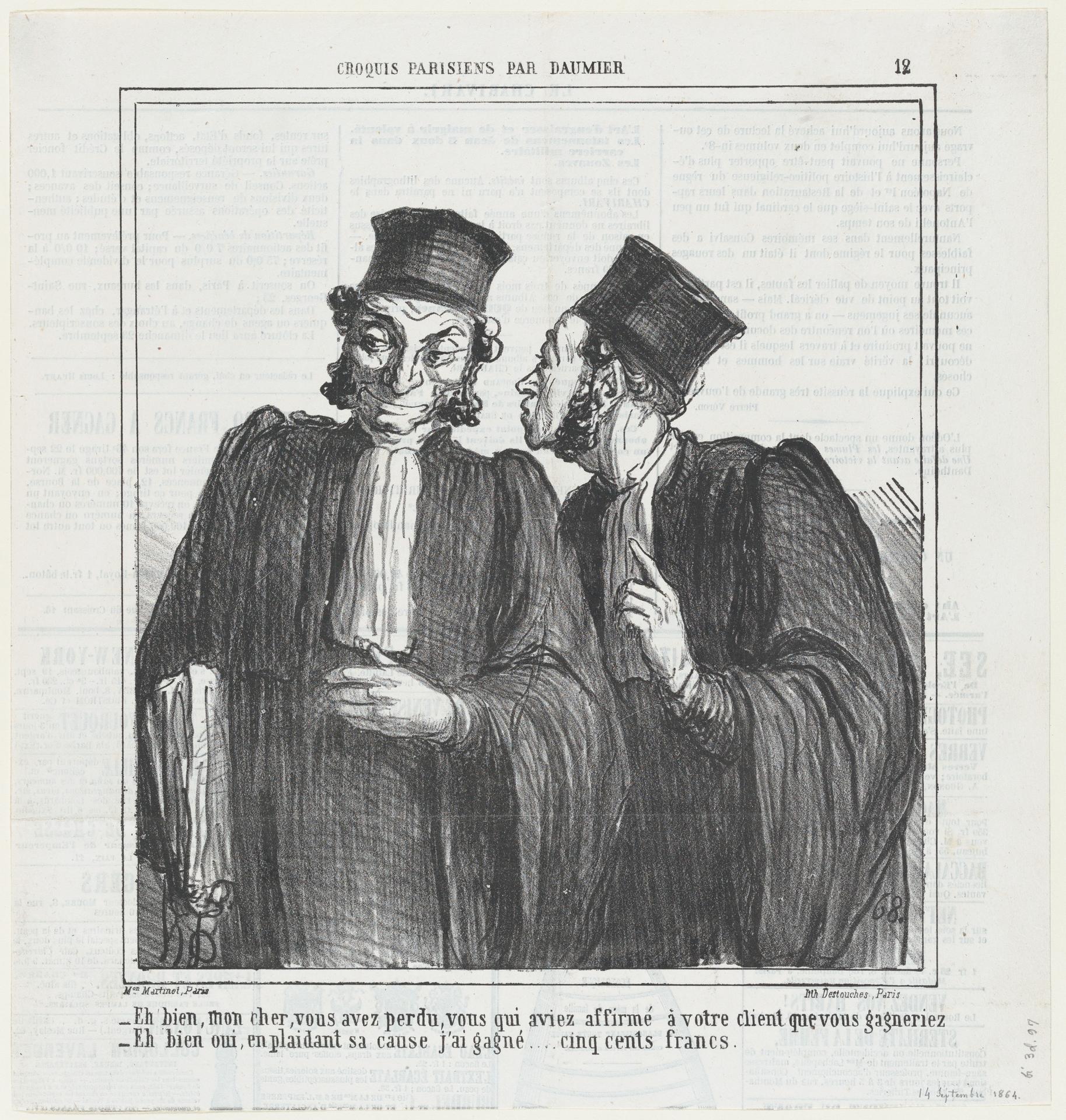
Well my friend, it seems you have lost..., from 'Parisian sketches,' published in Le Charivari, September 14, 1864
Original title: Well my friend, it seems you have lost..., from 'Parisian sketches,' published in Le Charivari, September 14, 1864
kurzbeschreibung
One man points a finger at another, who stands holding a document in his hands. Honoré Daumier drew this lithograph in 1864; it belongs to the series 'Parisian Sketches' and appeared in 'Le Charivari' on September 14, 1864.
Description
An outstretched index finger governs the picture: the man on the right, in a suit and hat, points at his opposite number, a gesture that spells confrontation. The man being addressed holds a paper and seems to listen. Both wear dark jackets and white shirts. A plain background lets the figures stand out. The scene is black and white, caricatured and exaggerated.
Context
This print was made for the satirical magazine 'Le Charivari', where Daumier regularly commented on political and social matters. The series 'Parisian Sketches' portrayed everyday scenes and types of Parisian society. The lithograph appeared on September 14, 1864 and survives in the second state of two printings. Daumier was known for his sharp eye and pointed rendering of social interactions.
Impact
Clearly laid out, with the expressive gesture of the man on the right, the print pulls the viewer straight into the tense situation. One wonders what the conversation is about. The caricatural exaggeration gives the scene a humorous touch, typical of Daumier's style.
Technique
Drawn on stone with greasy chalk and then printed, this is a lithograph on newsprint. Such paper was usual for satirical prints of the period, being cheap and allowing rapid distribution. The second printing state reproduces the revised version of the lithograph.
AI-generated description text
Source: Metropolitan Museum of Art · Public Domain (CC0 1.0)