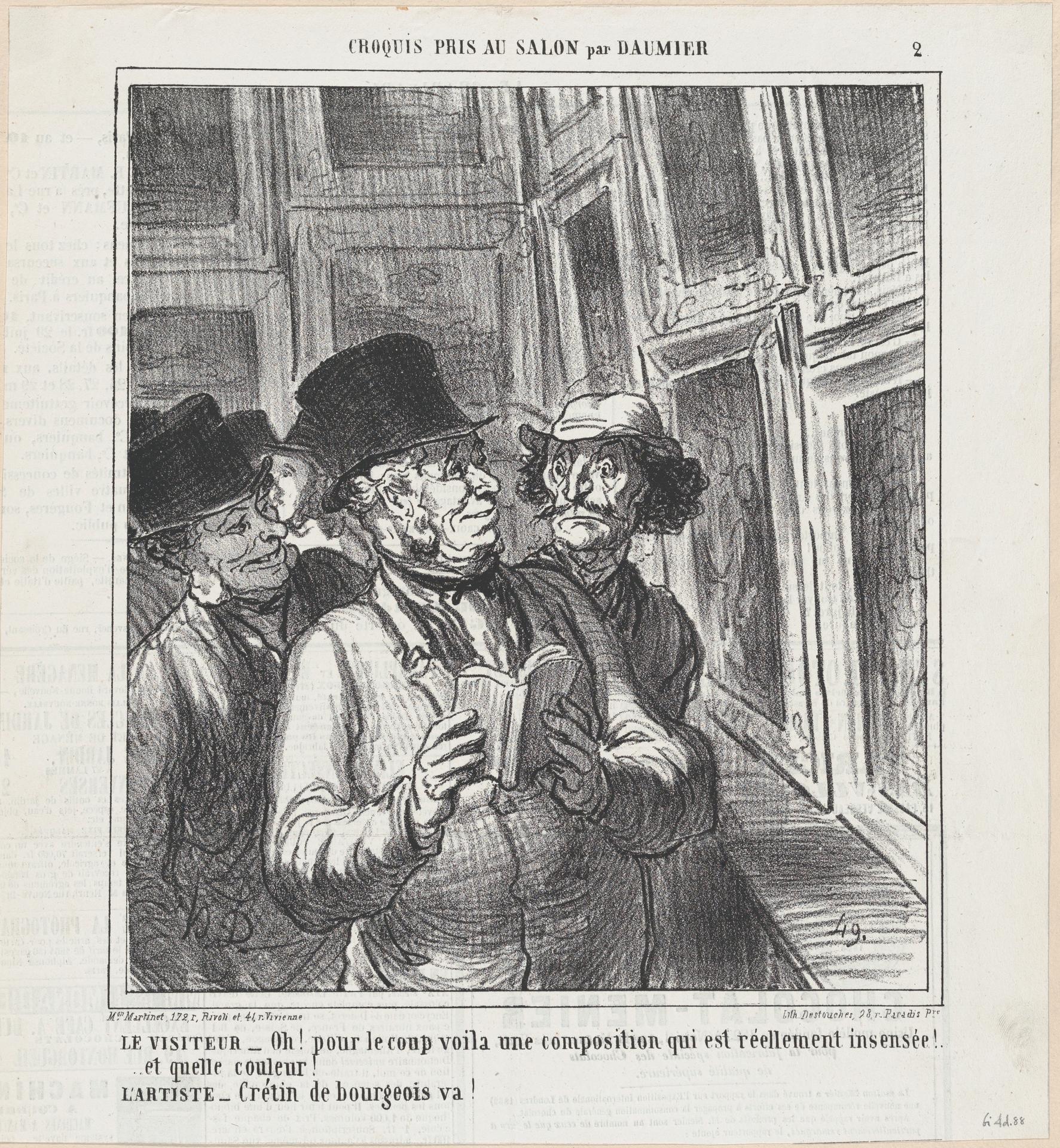
The visitor and the artist, from 'Sketches from the Salon,' published in Le Charivari, May 30, 1864
Original title: The visitor and the artist, from 'Sketches from the Salon,' published in Le Charivari, May 30, 1864
kurzbeschreibung
Honoré Daumier's lithograph 'Der Besucher und der Künstler' (The Visitor and the Artist) appeared on May 30, 1864, in the journal 'Le Charivari'. Part of the series 'Sketches from the Salon', it presents a comic encounter between a Salon visitor and a painter. The print was made on newsprint.
Description
Two figures command the interior, likely a salon or gallery: in front, a man with a book in hand speaks to his counterpart; to the right, a figure with a startled, worried expression. Behind them, other people appear, their reactions divided. The layout draws the eye toward the exchange between the two main figures. Even, shadowless light defines the view, typical of lithographs of this kind.
Context
Daumier made this print for the satirical journal 'Le Charivari', which regularly published caricatures on social themes. In the series 'Sketches from the Salon', he targeted the Paris art exhibitions, which were major social events. At the time, the official Salon was firmly controlled by the Académie des Beaux-Arts. From a bourgeois perspective, Daumier often criticized the art world and its public.
Impact
The exaggerated encounter between art lover and artist, with overblown expressions and gestures, brings a smile to the viewer. The humorous, caricatural tone arises from this heightening of an everyday situation. The black-and-white of the lithograph is clear and high-contrast, focusing attention on the figures.
Technique
The drawing was made with a greasy crayon on limestone, from which the print was taken. According to Delteil's catalogue raisonné, this is the second of two states. For publication in 'Le Charivari', newsprint was the usual material, allowing mass distribution.
AI-generated description text
Source: Metropolitan Museum of Art · Public Domain (CC0 1.0)