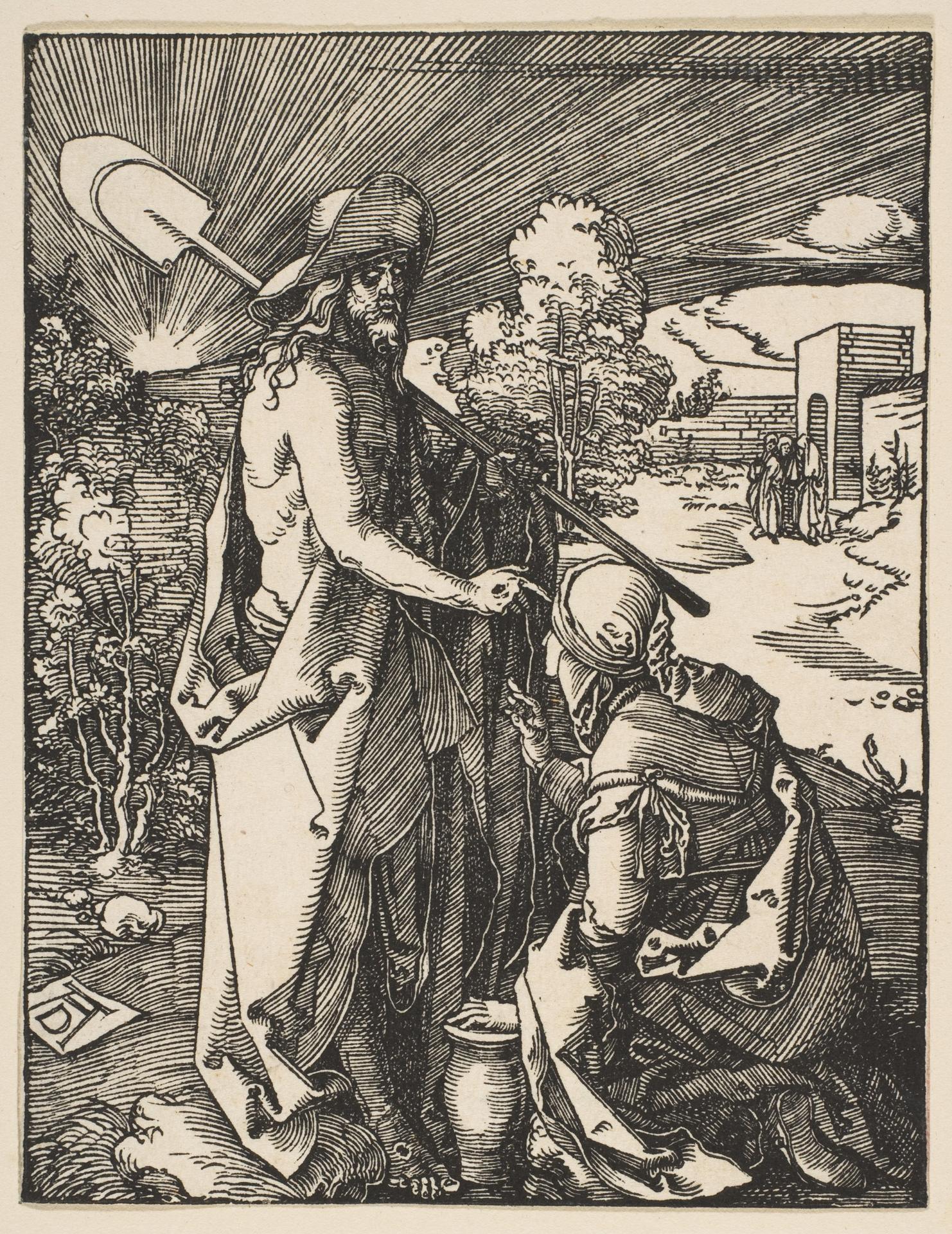
Christ Appearing to Mary Magdalen, from "The Small Passion"
Original title: Christ Appearing to Mary Magdalen, from "The Small Passion"
kurzbeschreibung
This woodcut by Albrecht Dürer, dated around 1510, is part of his series "The Small Passion." It depicts the moment Christ appears to Mary Magdalene after his resurrection, a key scene from the Gospels. The composition focuses on the encounter between the two figures, set in a landscape with architectural elements.
Description
In the foreground, Christ stands on the left, dressed in simple robes and a hat, holding a shovel in his right hand. He gestures toward Mary Magdalene, who kneels on the right, her head covered with a shawl and holding a small vessel. Her posture and raised hands convey surprise and awe. Rays of light emanate from Christ, suggesting divine presence, while in the background, trees, a building, and distant figures frame the scene. The woodcut is monochrome, with sharp, detailed lines typical of Dürer's printmaking.
Context
Dürer created "The Small Passion" between 1509 and 1511, a series of 37 woodcuts illustrating the life and suffering of Christ. This particular scene follows the biblical account in John 20, where Mary Magdalene encounters Jesus in the garden, mistaking him for a gardener. The series was widely circulated and contributed to Dürer's reputation as a master of printmaking. The work reflects the late medieval devotional focus on Christ's Passion and resurrection.
Impact
The image captures a moment of intimate revelation, balancing the divine and the human. The kneeling Mary Magdalene and the calm, authoritative Christ create a dynamic of awe and recognition. The stark black-and-white contrast and intricate linework draw the viewer into the emotional depth of the scene.
Technique
Dürer used the woodcut technique, carving the design into a wooden block, inking it, and transferring it to paper. The medium allows for bold contrasts and fine details, visible in the textures of clothing, foliage, and architecture. The monochromatic print relies entirely on line and shading to convey form and atmosphere.
AI-generated description text
Source: Metropolitan Museum of Art · Public domain (CC0)