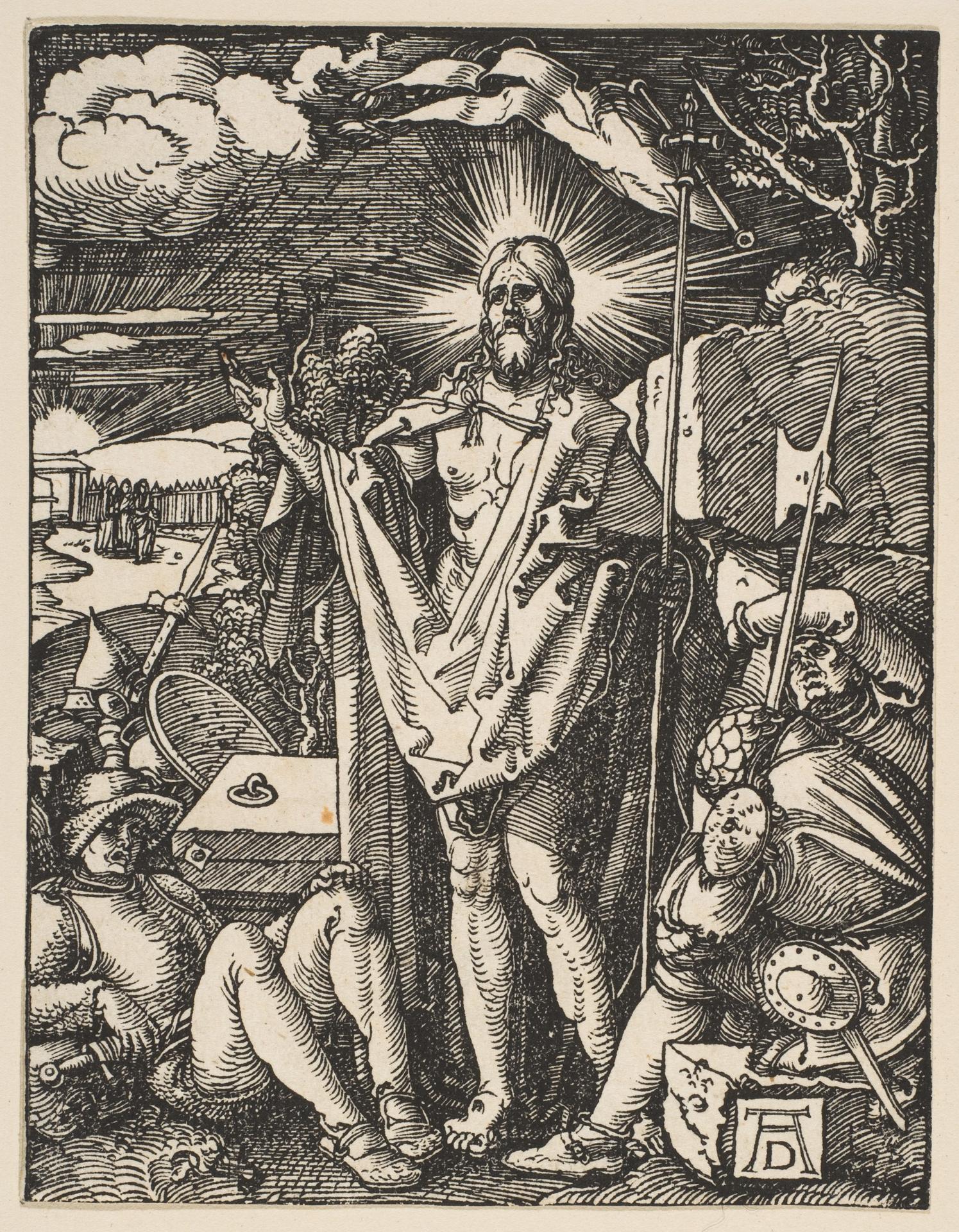
The Resurrection, from "The Little Passion"
Original title: The Resurrection, from "The Little Passion"
kurzbeschreibung
This woodcut by Albrecht Dürer, dating to around 1510, depicts the Resurrection of Christ as part of his renowned series "The Little Passion." Christ rises triumphantly, surrounded by a radiant halo and flanked by angels and adoring soldiers, set against a detailed landscape with a cemetery.
Description
At the center, Christ stands upright in a flowing robe, his face encircled by a luminous halo, holding a banner in his right hand and gazing upward. To his left, soldiers kneel in worship, while an angel holding a crown stands behind them; on the right, more soldiers bow in reverence. The background shows a landscape with clouds and a cemetery, and the overall composition is symmetrical, drawing the eye to Christ. The woodcut uses monochrome shading to define the textures of garments and hands, with light falling from above to emphasize Christ's divinity.
Context
Dürer created "The Little Passion" between 1508 and 1510, a series of 37 woodcuts illustrating the life and suffering of Christ, which was published in 1511. The series was highly popular for its compact size and accessibility, making it a commercial success across Europe. This woodcut reflects the late Gothic and early Renaissance interest in expressive detail and emotional narrative, showcasing Dürer's mastery as a printmaker.
Impact
The image conveys a sense of divine triumph and solemnity, with Christ's upward gaze and radiant halo creating a focal point of spiritual awe. The orderly composition and detailed rendering of the soldiers' gestures evoke both reverence and wonder, drawing the viewer into the miraculous moment.
Technique
Dürer employed the woodcut technique, carving the design into a wooden block, inking it, and printing it onto paper. The use of fine, varied line work and cross-hatching creates depth and texture, typical of his mature printmaking style. The monochromatic palette relies on the contrast between black ink and paper to model form and light.
AI-generated description text
Source: Metropolitan Museum of Art · Public domain (CC0)