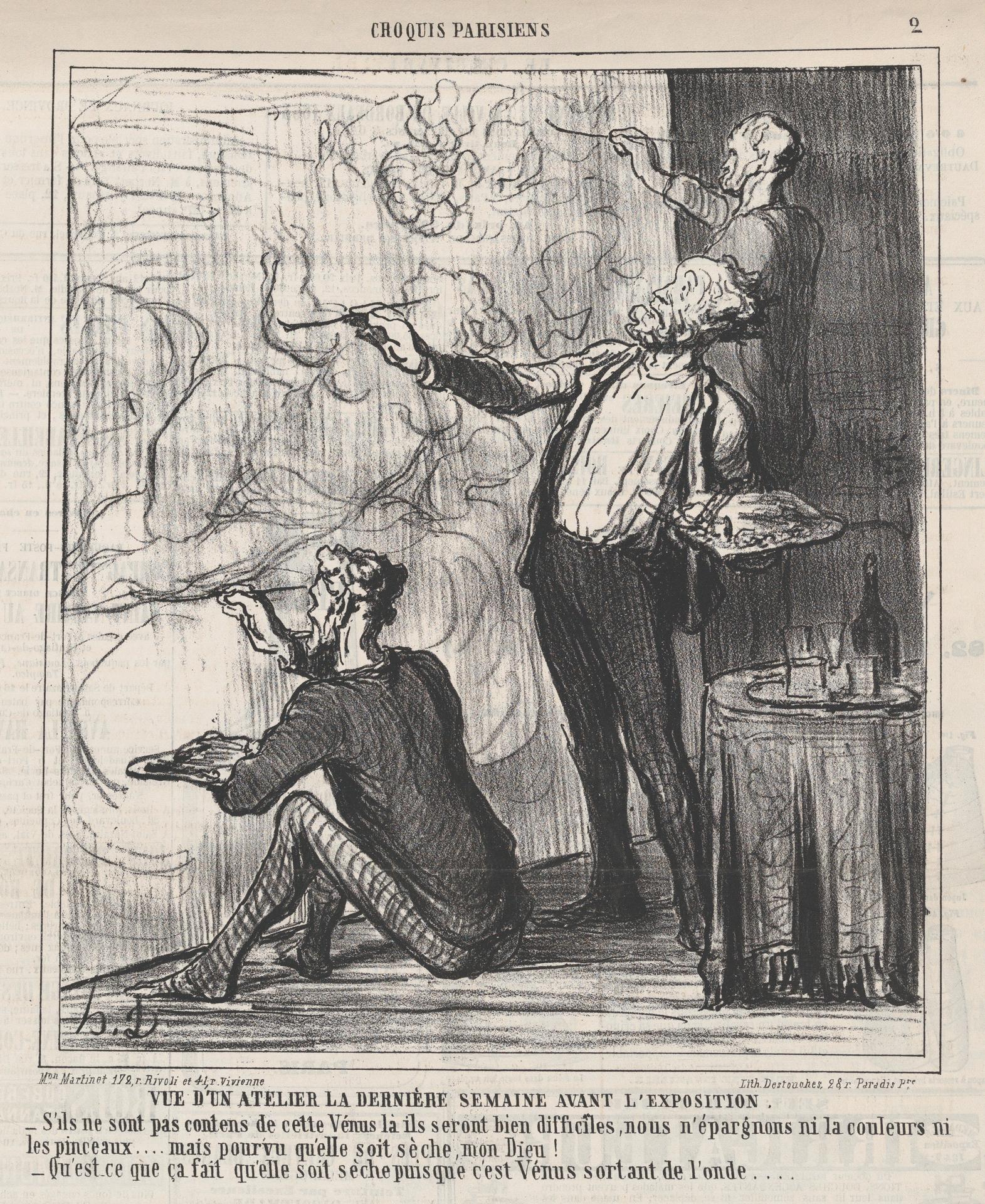
View of a studio the final week before the exhibition, from 'Parisian sketches,' published in Le Charivari, April 1, 1864
Original title: View of a studio the final week before the exhibition, from 'Parisian sketches,' published in Le Charivari, April 1, 1864
kurzbeschreibung
Honoré Daumier made this lithograph in 1864, offering a look inside a studio during the days just before an exhibition. Three people are at work on a painting of a Venus rising from the water. The print belongs to the series 'Parisian Sketches' and appeared in the satirical journal Le Charivari.
Description
Three figures cluster around a large painting in a studio. Two are seated and painting, a third stands; all hold brushes and palettes. The canvas on the easel depicts a Venus emerging from the sea. Sketches hang on the wall, and to the right a bottle, a glass and a palette sit on a table. The arrangement feels restless: the figures face different directions yet stay tied to the painting. Light falling from the front picks out the people and the picture.
Context
Daumier drew this lithograph for the 'Parisian Sketches' series, published in Le Charivari. The series poked fun at Parisian art life, above all the preparations for the annual Salon, the official art exhibition. The final week before it was a time of intense work and bustle, which Daumier records with irony. Publication on 1 April 1864 fell on April Fool's Day in France, heightening the satirical tone.
Impact
Lively and humorous, the print captures the concentrated, almost feverish mood of the studio. The black-and-white drawing, with its clear lines and restless poses, gives the scene something immediate, verging on caricature. The viewer is drawn into the action and senses the satire aimed at the art world.
Technique
Daumier used lithography: a greasy crayon is drawn on a stone, from which the image is then printed. This impression is on newsprint, which explains its role as part of a magazine publication. It is the second state of two, as recorded by Delteil.
AI-generated description text
Source: Metropolitan Museum of Art · Public Domain (CC0 1.0)