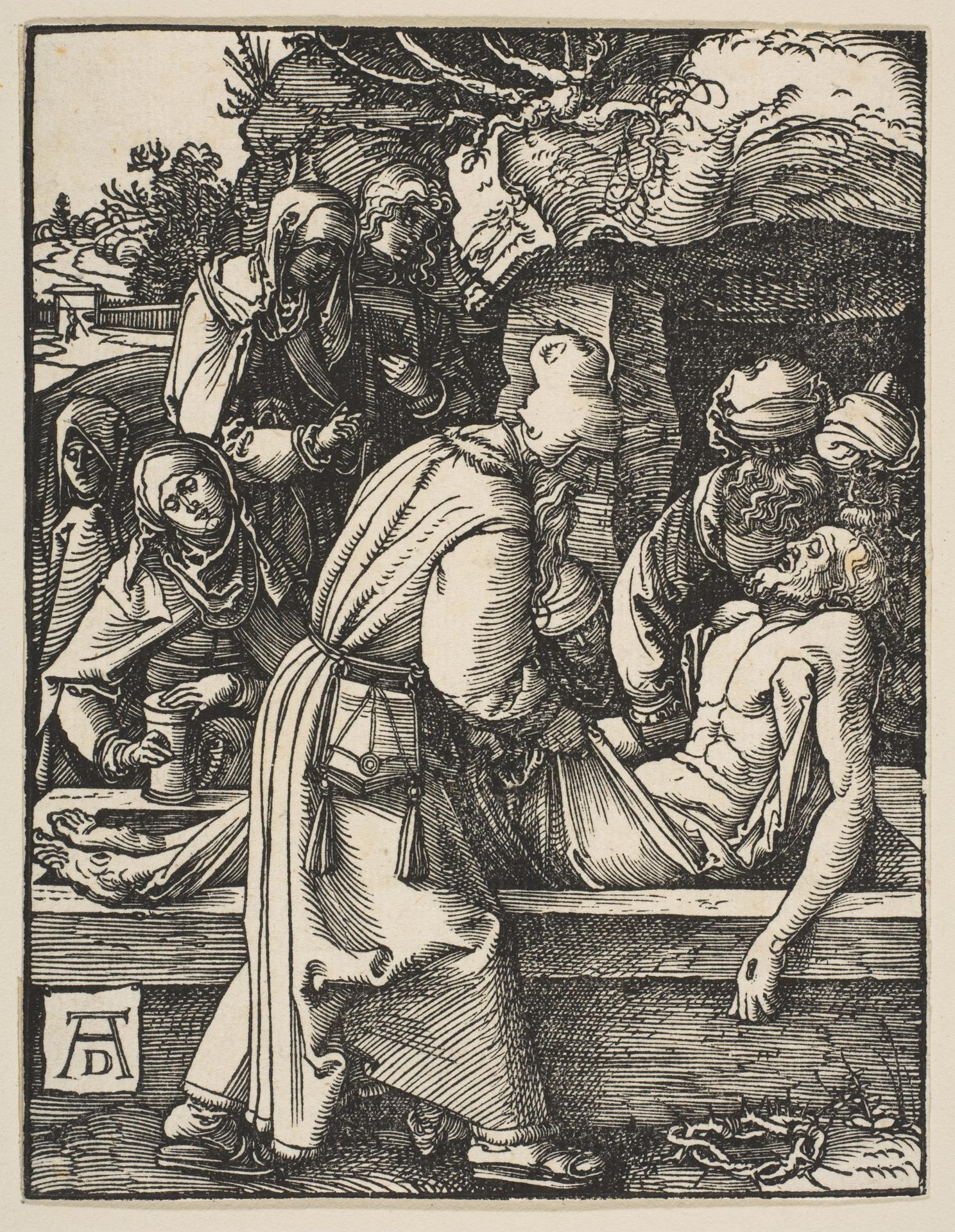
The Deposition, from "The Small Passion"
Original title: The Deposition, from "The Small Passion"
kurzbeschreibung
Albrecht Dürer's woodcut 'The Deposition' from 'The Small Passion' (ca. 1509) depicts the lowering of Christ's body from the cross. The scene is centered on Christ laid on a table, surrounded by mourners including Joseph of Arimathea and Mary Magdalene. This print is part of a series of 37 woodcuts illustrating the Passion of Christ.
Description
The composition is symmetrical, with Christ's body as the central focal point, lying horizontally on a stone table. Joseph of Arimathea, in the middle, supports Christ's feet, while Mary Magdalene holds a vessel, possibly for anointing. In the background, additional figures, including a woman with a child, observe the scene. The figures wear traditional robes, and the monochrome woodcut uses varied line density to create tonal depth and a sense of volume.
Context
Dürer created 'The Small Passion' between 1508 and 1509, a series of woodcuts intended for a broad audience, reflecting the growing demand for affordable religious imagery. The series was published as a book in 1511, with Latin verses by Benedictus Chelidonius. Dürer's woodcuts were highly influential, demonstrating the medium's potential for intricate detail and dramatic narrative.
Impact
The print conveys a solemn, contemplative mood through the restrained poses and the careful arrangement of figures around Christ. The dense cross-hatching and varied line weights give the scene a sense of depth and texture, drawing the viewer into the intimate moment of mourning. The composition balances grief with a quiet dignity, characteristic of Dürer's Passion scenes.
Technique
This is a woodcut, a relief printing technique where the image is carved into a wooden block, inked, and pressed onto paper. Dürer's mastery is evident in the fine, expressive lines and the use of parallel hatching to model forms and suggest shadow. The print is monochrome, relying solely on line and texture to create visual richness.
AI-generated description text
Source: Metropolitan Museum of Art · Public domain (CC0)