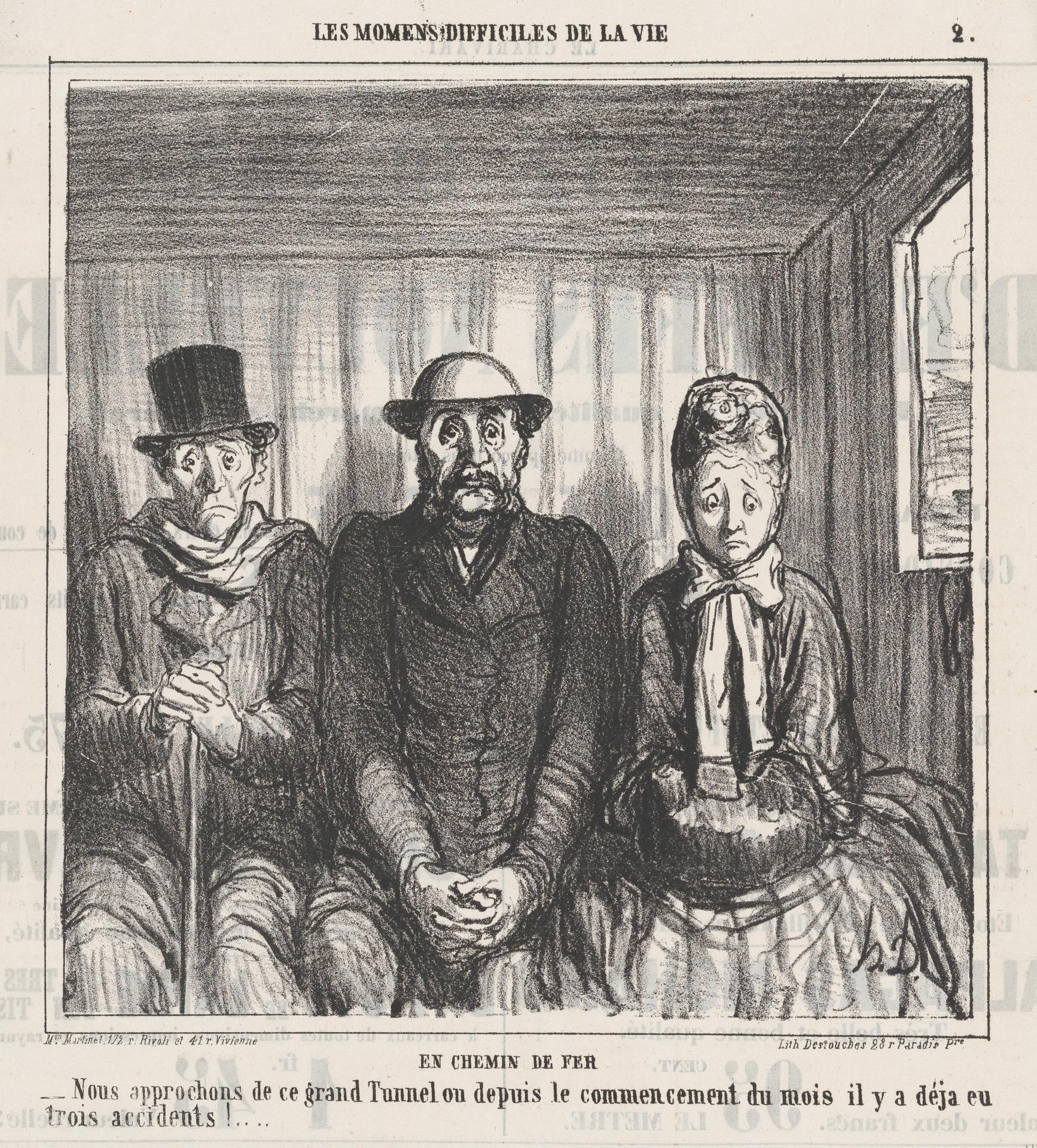
On the train, from 'The difficult moments of life,' published in Le Charivari, March 12, 1864
Original title: On the train, from 'The difficult moments of life,' published in Le Charivari, March 12, 1864
kurzbeschreibung
Honoré Daumier's lithograph 'Im Zug' (In the Train), dated 12 March 1864, shows three travellers in a railway compartment. The print belongs to the series 'Les Moments Difficiles de la Vie' and appeared in the journal Le Charivari. It is executed as a lithograph on newsprint, in the second of two states according to Delteil.
Description
Three people sit facing one another: on the left a man in a top hat and jacket, in the middle someone with a hat and jacket, on the right a person wearing an apron and headscarf. Their expressions betray discomfort, even fear. A curtained window and a section of wall form the background. Along the bottom edge runs a French text alluding to the approaching long tunnel, in which three accidents have already occurred that month. Black-and-white tonal values and frontal light bring the faces into focus.
Context
For the satirical newspaper Le Charivari, Daumier devised the series 'Les Moments Difficiles de la Vie', in which he took aim at social and political grievances. The sheet is dated 12 March 1864, during a phase of rapid expansion of the French railway, when train accidents were not uncommon. Daumier thus took up the everyday fears of travellers, a theme also present in contemporary pictorial journalism. Delteil's catalogue raisonné lists the copy as the second state.
Impact
A tense, almost oppressive mood arises, carried by the worried faces and the reference to the tunnel. The caricatural exaggeration of emotions lets the travellers' fear be experienced directly. At the same time, the black-and-white lithograph oscillates between documentary sobriety and satirical pointedness.
Technique
Lithography on newsprint: the drawing is applied to the stone with greasy chalk and then printed. Daumier used the process for quick, precise lines and nuanced gradations that bring out the figures' facial expressions. The restriction to black and white corresponds to the appearance of nineteenth-century newspaper lithographs.
AI-generated description text
Source: Metropolitan Museum of Art · Public Domain (CC0 1.0)