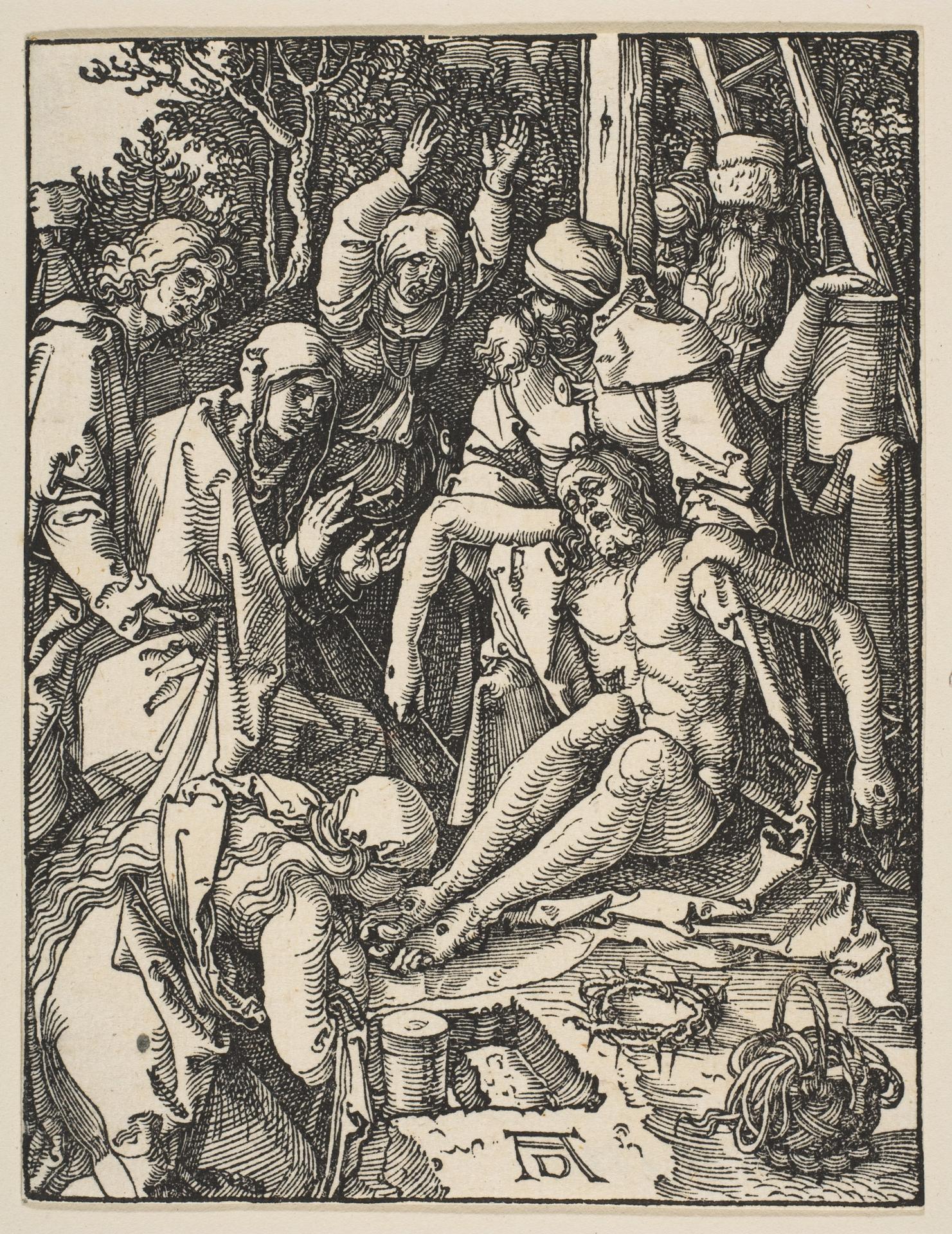
The Lamentation, from "The Small Passion"
Original title: The Lamentation, from "The Small Passion"
kurzbeschreibung
Albrecht Dürer's woodcut 'The Lamentation' (ca. 1509) depicts the mourning of Christ's body after the Crucifixion. Part of the 'Small Passion' series, it is a masterful example of Renaissance printmaking, rendered in stark black and white.
Description
The composition centers on the lifeless body of Christ, reclining in the foreground, surrounded by a group of mourners. Their expressive gestures—raised arms, clasped hands, and bowed heads—convey deep sorrow. In the background, a landscape with trees and a building sets the scene, while the figures' flowing robes and the intricate linework create a sense of movement and texture.
Context
This woodcut belongs to Dürer's 'Small Passion,' a series of 37 prints illustrating the life and suffering of Christ, published in 1511. Dürer, a leading figure of the Northern Renaissance, revolutionized printmaking with his technical skill and artistic innovation. The series was highly popular and widely distributed, making religious imagery accessible to a broader audience.
Impact
The image evokes a profound sense of grief and solemnity through its dramatic poses and dense, expressive lines. Dürer's mastery of light and shadow, achieved purely through line work, gives the scene a striking depth and emotional intensity that draws the viewer into the moment of mourning.
Technique
This is a woodcut, a relief printing technique where the image is carved into a wooden block, inked, and pressed onto paper. Dürer's precise and varied line work—from fine hatching to bold contours—creates tonal variation and texture without the use of color. The print is monochromatic, relying on the contrast between black ink and white paper.
AI-generated description text
Source: Metropolitan Museum of Art · Public domain (CC0)