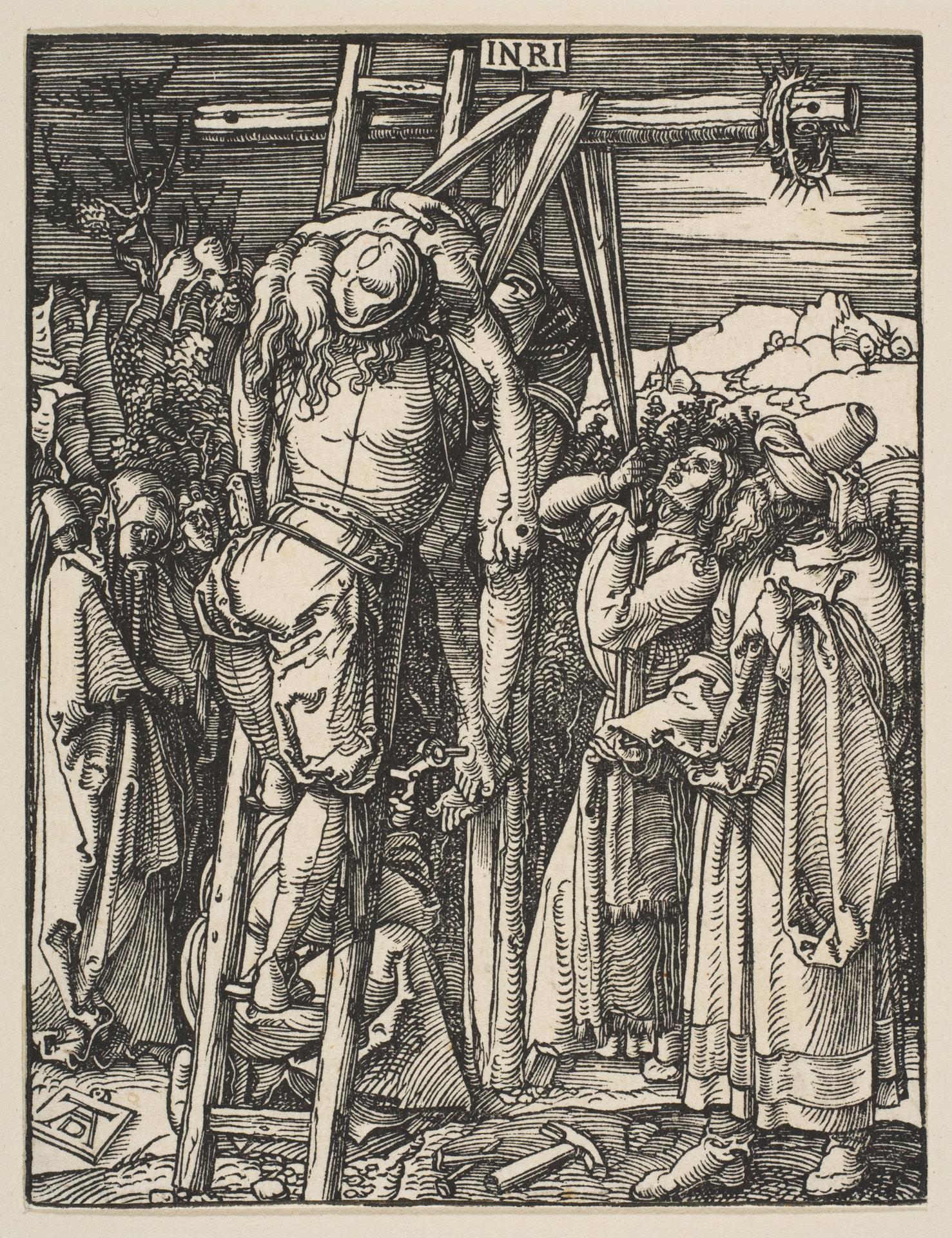
The Descent from the Cross, from "The Small Passion"
Original title: The Descent from the Cross, from "The Small Passion"
kurzbeschreibung
This woodcut by Albrecht Dürer, created around 1509, depicts the Descent from the Cross, part of his series "The Small Passion." The scene shows Christ being lowered from the cross, aided by a woman and surrounded by other figures in traditional attire. The print is a masterful example of Dürer's detailed linework and Renaissance composition.
Description
In the center, Christ's body hangs limply from the cross, his arms bound and his head bowed in suffering. A woman beside him supports his weight, while other figures in the background carry tools and attend to the scene. The cross bears the inscription 'INRI' at the top. The composition is balanced, with Christ as the focal point and figures flanking him on both sides. The black-and-white woodcut uses fine hatching and shading to create depth and texture.
Context
Dürer created "The Small Passion" between 1508 and 1510, a series of 36 woodcuts illustrating the Passion of Christ. This print was part of a popular devotional book that made religious imagery accessible to a broader audience. Dürer was a master of the woodcut technique, elevating it to a fine art form during the Northern Renaissance.
Impact
The image conveys a profound sense of grief and solemnity, drawing the viewer into the emotional weight of the moment. Dürer's precise lines and balanced composition lend the scene a quiet dignity, making it both a devotional and artistic masterpiece.
Technique
This work is a woodcut, a relief printing technique where the image is carved into a wooden block, inked, and pressed onto paper. Dürer's skill in engraving allows for intricate details and subtle tonal variations, achieved through cross-hatching and parallel lines. The use of black ink on white paper creates a stark, dramatic contrast that emphasizes the emotional intensity of the scene.
AI-generated description text
Source: Metropolitan Museum of Art · Public domain (CC0)