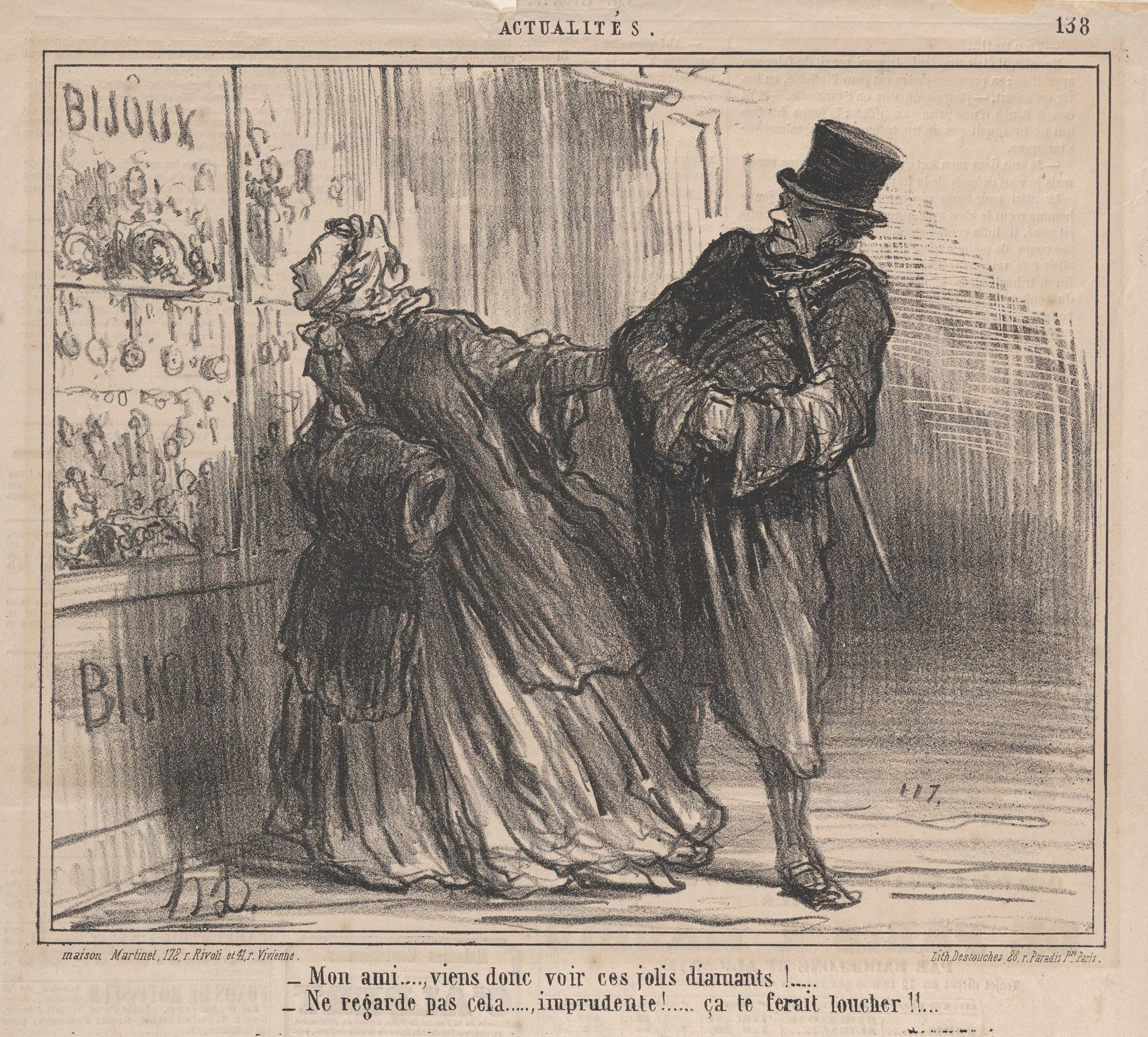
My dear, come and have a look at these beautiful diamonds!, from 'News of the Day,' published in Le Charivari, January 20, 1860
Original title: My dear, come and have a look at these beautiful diamonds!, from 'News of the Day,' published in Le Charivari, January 20, 1860
kurzbeschreibung
Unlike many genre scenes of its time, this 1860 lithograph by Honoré Daumier takes place not in a salon but right outside a jeweler's window. The print belongs to the series 'News of the Day' and was published in the satirical journal Le Charivari. What unfolds is an everyday encounter, pointedly told with a social undertone.
Description
A couple has stationed themselves in front of a jewelry shop. The woman, in a long flowing dress and scarf, gestures animatedly at the display, while the man beside her—in a top hat, coat, and carrying a cane—looks rather uneasy. Behind them, the shop windows with their jewelry are visible. The whole remains in black and white, as was usual for lithographs of those years. A French dialogue between the figures fills the lower edge. The drawing is sharply caricatural and aimed at comedy.
Context
The sheet was published on January 20, 1860, in Le Charivari, the French satirical journal for which Daumier drew regularly. It is part of the series 'News of the Day,' which took up daily events and social issues. The artist was known for his critical eye on the bourgeoisie and the social contrasts of 19th-century Paris.
Impact
The contrast between the woman's enthusiasm and the man's worry gives the print a comic touch that also prompts reflection. Viewers may smile at consumer behavior and the dynamics of a couple's relationship. Through this lighthearted tone, the social critique remains accessible.
Technique
The print was produced as a lithograph on newsprint—a common process for satirical prints at the time. The present impression is the second state of two (according to Delteil). The drawing was likely done with chalk on the stone, allowing fine lines and graded shading.
AI-generated description text
Source: Metropolitan Museum of Art · Public Domain (CC0 1.0)