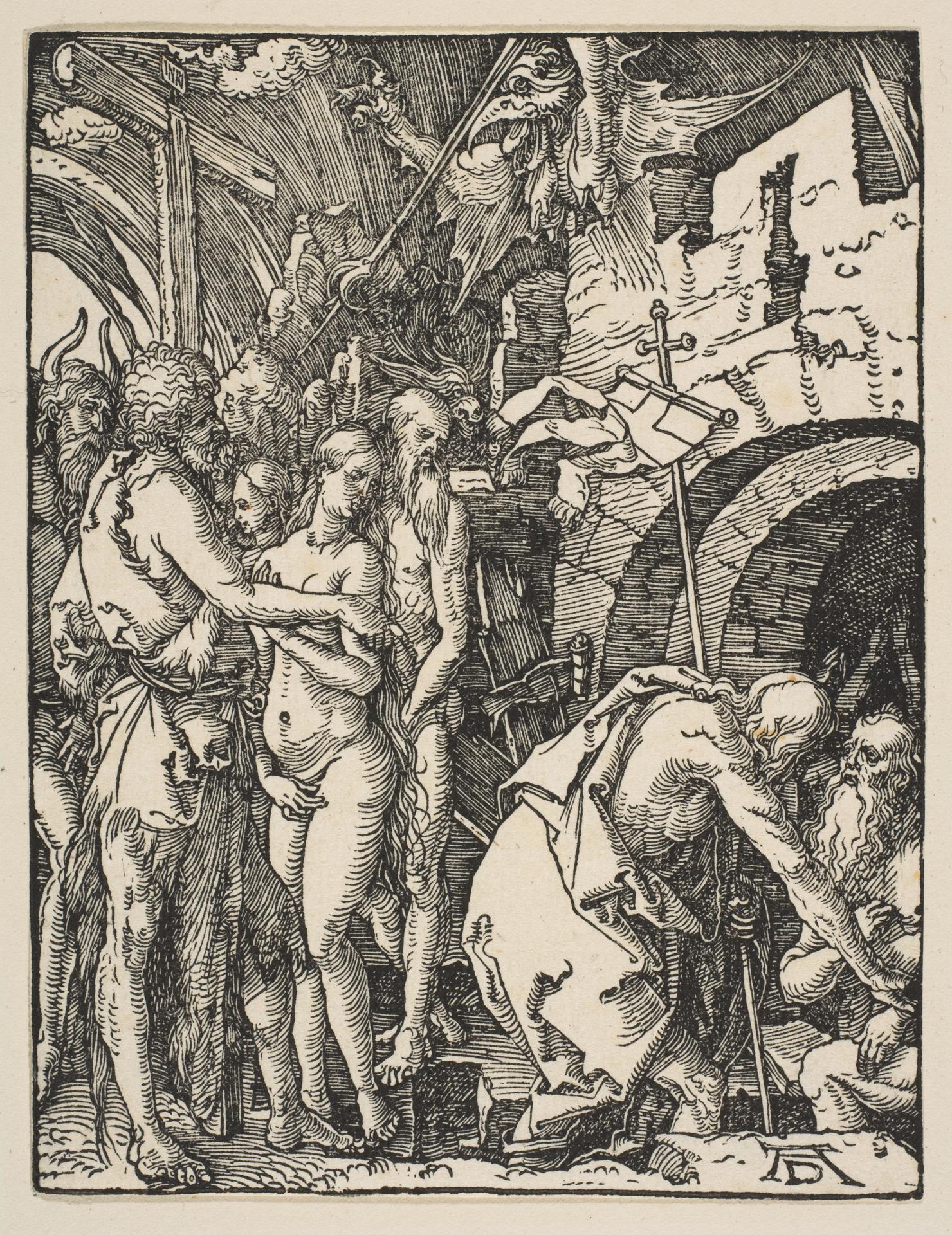
Christ in Limbo, from "The Small Passion"
Original title: Christ in Limbo, from "The Small Passion"
kurzbeschreibung
This woodcut by Albrecht Dürer, dating to about 1509, depicts Christ in Limbo, a scene from the Small Passion series. The composition shows the nude Christ seated on a rock, surrounded by figures including devils and a kneeling saint. It is a masterful example of Dürer's graphic work in the early 16th century.
Description
At the center, Christ sits nude on a large stone, his body rendered with fine, expressive lines. To the left, two devilish figures, one with horns and a tail, gesture toward him, while to the right a kneeling figure, possibly Saint Jerome, bows with his head in his hands. In the background, additional figures, including angels and demons, emerge from the shadowy space. The composition is strongly vertical, with Christ as the focal point, and the dense cross-hatching creates dramatic contrasts of light and dark.
Context
The Small Passion is a series of 37 woodcuts by Dürer, published in 1511, depicting scenes from the life and passion of Christ. This particular scene illustrates the Harrowing of Hell, a subject popular in late medieval theology, though not directly from the Bible. Dürer's woodcuts were highly influential, and the series was widely circulated, contributing to his reputation across Europe.
Impact
The image conveys a sense of solemn triumph, as Christ's calm pose contrasts with the agitated devils around him. The intricate linework draws the viewer's eye to the central figure, creating a focus of spiritual authority. The stark black-and-white palette enhances the dramatic tension, making the scene both intimate and monumental.
Technique
This is a woodcut, a relief printing technique where the image is carved into a wooden block, inked, and pressed onto paper. Dürer's skill in woodcut is evident in the fine, varied linework and the use of cross-hatching to achieve tonal depth. The print is in black and white, a limitation of the medium that Dürer exploited to create striking chiaroscuro effects.
AI-generated description text
Source: Metropolitan Museum of Art · Public domain (CC0)