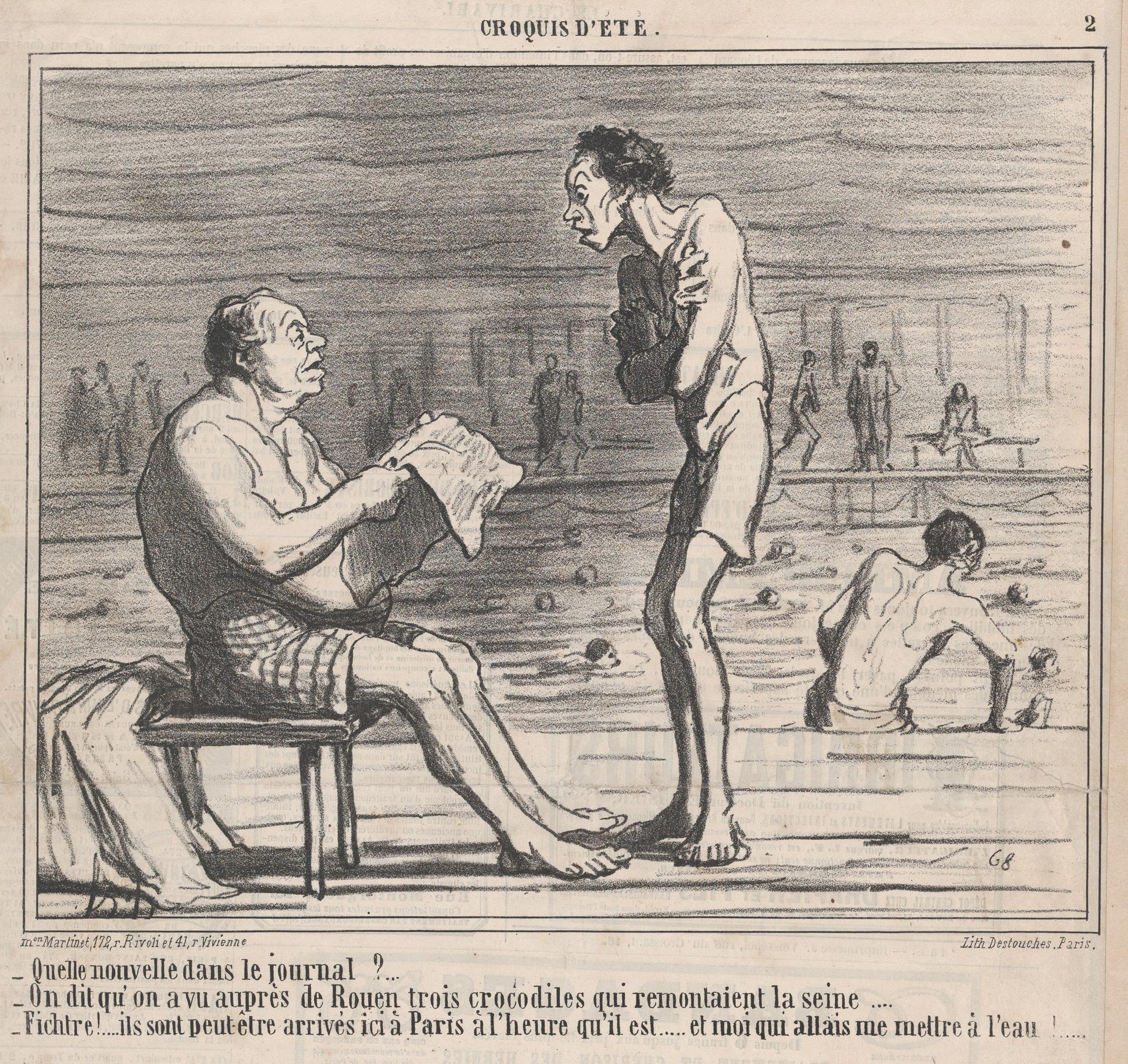
Quelle nouvelle dans le journal?...., from Croquis d'Été, published in Le Charivari, August 5, 1859
Original title: Quelle nouvelle dans le journal?...., from Croquis d'Été, published in Le Charivari, August 5, 1859
kurzbeschreibung
Honoré Daumier contributed this light-hearted bathing scene to his 'Croquis d'Été', and the lithograph appeared in Le Charivari on 5 August 1859. Two men occupy the foreground, one of them busy with a newspaper, while more bathers surface behind them.
Description
A man in shirt and trousers has settled down at the front and reads his paper; facing him stands a companion dressed only in a shirt, arms folded, evidently holding forth. The layout stretches out broadly and horizontally, kept in black and white. Graded ink tones and lines of varying weight produce the shading typical of lithographs from those years.
Context
Daumier made this sheet for the satirical journal Le Charivari, which printed it on 5 August 1859. Within the 'Croquis d'Été' series he drew on everyday summer observations, casting a mocking sideways glance at the urban bourgeoisie. The open-air bathing motif points to bathing culture, which was only just developing in nineteenth-century Paris.
Impact
The caricature comes alive and turns funny above all through the contrasting postures of the two men. One smiles at an ordinary conversation held in an unusual place. Clear contours and a spare visual language give the print a direct, immediate effect.
Technique
The work was executed as a lithograph on newsprint, in the second state according to Delteil. This printing method could capture fine hatching and soft tonal values, which benefits the caricature. Printing was done on thin, acidic paper, as was typical for newspaper supplements of the period.
AI-generated description text
Source: Metropolitan Museum of Art · Public Domain (CC0 1.0)