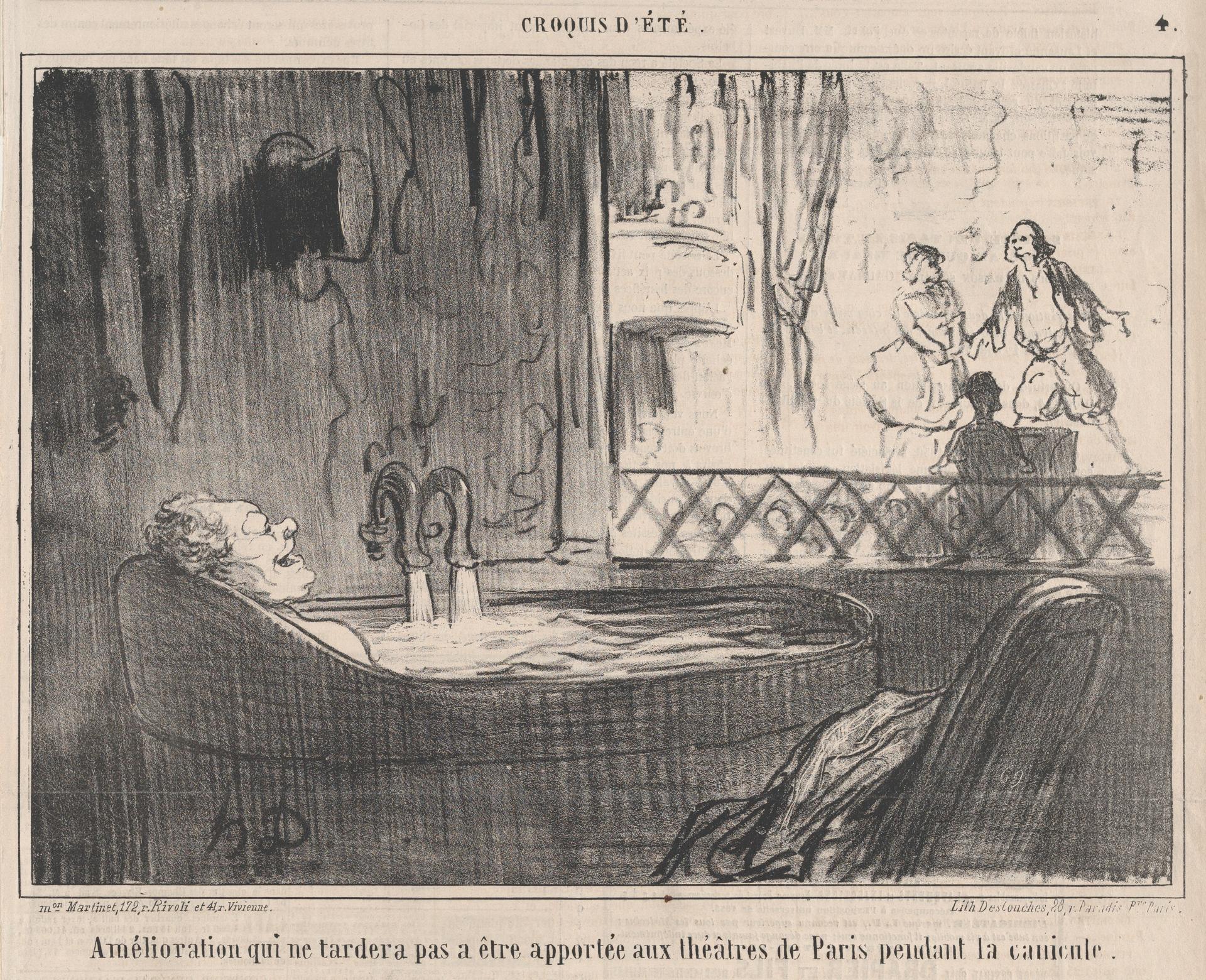
Amélioration qui ne tardera pas a être apportée aux théâtres de Paris pendant la canicule.
Original title: Amélioration qui ne tardera pas a être apportée aux théâtres de Paris pendant la canicule., from Croquis d'Été, published in Le Charivari, August 16-17, 1859
kurzbeschreibung
Honoré Daumier took up the oppressive summer heat in Paris in 1859 and contributed this lithograph to his series 'Croquis d'Été'. A figure in a bathtub is seen, flanked by two other people. The print appeared on newsprint, in the satirical journal 'Le Charivari'.
Description
In the foreground a figure splashes in the tub, eyelids closed, mouth wide open as if to scream or gasp for air. A towel hangs over a chair beside the bath. On a raised platform behind, two figures in vaguely historical dress stand talking. The layout is asymmetrical, drawing the eye to the bather; the rendering is confined to shades of grey.
Context
The lithograph was published in 'Le Charivari', a journal known for its political and social satire. Daumier had conceived the 'Croquis d'Été' series as a commentary on the summer experiences of Parisians. This sheet refers to the heatwave of August 1859 and alludes to the poor conditions in the theaters of Paris.
Impact
The scene is comic and at the same time prompts reflection, because it demonstrates the absurdity of the summer predicament. Realistic description and exaggerated facial expression combine to give the sheet a caricatural note and elicit a smile from the viewer.
Technique
Daumier worked in lithography: he drew with greasy chalk on a stone, from which the print was then taken on newsprint. The present impression is the second state of two, suggesting the plate was reworked. The grey tones and delicate lines correspond to Daumier's characteristic hand and allow detailed reproduction.
AI-generated description text
Source: Metropolitan Museum of Art · Public Domain (CC0 1.0)