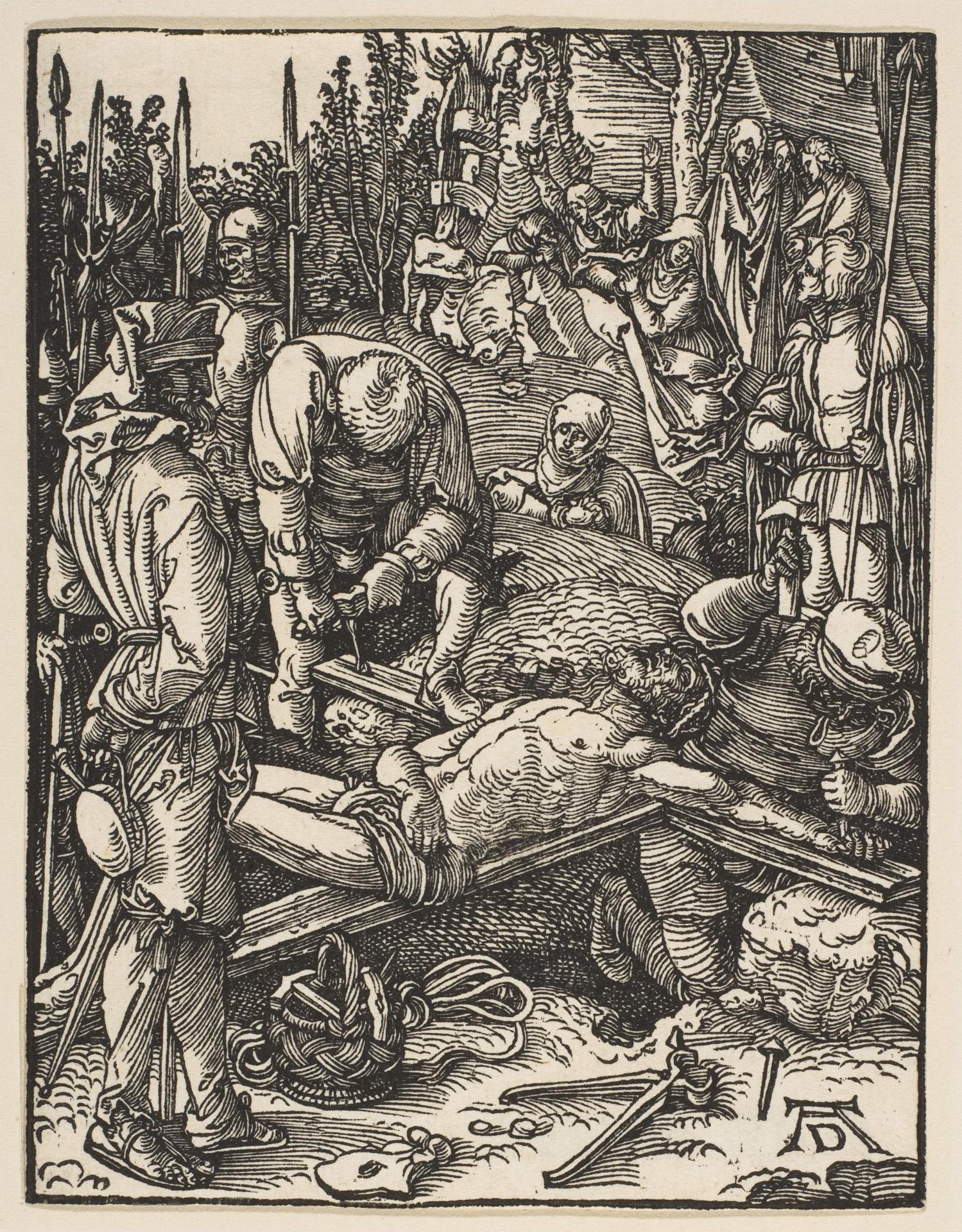
Christ Nailed to the Cross, from "The Small Passion"
Original title: Christ Nailed to the Cross, from "The Small Passion"
kurzbeschreibung
This woodcut by Albrecht Dürer, created around 1509, depicts the moment Christ is nailed to the cross. It is part of the artist's renowned series 'The Small Passion,' which illustrates the Passion of Christ. The scene is dense with figures, including soldiers and onlookers, set against a landscape.
Description
The composition centers on Christ, whose body is stretched horizontally across the cross, his arms extended and his form contorted in suffering. Surrounding him are soldiers bearing weapons and other figures who either pray or observe the event. In the background, trees and additional figures populate the scene, adding depth. The woodcut is monochrome, with strong lines and cross-hatching creating shadows and defining the forms.
Context
Dürer created 'The Small Passion' between 1507 and 1512, a series of 37 woodcuts that was published as a book in 1511. This particular woodcut was designed around 1509, during a period when Dürer was at the height of his printmaking career in Nuremberg. The series was intended for a broad audience, making the Passion narrative accessible through affordable prints.
Impact
The image conveys a raw, visceral intensity, capturing the physical agony of the crucifixion with unflinching detail. The crowded composition and the varied reactions of the figures draw the viewer into the drama, while the precise lines give the scene a sense of immediacy and gravity.
Technique
Dürer used the woodcut technique, carving the design into a wooden block, inking it, and pressing it onto paper. The sharp, precise lines and the use of cross-hatching demonstrate his mastery of the medium, allowing for subtle tonal variations and a high level of detail despite the monochrome nature of the print.
AI-generated description text
Source: Metropolitan Museum of Art · Public domain (CC0)