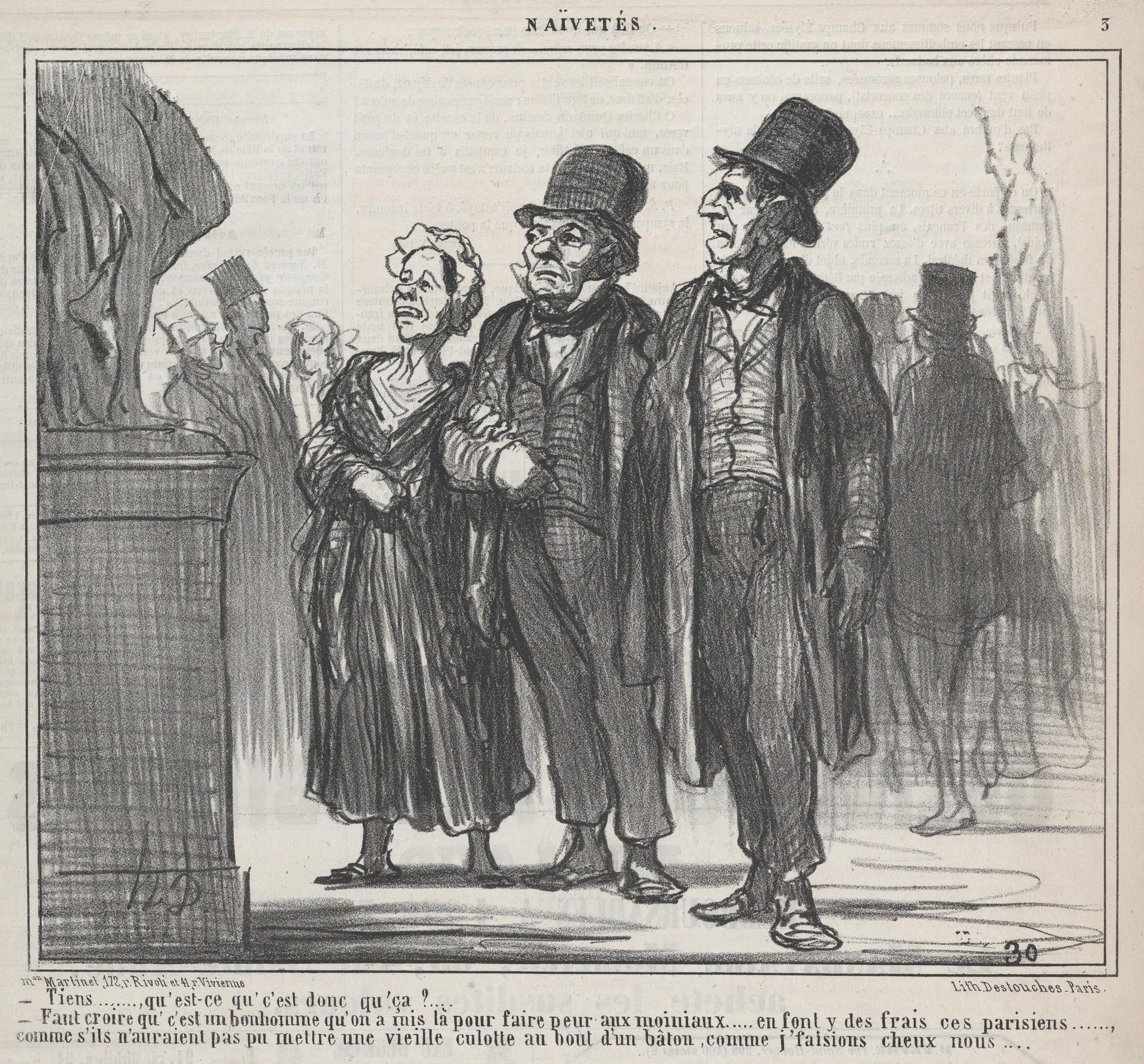
Tiens..., qu' est-ce qu' c'est donc qu' ça?..., from Naïvetés, published in Le Charivari, April 15, 1859
Original title: Tiens..., qu' est-ce qu' c'est donc qu' ça?..., from Naïvetés, published in Le Charivari, April 15, 1859
kurzbeschreibung
Honoré Daumier's lithograph Tiens..., qu'est-ce qu' c'est donc qu' ça?... appeared on 15 April 1859 in the journal Le Charivari as part of the series Naïvetés. The print presents a group of people in an interior responding to an exhibition setting.
Description
Three figures dominate the foreground: a woman in a long dress with a worried expression, flanked by two men in hats whose reactions diverge—one looks to the left, the other has his arms crossed. Behind them, other people are visible, also looking toward the group. The arrangement feels animated and directs attention to the interplay of the main figures. Executed in black and white with caricatural features, the lithograph retains its graphic punch.
Context
The Naïvetés series was created in the late 1850s for the satirical paper Le Charivari, where Daumier regularly tackled social and cultural subjects. At that time, public exhibitions and museums were gaining importance, and the bourgeoisie was beginning to engage with art. The artist used humorous scenes to lampoon the public's naivety and incomprehension when faced with works of art.
Impact
The exaggerated facial expressions and the differing reactions of the figures come across as comic and slightly ironic. The various directions of gaze create a restlessness that mirrors the confusion of those depicted. The print thus leaves an amusing yet thoughtful impression about how people approach art.
Technique
The lithograph was printed on newsprint; it exists in the second state of two known impressions (Delteil). The process allowed for fine lines and shading, which are used here for the caricatural rendering of the figures. The black-and-white execution is typical of prints of the period and emphasizes the graphic quality.
AI-generated description text
Source: Metropolitan Museum of Art · Public Domain (CC0 1.0)