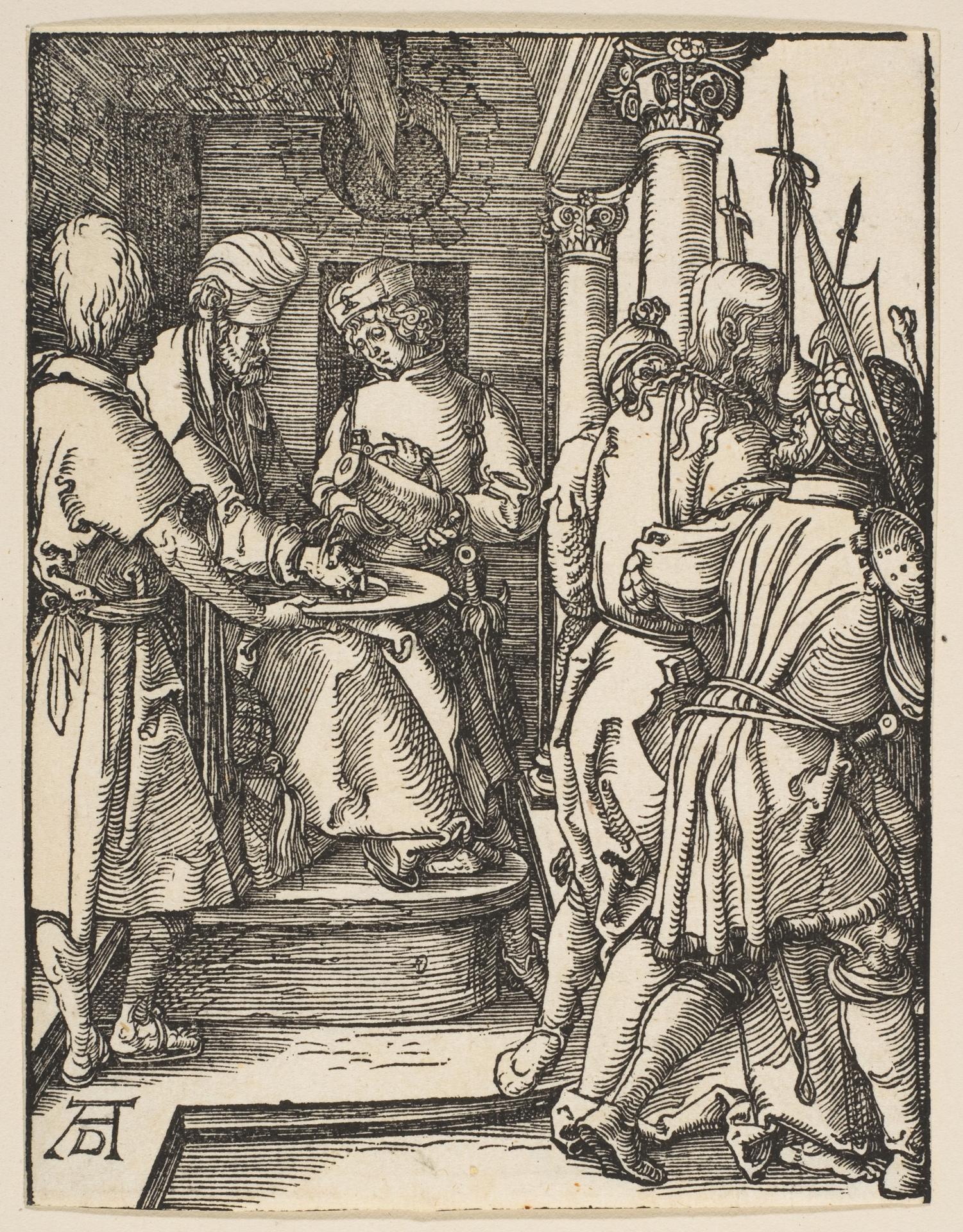
Pilate Washing His Hands, from "The Small Passion"
Original title: Pilate Washing His Hands, from "The Small Passion"
kurzbeschreibung
This woodcut by Albrecht Dürer, created around 1509, depicts Pontius Pilate washing his hands after condemning Jesus Christ. It is part of the renowned series "The Small Passion," which illustrates scenes from the Passion of Christ.
Description
Pilate sits on a throne at the center, holding a small bowl from which he pours water into a basin presented by a servant. Two soldiers flank the scene, one bearing a lance, while classical columns and a roofline form the background. The figures wear Renaissance-era garments and headdresses, and the composition is symmetrical with Pilate as the focal point. The lighting is even, with no visible shadows, and the image is monochrome, typical of woodcut prints.
Context
Dürer produced "The Small Passion" between 1508 and 1510, a series of 37 woodcuts that was published as a book in 1511. The series was highly popular and contributed to Dürer's fame across Europe. This particular scene reflects the biblical account in Matthew 27:24, where Pilate symbolically absolves himself of responsibility for Jesus's execution.
Impact
The composition conveys a tense, formal atmosphere, emphasizing Pilate's act of washing as a gesture of reluctant judgment. The detailed linework and balanced arrangement draw the viewer's eye to the central action, creating a sense of gravity and moral ambiguity. The monochrome palette enhances the dramatic contrast between the figures and their architectural setting.
Technique
The work is a woodcut, a relief printing technique where the image is carved into a wooden block, inked, and pressed onto paper. Dürer's mastery is evident in the fine, expressive lines and the careful rendering of textures and drapery. The print is executed in black ink on paper, typical for the medium, allowing for multiple impressions to be made from the same block.
AI-generated description text
Source: Metropolitan Museum of Art · Public domain (CC0)