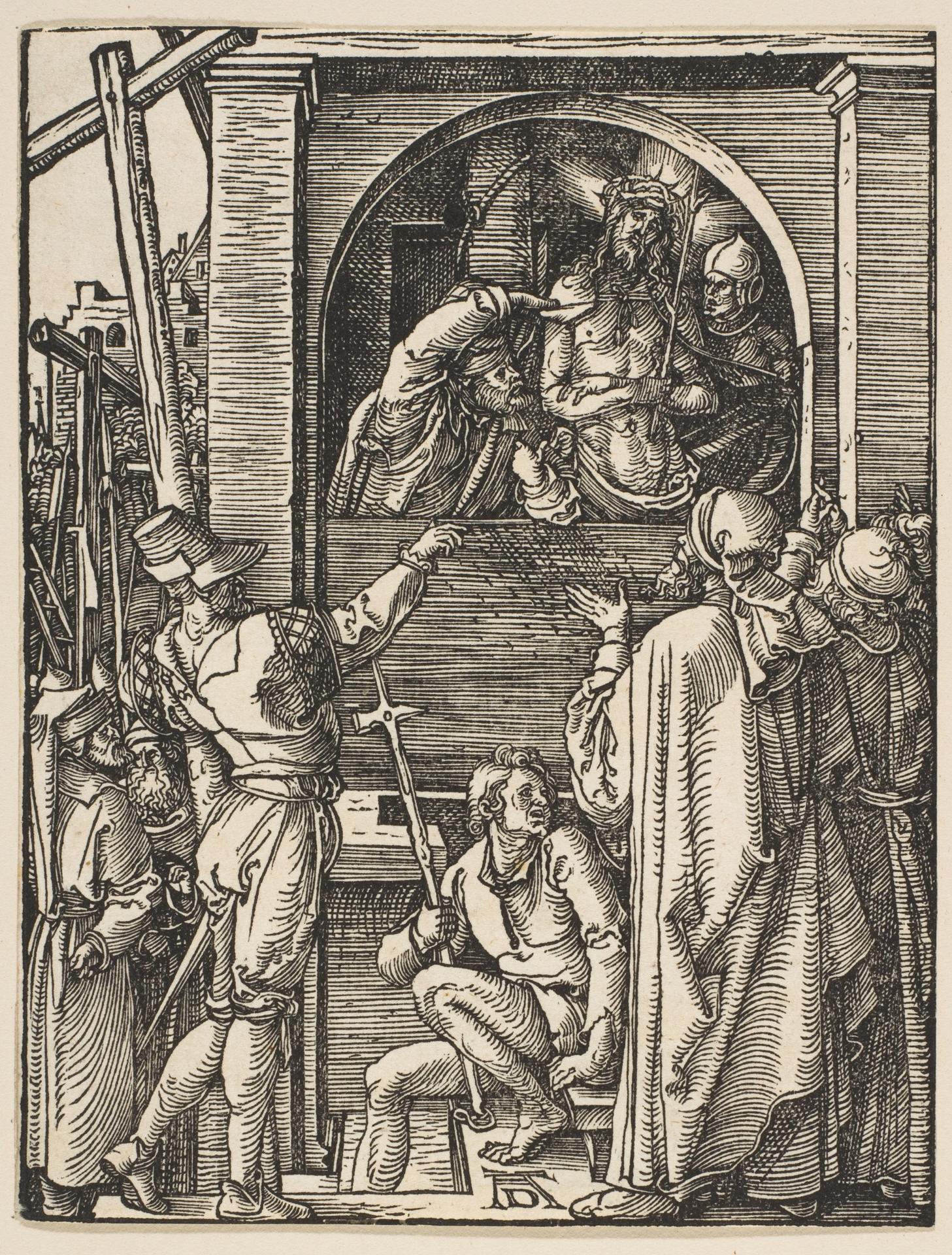
Ecce Homo, from "The Small Passion"
Original title: Ecce Homo, from "The Small Passion"
kurzbeschreibung
This woodcut by Albrecht Dürer, created around 1509, depicts the Ecce Homo scene from his Small Passion series. Christ, crowned with thorns, sits on a pedestal, flanked by soldiers and onlookers. The print is a masterful example of early 16th-century German graphic art.
Description
The composition centers on Christ, seated on a raised platform, with a soldier holding a lance beside him. To the left, a man in simple robes observes, while in the foreground a kneeling figure appears to plead for mercy. A woman with raised hands stands to the right, and additional figures fill the background. The scene is rendered in monochrome, with varied line weights and cross-hatching creating depth and texture.
Context
Dürer produced the Small Passion series between 1509 and 1511, a set of 37 woodcuts illustrating the life and suffering of Christ. The series was highly popular and contributed to Dürer's reputation as a master printmaker. The Ecce Homo scene reflects the late medieval devotional focus on Christ's Passion, emphasizing the human suffering of Jesus.
Impact
The print conveys a sense of solemnity and pathos through its balanced composition and detailed rendering. The contrast between the calm central figure of Christ and the surrounding crowd creates a powerful emotional tension. Dürer's precise lines give the scene a clarity that draws the viewer into the narrative.
Technique
This is a woodcut, a relief printing technique where the image is carved into a wooden block, inked, and transferred to paper. Dürer's skillful use of fine lines and cross-hatching achieves a remarkable range of tonal values. The print is part of a series, demonstrating the reproducibility and wide distribution of his graphic works.
AI-generated description text
Source: Metropolitan Museum of Art · Public domain (CC0)