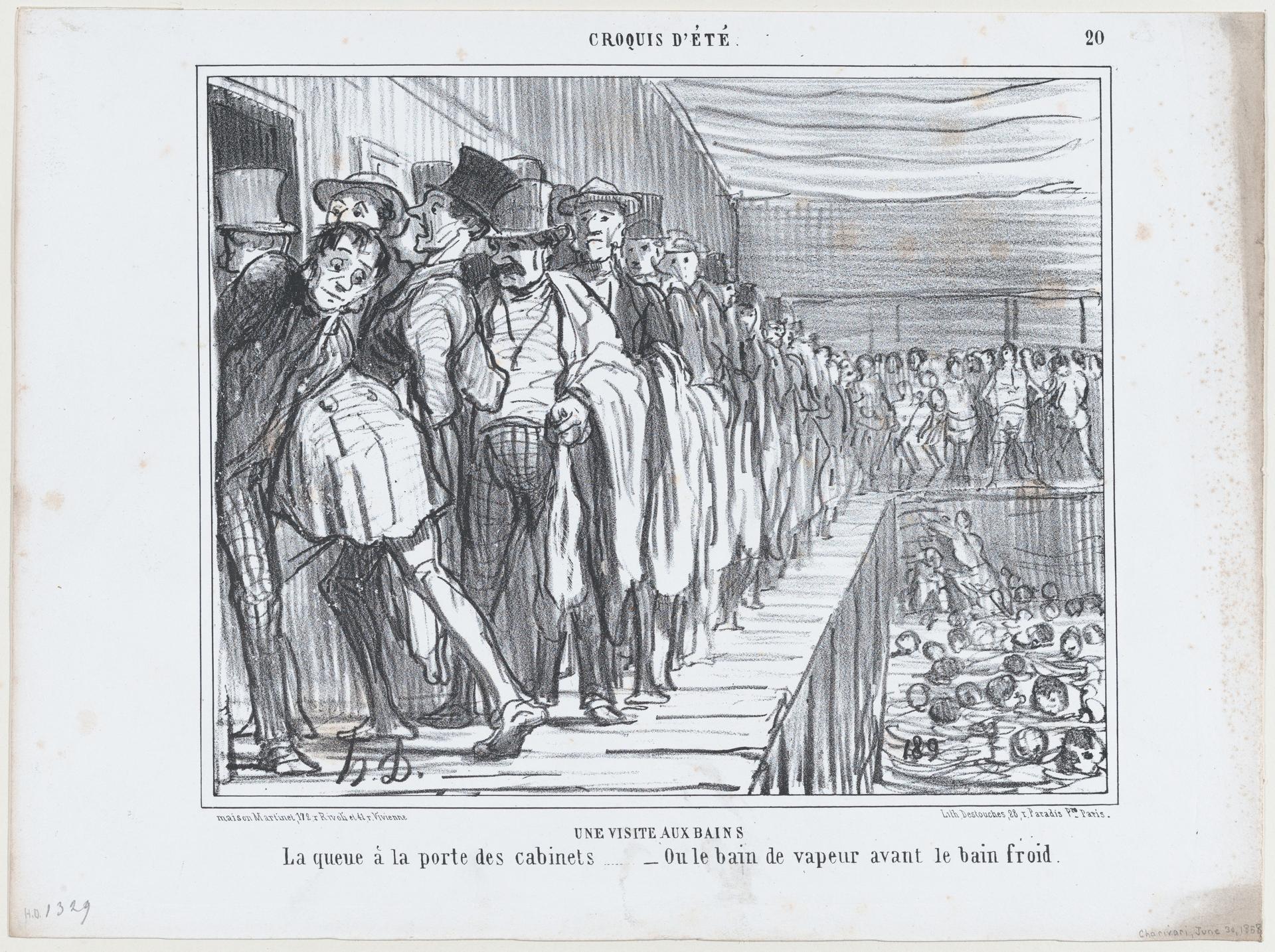
Une visite aux bains, from Croquis d'Été, published in Le Charivari, June 30, 1858
Original title: Une visite aux bains, from Croquis d'Été, published in Le Charivari, June 30, 1858
kurzbeschreibung
Honoré Daumier made this lithograph, 'Une visite aux bains', in 1858. It appeared on 30 June 1858 in 'Le Charivari' as part of his series 'Croquis d’Été'. The print is the second state of two (Delteil) and measures 26.7 × 36 cm. With humour, it presents a scene in a public bathhouse.
Description
A line of waiting men in suits and hats steps back into the foreground; their expressions shift between unease and anticipation. Behind them, bathers are scattered across the different areas of the establishment, some standing in a pool that serves as preparation for a cold bath. The layout draws the eye broadly backwards, with the waiting figures forming the prelude and the bathing activity unfolding behind them.
Context
Daumier created this lithograph for the satirical magazine 'Le Charivari', to which he contributed regularly. It belongs to the 'Croquis d’Été' (Summer Sketches), in which the artist took aim at everyday scenes of Parisian summer life. Public bathhouses were widespread in nineteenth-century Paris, and questions of hygiene and bathing culture were lively debated. Daumier used such motifs to cast an ironic light on the social types and behaviour of his time.
Impact
The exaggerated figures and the comic situation of queuing in the bathhouse give the print an amusing touch. From the juxtaposition of everyday observation and ironic exaggeration emerges an effect that prompts a smile but also gives pause for thought. The caricature never turns malicious; the humour remains mild and sympathetic.
Technique
For this print, Daumier used lithography, a planographic printing process that became widespread in nineteenth-century printmaking. With greasy chalk he transferred the drawing onto a limestone block, from which it was then printed. The impression remained black and white; fine hatching and graduated contrasts shape the figures and the space. The present version is the second state of the print, which suggests later revisions to the plate.
AI-generated description text
Source: Metropolitan Museum of Art · Public Domain (CC0 1.0)