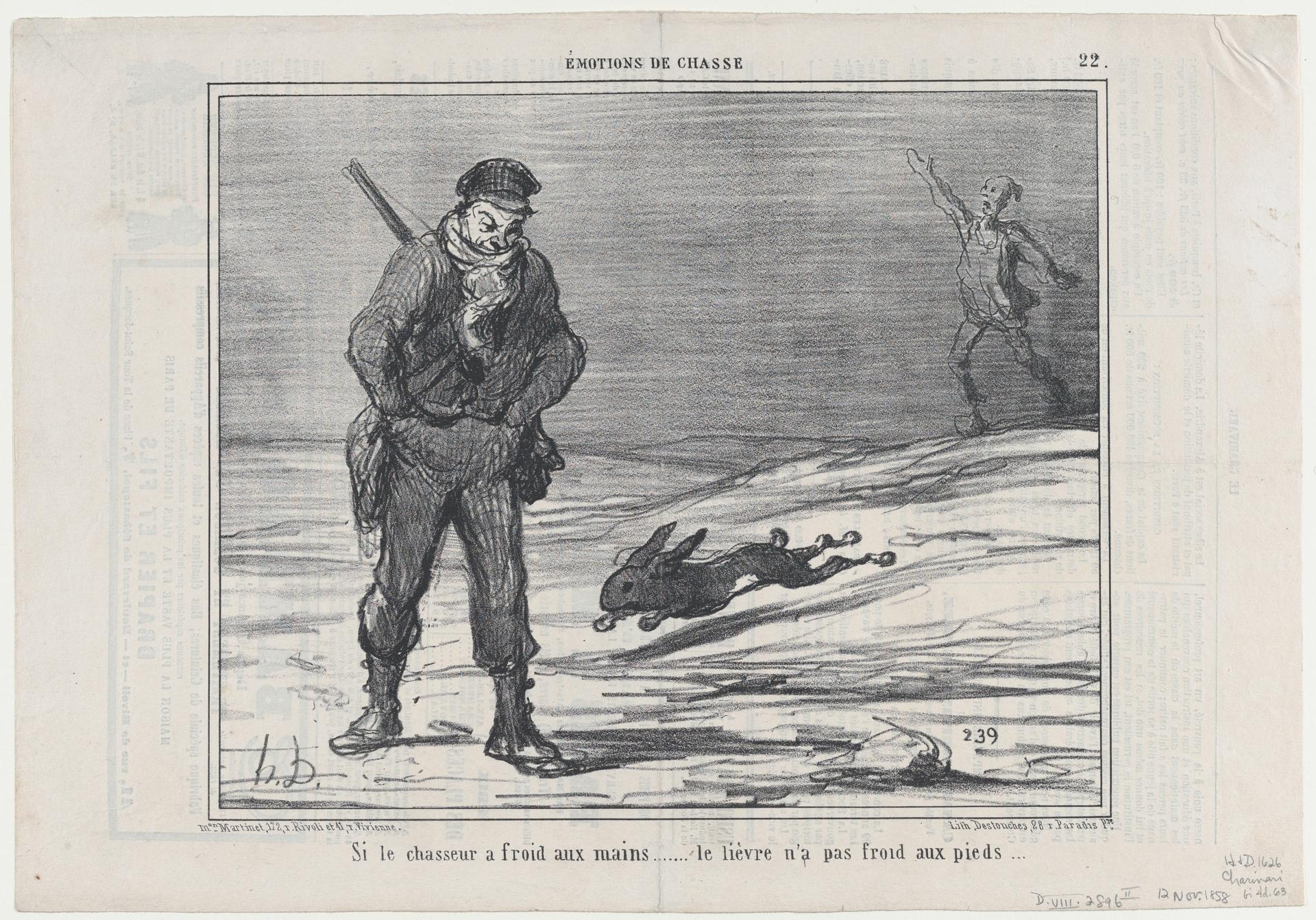
Si le chasseur a froid aux mains..... le lièvre n'a pas froid aux pieds..., from Émotions de Chasse, published in Le Charivari, November 12, 1858
Original title: Si le chassuer a froid aux mains..... le lièvre n'a pas froid aux pieds..., from Émotions de Chasse, published in Le Charivari, November 12, 1858
kurzbeschreibung
Honoré Daumier took aim at the hunting craze of his day in November 1858: a hunter with a shotgun stands over a rabbit lying on the ground, while a second rabbit escapes behind him. The print belongs to the series 'Émotions de Chasse' and appeared on 12 November 1858 in 'Le Charivari'. It is the second state of the lithograph according to Delteil.
Description
A hunter in traditional gear — cap, scarf and boots — grips a shotgun and stares at a rabbit stretched flat on the ground, seemingly still moving. Another rabbit flees in the distance. The landscape is plain and flat. The image is rendered in black and white with graded greys. The caricatural style exaggerates the figures and plays humorously with perspective.
Context
Daumier made this lithograph for the satirical journal 'Le Charivari', where he regularly published political and social caricatures. The series 'Émotions de Chasse' poked fun at hunters' mishaps and parodied the bourgeois passion for hunting. Daumier worked at a time when lithography was established as a mass medium for satirical prints. The date of 12 November 1858 places the work in his mature period.
Impact
The lithograph gets its comic effect from the contrast between the static hunter and the dynamic rabbits. The sparse landscape and exaggerated poses draw attention to the absurd situation. The viewer is invited to smile without the image sliding into the grotesque.
Technique
This is a lithograph on newsprint, printed in black and white. The varying greys come from the lithographic process, in which greasy chalk is applied to stone and then printed. It is the second state of the print, indicating later revisions or corrections.
AI-generated description text
Source: Metropolitan Museum of Art · Public Domain (CC0 1.0)