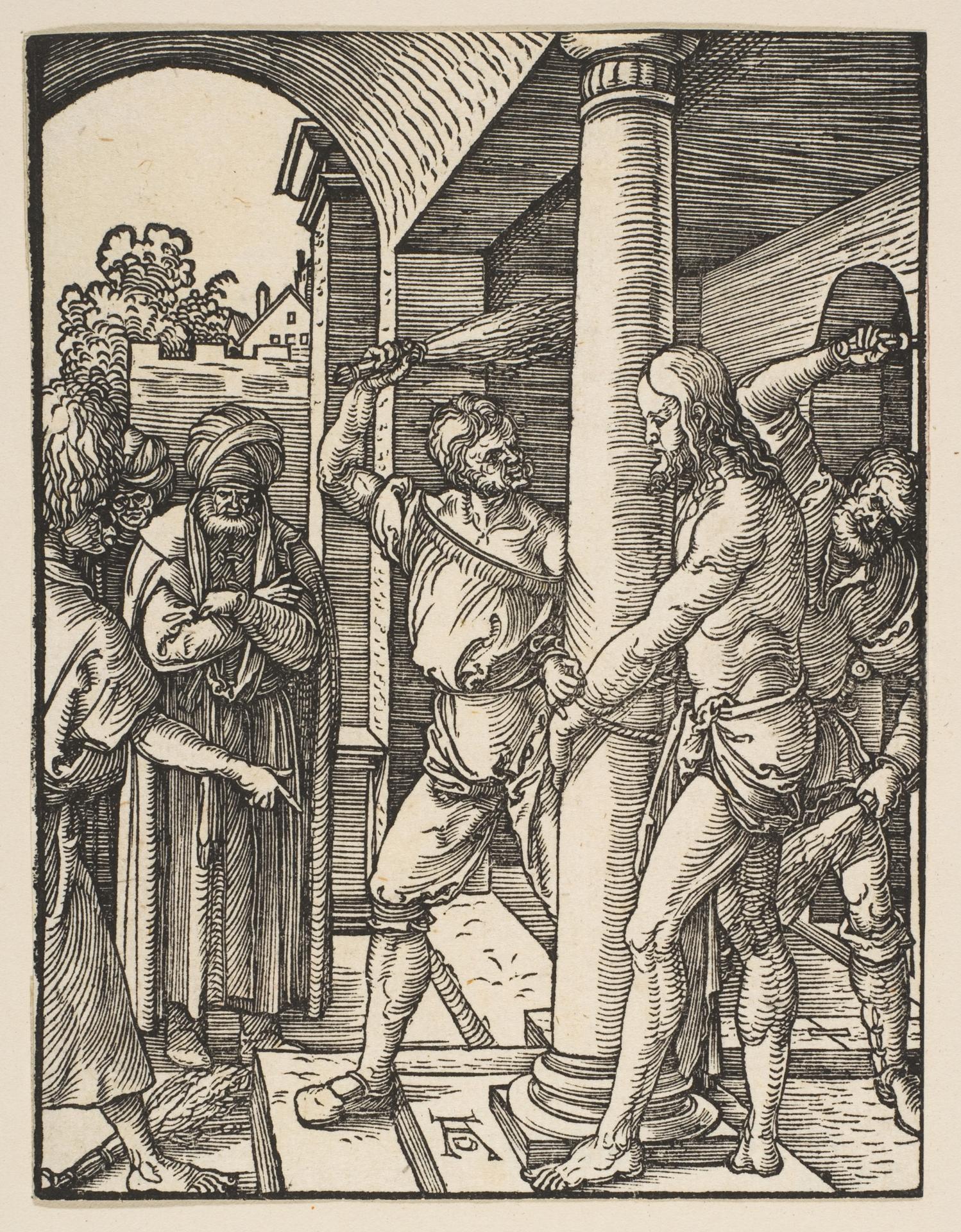
The Flagellation, from "The Small Passion"
Original title: The Flagellation, from "The Small Passion"
kurzbeschreibung
The Flagellation is a woodcut by Albrecht Dürer, created around 1509 as part of his series known as the Small Passion. It depicts the biblical scene of Jesus Christ being scourged by Roman soldiers before his crucifixion. The work is a masterful example of early 16th-century printmaking.
Description
In the foreground, Jesus stands bound to a pillar, his body slightly turned and his head bowed in a contemplative, suffering pose. Four soldiers surround him: two raise whips to strike, while the others observe the punishment. The figures are clad in garments that suggest Roman attire, with detailed drapery and expressive postures. Behind them, a landscape with trees and buildings frames the scene, providing a structured backdrop. The composition is clear and balanced, with the central action of the flagellation dominating the foreground and the setting indicating the location of the event.
Context
This woodcut belongs to Dürer's Small Passion, a series of 36 prints illustrating the life and passion of Christ, published in 1511. Dürer created the series during a period of intense artistic activity in Nuremberg, where he had established himself as a leading printmaker. The Small Passion was intended for a broad audience, as woodcuts were relatively inexpensive to produce and distribute, making religious imagery accessible to the general public.
Impact
The print conveys a sense of intense physical and emotional suffering through the strained pose of Christ and the dynamic gestures of the soldiers. The meticulous linework and careful composition draw the viewer's eye to the central figure, evoking empathy and contemplation. The monochromatic palette and even lighting lend a solemn, almost meditative quality to the scene.
Technique
Dürer employed the woodcut technique, carving the design into a wooden block and printing it with ink to create the image. The fine, detailed lines demonstrate his exceptional skill in translating complex scenes into the medium. The even distribution of light and shadow is characteristic of Dürer's approach, which elevated woodcut printing to a high artistic level.
AI-generated description text
Source: Metropolitan Museum of Art · Public domain (CC0)