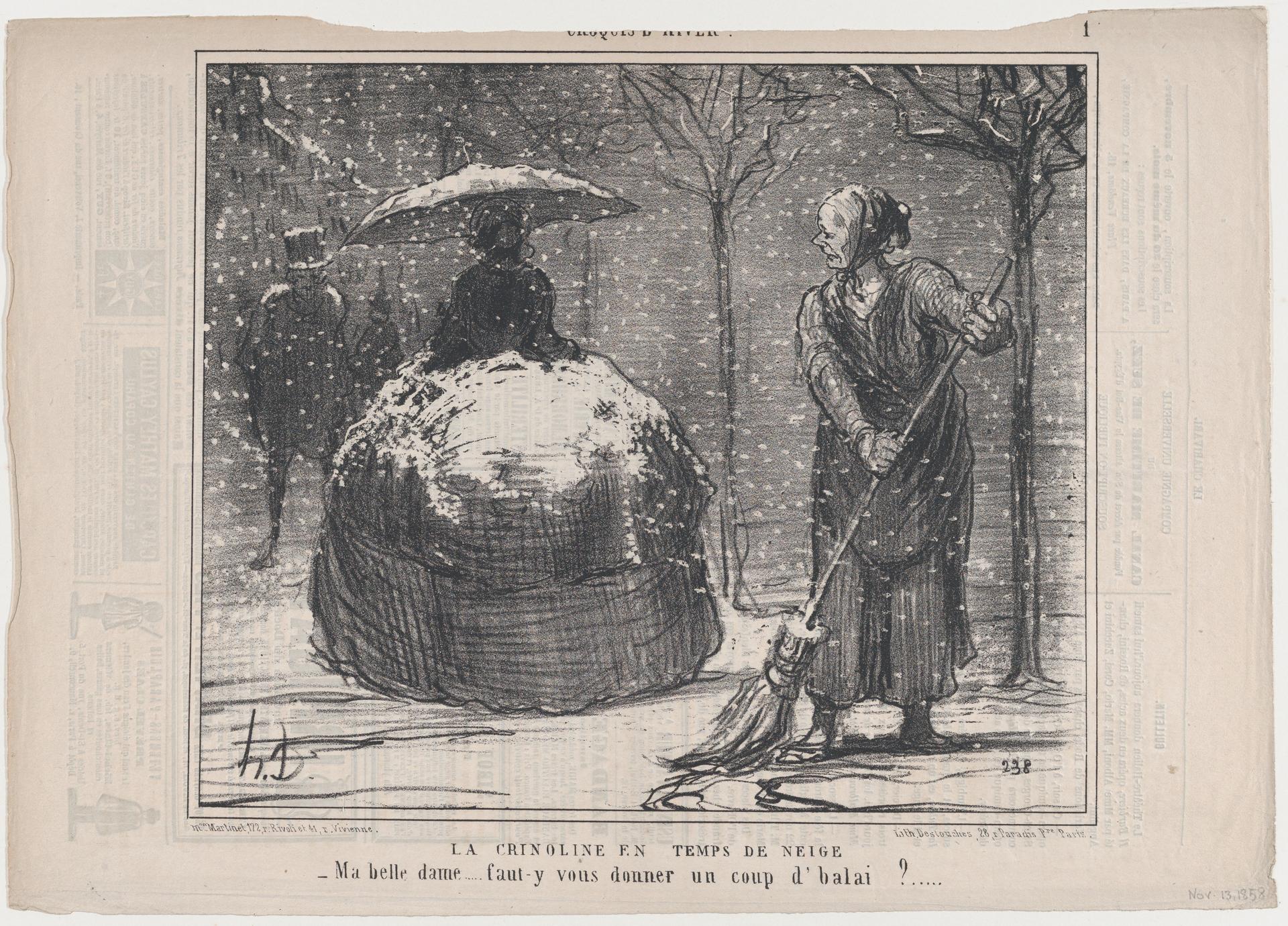
La crinoline en temps de neige
Original title: La crinoline en temps de neige, from Croquis d'Hiver, published in Le Charivari, November 13, 1858
kurzbeschreibung
Honoré Daumier's lithograph "Die Krinoline bei Schnee" (The Crinoline in the Snow) dates from 1858 and pictures a woman whose snow-covered crinoline is being prodded by an older woman with a broom. It belongs to the series "Croquis d'Hiver" and appeared in Le Charivari on 13 November 1858.
Description
A woman in an oversized crinoline, dusted white with snow, occupies the foreground, while an older woman with a broom stands just to her right. Further figures, among them a man in a peaked cap, appear in the distance. The layout stretches horizontally, and the lithograph keeps to greys throughout. Snowflakes and the shadows they cast on skirt and ground tell us about the light and the weather. The satirical tone is sharpened by the caption beneath: "Ma belle dame... faut-y vous donner un coup d'balai ?"
Context
Daumier drew this print for "Croquis d'Hiver", a series he made for the satirical paper Le Charivari. It was published on 13 November 1858 and joins a run of winter caricatures commenting on the daily life and fashions of Parisians. The crinoline was a fashionable yet contested garment in the 1850s, and a frequent target for mockery.
Impact
Comedy and social observation of fashion go hand in hand here. Under its coating of snow the enormous crinoline looks absurd and cumbersome, which only sharpens the gesture of the woman swinging her broom. The print invites a smile without ever turning cruel.
Technique
Lithography on newsprint, second of two states (Delteil). The process allowed for delicate lines and shading, which were put to use rendering the snow and the outlines. The greys come from black ink printed onto the paper.
AI-generated description text
Source: Metropolitan Museum of Art · Public Domain (CC0 1.0)